Jataka 547
Vessantara Jātaka
The Great Vessantara
as told by Eric Van Horn
originally translated by H.T. Francis and R.A. Neil, Cambridge University
originally edited by Professor Edward Byles Cowell, Cambridge University
This is a curious and mildly unsettling tale. It is about generosity, but it is generosity in an extreme way. In it the Buddha-to-be gives away almost everything including his children and his wife. He even gives his children to a cruel brahmin who mistreats them. Buddhist history is full of stories where people are carried to extremes, and this seems like one of them.
The Buddha always taught moderation. For example, when he discussed how to handle money, he said that you should first be able to take care of yourself and your family. Then you should put something aside for a rainy day, some to help others, and some to support the Saṇgha. This is an exercise in prudence. So the idea that one should go to extremes in giving is not in accordance with the Buddha’s Dharma.
Now that I disparaged the sorry, let me add that there is some exquisite poetry in it. One verse of note is the lengthy description of Lake Mucalinda. Large portions of this story read like an epic poem.
“Ten boons.” The Master told this story while he was living near Kapilavatthu in the Banyan Grove. It is about a shower of rain.
(The “Ten Boons” are (1) to be chief queen, (2) to have dark eyes, (3) to have dark eyebrows, (4) to be named “Phusatī,” (5) to have a son, (6) to keep her figure slim, (7) that her breasts be firm, (8) not to become grey-haired, (9) to have soft skin, and (10) to save the condemned.)
When the Master was turning the precious Wheel of the Dharma, he went in due course to Rājagaha. He spent the winter there with Elder Udāyi. He was attended by 20,000 arahants.
He entered Kapilavatthu (where the Buddha was born and raised) where the Sakya princes gathered to see the chief of their clan. They inspected the Blessed One’s abode, saying, “This banyan grove is a delightful place worthy of Sakka.” (“Sakka” was also known as “Indra.” He was the god of the Tāvatiṃsa heaven.) They made all due provision for guarding it. They prepared to meet him with fragrant posies in their hands. First, they sent all the youngest boys and girls of the township dressed in their best. Next, they sent the princes and princesses. They honored the Master with fragrant flowers and powders. They escorted the Blessed One as far as the Banyan Park. There the Blessed One took his seat on the adorned seat that had been prepared for him. He was surrounded by the 20,000 arahants.
Now the Sākiyas are a proud and stubborn race. They thought to themselves, “Siddhattha’s boy (Rahula) is younger than we are. He is our younger brother, our nephew, our grandson.” They said to the younger princes, “You do him obeisance. We will sit behind you.”
But they sat there without paying homage to the Blessed One. He saw what they were doing. He thought to himself, “My kinsfolk pay me no honor. Well, I will make them do so.” So he established rapture (jhana) that is based on the transcendent faculty. With this, he rose up into the air. And as though shaking off the dust of his feet upon their heads, he performed a miracle like the twofold miracle at the foot of the knot mango tree (described in Jātaka 483).
The king (King Suddhodana, the Buddha’s father) saw this wonder and said, “Sir, on the day of your birth, when I saw your feet placed on the head of brahmin who had come to pay you obeisance, I paid homage to you. (The brahmin “Kāladevala” was an advisor to King Suddhodana. He was also known as “Atisha.” He prophesied that the child would become either a great king or a supreme religious leader.) That was the first time. On the day of the Plowing Festival when you sat on the royal seat under the shade of a rose apple tree (this is the tree where the child Buddha-to-be experienced the first jhana), when I saw that the shadow of the tree did not move, I paid obeisance to your feet. That was the second time. And now I see a miracle that I have never seen before, and I pay obeisance at your feet. This is the third time.” So when the king had paid obeisance, not one Sākiya could sit still and refrain. They all paid obeisance, one and all.
The Blessed One, having made his kinsfolk pay him obeisance, came down from the air and sat on the appointed seat. When the Blessed One was seated, his kinsfolk were made wise. They sat with peace in their hearts. Then a great cloud arose and burst in a shower of rain. Down came the rain. It was red and made a loud noise. Those who wanted to get wet were wetted, but those who did not did not have even a drop fall on his body.
All who saw it were astonished at the miracle. They cried to one another,” Lo! A marvel! To a miracle! To the power of the Buddhas on whose kinsfolk such a shower of rain is falling!” When he heard this, the Buddha said, “This is not the first time that a great shower of rain has fallen on my kinsfolk.” And then, at their request, he told them this story from the past.
Once upon a time, a king named “Sivi” reigned in the city of Jetuttara in the kingdom of Sivi. He had a son named “Sañjaya.” When the lad came of age, the king brought him a princess named “Phusatī.” She was the daughter of King Madda. Then King Sivi handed the kingdom over to him, making Phusatī his queen consort.
Her former connection with the world was as follows. In the ninety-first age from this, a Teacher arose in the world. His name was “Vipassī.” While he was dwelling in the deer park of Khema near the city of Bandhumatī, a certain king sent a golden wreath to King Bandhuma. It was worth 100,000 gold coins. He also had some precious sandal wood.
Now the king had two daughters. He wanted to give a present to them. He gave sandal wood to the elder and the golden wreath to the younger. But both declined to use these gifts for themselves. They wanted to offer them in respect to the Master. So, they said to the king, “Father, we will offer this sandal wood and this golden wreath to the Dasabala (the Buddha).” To this the king gave his consent.
So the elder princess powdered the sandal wood and filled a golden box with the powder. The younger sister had the golden wreath made into a golden necklet and likewise put it into a golden box. Then they went to the hermitage in the deer park. The elder sister reverently sprinkled the Dasabala’s golden body with the sandal wood powder. She scattered the rest in his cell and said this prayer: “Sir, in time to come, may I be the mother of a Buddha like you.” The younger daughter reverently placed the gold-lace necklet that had been made from the golden wreath upon the Dasabala’s golden body. She prayed, “Sir, until I become an arahant, may this ornament never part from my body.” And the Master granted their prayers.
Both of them—after their lives ended—were reborn in the world of gods. The elder sister passed from the world of gods to the world of men and back again. At the end of the ninety-first age, Queen Māyā became the mother of the Buddha. The younger sister passed to and fro in a like manner, and in the time of the Dasabala, Kassapa became the daughter of King Kiki. She was born with the semblance of a necklet on her neck and shoulders. She was as beautiful as if she had been drawn by a painter. She was named “Uracchadā.”
When she turned 16, she heard a pious utterance of the Master and attained to the fruit of the First Path (stream-entry). Then, on the very same day, she became an arahant. Subsequently she ordained in the Saṇgha and entered Nirvana.
Now King Kiki had seven other daughters, whose names were:
“Samaṇī, Samaṇā, the holy Sister Guttā,
Bhikkhudāsikā, and Dhammā and Sudhammā,
And of the sisters the seventh Saṃghadāsī.”
In this manifestation of the Buddha, these sisters were:
“Khemā, Uppalavaṇṇā, the third was Paṭācārā,
Gotamā, Dhammadinnā, and sixthly Mahāmāyā,
And of this band of sisters the seventh was Visākhā.”
Now of these, Phusatī became Sudhammā. She did good deeds and gave alms, and by the fruit of the offering of sandal wood to the Buddha Vipassī, her body was sprinkled with choice sandal wood. Then passing to and fro between the worlds of men and of gods, eventually she became chief queen of Sakka, king of the gods. After her days there were done and the five customary signs (i.e., the Five Moral Precepts) were seen, Sakka king of the gods, realized that her time was exhausted. He escorted her with great glory to the pleasure garden in Nandana grove (a mythical paradise where celestial beings reside). Then, as she reclined on a richly adorned seat, he sat beside it. He said to her: “Dear Phusatī, I grant you ten boons. Choose.” With these words, he uttered the first stanza in this Great Vessantara Birth with its thousand stanzas:
“Ten boons I give you, Phusatī, O beautiful lady bright,
Choose whatever is on the earth that is precious in your sight.”
In this way she was established in the world of gods by the preaching in the Great Vessantara.
But she did not know the circumstances of her rebirth. She felt faint and said the second stanza:
“Glory to you, O king of gods! What harm is done by me,
To send me from this lovely place as winds blow down a tree?”
Sakka saw that she was despondent. He uttered two stanzas:
“Dear you still are as you have been, and harm you have not done,
I speak because your merit now is all used up and gone.
“Now your departure is at hand, the hour of death draws nigh,
Ten boons I offer you to choose, then choose, before you die.”
Hearing the words of Sakka and convinced that she must die, she chose the boons:
“King Sakka, lord of beings all, a boon has granted me.
I bless him, craving that my life in Sivi’s realm may be.
“Black eyes, black pupils like a fawn, black eyebrows may I have,
And ‘Phusatī’ my name,—this boon, O bounteous one, I crave.
“A son be mine, revered by kings, famed, glorious, debonair,
Bounteous, ungrudging, one to lend a ready ear to prayer.
“And while the babe is in my womb let not my figure go,
Let it be slim and graceful like a finely fashioned bow.
“Still, Sakka, may my breasts be firm, nor white-haired may I be.
My body all unblemished, may I set the death-doomed free.
“Mid herons’ cries, and peacocks’ calls, with waiting women fair,
Poets and bards to sing our praise, shawls waving in the air.
“When rattling on the painted door the menial calls aloud,
‘God bless King Sivi! Come to meat!’ be I his queen avowed.”
Sakka said:
“Know that these boons, my lady bright, which I have granted thee,
In Sivi kingdom, beauteous one, all ten fulfilled shall be.”
So spoke the monarch of the gods, the great Sujampati,
Called Vāsava, well pleased to grant a boon to Phusatī.
When she had chosen her boons, she left that world and was conceived in the womb of King Madda’s queen. And when she was born, because her body was sprinkled with the perfume of sandal wood, they named her “Phusatī.” She grew up amidst a great company of attendants until in her sixteenth year she surpassed all others in beauty.
At that time Prince Sañjaya, son of the king of Sivi, was to be invested with the White Umbrella (become king). The princess was sent for to be his bride, and she was made Queen Consort at the head of 16,000 women. Wherefore it is said:
“Next born a princess, Phusatī was to the city led
Jetuttara, and there directly to Sañjaya was wed.”
Sañjaya loved her gladly and dearly.
Now Sakka reflected how nine of his ten boons to Phusatī had been fulfilled. “But one is left unfulfilled,” he thought, “a goodly son. This I will fulfill for her.”
At that time the Great Being was in the Heaven of the Thirty-Three, and his time there was done. Sakka saw this and approached him. He said, “Venerable Sir, you must enter the world of men. Without delay you must be conceived in the womb of Phusatī. She is the queen consort of the King of Sivi.”
With these words, he asked the consent of the Great Being and the 60,000 sons of the gods who were destined to rebirth with him. Then he returned to his own realm. The Great Being descended and was reborn, and the 60,000 gods were born in the families of 60,000 courtiers.
When the Great Being was conceived in her womb, Phusatī found herself with child. She wanted six alms-halls to be built, one at each of the four gates, one in the middle of the city, and one at her own door. From these, she intended to distribute 600,000 gold coins each day. The king learned how it was with her. He consulted the fortune tellers who said, “Great King, a being devoted to almsgiving has been conceived in your wife’s womb. He will never be satisfied with giving.” Hearing this he was pleased, and he, too, made a practice of giving.
From the time of the Bodhisatta’s conception, there was no end to the king’s revenue. Because of the king’s goodness, the kings of all India sent him presents.
Now while with child the queen remained with her large company of attendants until ten months had passed. Then she wished to visit the city. She informed the king, who caused the city to be decorated like a city of the gods. He put his queen in a noble chariot and made a procession around the city. When they reached the midst of the Vessa quarter, the pains seized her. They told the king, and then and there he caused a bedchamber to be prepared, and he had her go there. She brought forth a son, wherefore it is said:
“Ten months she bore me in her womb, procession then they made,
And Phusatī in Vessa Street of me was brought to bed.”
The Great Being came from his mother’s womb free from impurity. He was open-eyed, and he instantly held out his hand to his mother. He said, “Mother, I wish to make some gift. Is there anything you wish?” She replied, “Yes, my son, give as you wish.” He dropped a purse of a thousand gold coins into her outstretched hand. The Great Being spoke three times as soon as he was born. This also happened in the Ummagga Birth (Jātaka 546), in this birth and in his last birth.
On his name-day, they gave him the name “Vessantara” because he was born on the Vessa Street. Wherefore it is said:
“My name not from the mother’s side nor from the father’s came,
As I was born in Vessa Street, Vessantara’s my name.”
On his birthday, a female flying elephant gave birth to a young one. It was deemed to be a lucky omen. It was white all over, and it was left in the royal stables. Because this creature came to supply a need of the Great Being, they named it “Paccaya” (“support”). The king appointed 240 nurses for the Great Being. They were neither too tall nor too short. They were free from fault and had sweet milk. The king also appointed nurses for the 60,000 children born with him. And so he grew up surrounded by this great company of 60,000 children.
The king ordered a prince’s necklace to be made. It cost 100,000 gold coins. He gave it to his son. But he, being of four or five years of age, gave it away to his nurses, and he would not take it back when they wished to return it. They told this to the king, who said, “What my son has given is well given. Let it be a brahmin’s gift,” and he had another necklace made. But the prince—still in his childhood—gave this as well to his nurses, and he did so nine times over.
When he was eight years old, as he reclined on his couch, the boy thought to himself, “All that I give comes from without. This does not satisfy me. I wish to give something of my very own. If one should ask for my heart, I would cut open my breast and tear it out and give it. If one asked for my eyes, I would pluck out my eyes and give them. If one should ask for my flesh, I would cut off all the flesh of my body and give it.” In this way he pondered with all his being and the depths of his heart this earth, 40,000 quadrillion leagues (a league is three miles or 4.6 kilometers) in extent and 200,000 leagues in depth, quaked, thundering like a great mad elephant.
Sineru—chief of mountains—bowed like a sapling in hot steam and seemed to dance. It stood leaning towards the city of Jetuttara. At the earth’s rumbling the sky thundered with lightning and rain, forked lightning flashed, the ocean was stirred up. Sakka, king of the gods, clapped his arms. Mahābrahmā gave a sign of approval. As high as Brahma’s World all was in an uproar, wherefore it is also said:
“When I was yet a little boy, but of the age of eight,
Upon my terrace, charity and gifts I meditate.
“If any man should ask of me blood, body, heart, or eye,
Or blood or body, eye or heart I’d give him, was my cry.
“And as with all my being I pondered with thoughts like these
The unshaken earth did shake and quake with mountains, woods and trees.”
By the age of 16, the Bodhisatta had attained a mastery of all the sciences. Then his father, wishing to make him king, consulted with his mother. From the family of King Madda they brought his first cousin. Her name was “Maddī.” She had 16,000 attendant women. He made her his queen consort and then they sprinkled him with the water of coronation. From the time of his coronation, he distributed alms, giving 600,000 gold coins each day.
By and by Queen Maddī gave birth to a son. They laid him in a golden hammock, for which they gave him the name “Prince Jāli.” By the time he could walk, the queen gave birth to a daughter. They laid her in a black skin, for which they gave her the name of “Kaṇhājinā.” Each month the Great Being would visit his six alms-halls six times while mounted upon his magnificent elephant.
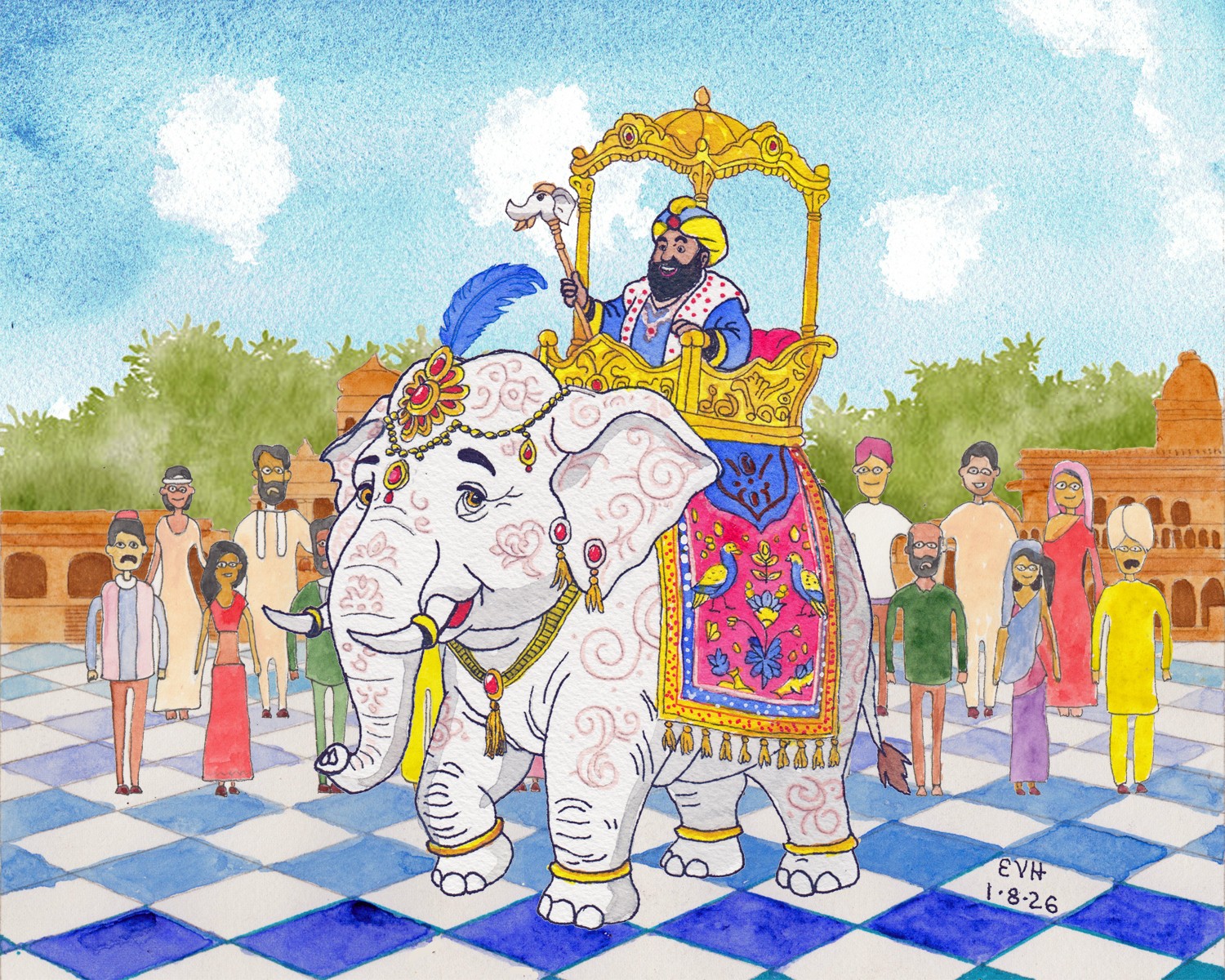 Figure: The Great Being on his elephant.
Now at that time there was drought in the kingdom of Kāliṇga. The corn did not grow. There was a great famine, and men who were unable to work resorted to robbery. Tormented by want, the people gathered in the king’s courtyard and chastised him. Hearing this, the king said, “What is it, my children?” They told him. He replied, “Good, my children, I will bring the rain,” and he dismissed them.
He pledged himself to virtue and kept the holy day vow, but he could not make the rain come. So he summoned the citizens together and said to them, “I pledged myself to virtue and for seven days I kept the holy day vow. Yet I could not make the rain come. What is to be done now?” They replied, “If you cannot bring the rain, my lord, Vessantara in the city of Jetuttara—King Sañjaya’s son—is devoted to charity. He has a glorious white elephant. Wherever he goes the rain falls. Send brahmins and ask for that elephant to bring him here.”
The king agreed. He assembled the brahmins and chose eight of them. He gave them provisions for their journey and said to them, “Go and fetch Vessantara’s elephant.”
On this mission, the brahmins proceeded in due course to Jetuttara city. They were entertained in the alms hall. Their bodies were sprinkled with dust and smeared with mud, and on the day of the full moon, they asked for the king’s elephant. They went to the eastern gate to wait for the king to arrive at the alms hall.
Early in the morning, the king—intending a visit the alms hall—washed himself with 16 pitchers of perfumed water. He broke his fast, then he mounted his richly adorned noble elephant. He proceeded to the eastern gate. The brahmins found no opportunity to meet him there, so they went to the southern gate. They stood on a mound and watched the king giving alms at the eastern gate. When he came to the southern gate, they stretched out their hands and cried, “Victory to the noble Vessantara!” When he saw the brahmins, the Great Being drove the elephant to where they stood. And seated on the elephant’s back, he uttered the first stanza:
“With hairy armpits, hairy heads, stained teeth, and dust on poll,
O brahmins, stretching forth your hands, what is it that you crave?”
To this the brahmins replied:
“We crave a precious thing, O prince that do your people save,
That choice and saving elephant with tusks like any pole.”
When the Great Being heard this, he thought, “I am willing to give anything that is my own, from my head onwards, and what they ask is something without me. I will fulfill their wish.” And from the elephant’s back, he replied:
“I give, and never shrink from it, that which the brahmins want,
This noble beast, for riding fit, fierce tusked elephant.”
and consenting, he said:
“The king, the savior of his folk, dismounted from its back,
And glad in sacrificing, gave the brahmins what they lack.”
The ornaments on the elephant’s four feet were worth 400,000 gold coins, those on his two sides were worth 200,000, and the blanket under his belly 100,000. On his back were nets of pearls, of gold, and of jewels, three nets worth 300,000 gold coins. In the two ears there were 200,000 gold coins. On his back there was a rug worth 100,000 gold coins. The ornament on the frontal globes was worth 100,000 gold coins. He had three wrappings worth 300,000 gold coins. The small ear ornaments cost 200,000. Those on the two tusks cost 200,000. The ornament for luck on his trunk cost 100,000. That on his tail cost 100,000, not to mention the priceless ornaments on his body that were worth 220,000 gold coins. The ladder used for mounting cost 100,000 gold coins. His food vessel cost 100,000. The total amount comes to as much as four and twenty hundred thousand. Moreover, the jewels—great and small—upon the canopy, the jewels in his necklace of pearls, the jewels in the goad, the jewels in the pearl necklace about his neck, the jewels on his frontal globes, all these without price, the elephant also without price, along with the elephant seven priceless things—all these he gave to the brahmins. He also gave 500 attendants with the grooms and stablemen. And with that gift an earthquake came to pass, and the other portents as related above.

To explain this, the Master spoke:
“Then was a mighty terror felt, then bristling of the hair,
When the great elephant was given the earth did quake for fear.
“Then was a mighty terror felt, then bristling of the hair,
When the great elephant was given, trembled the town for fear.
“With a resounding mighty roar the city all did ring
When the great elephant was given by Sivi’s foster-king.”
All of the city of Jetuttara trembled. The brahmins at the southern gate, we are told, received the elephant. They mounted on his back, and amidst a thronging multitude, they passed through the city. Beholding them, the crowd cried out, “O brahmins, mounted upon our elephant, why are you taking our elephant?” The brahmins replied, “The great King Vessantara has given the elephant to us. Who are you?” And so with scornful gestures to the crowd, they passed through the city and left by the northern gate with the help of the deities.
The people of the city were angry with the Bodhisatta. They uttered loud reproaches.
To explain this, the Master said:
“Upon that loud and mighty sound, so terrible to hear,
When the great elephant was given the earth did quake for fear.
“Upon that loud and mighty sound, so terrible to hear,
When the great elephant was given trembled the town to hear.
“So loud and mighty was the sound all terrible did ring,
When the great elephant was given by Sivi’s foster-king.”
The citizens, trembling at heart for this gift, addressed themselves to the king. Therefore, it is said:
“Then prince and brahmin, Vesiya and Ugga, great and small,
Mahouts and footmen, charioteers and soldiers, one and all,
“The country landowners, and all the Sivi folk come by.
Seeing the elephant depart, thus to the king did cry.
“’Your realm is ruined, sire. Why should Vessantara your son
Thus give away our elephant revered by everyone?
“’Why give our savior elephant, pole-tusked, goodly, white,
Which ever knew the vantage-ground to choose in every fight?
“’With jewels and his yak-tail fan, which trampled down all foes,
Long-tusked, furious, white as Mount Kelāsa with his snows.
“’With trappings and white parasol, fit riding for a king,
With leech and driver, he has given away this precious thing.’”
After saying this, they said again:
“Whoever bestows food and drink, with raiment, fire and fleet,
That is a right and proper gift, for brahmins that is meet.
“O Sañjaya, your people’s friend, say why this thing was done
By him, a prince of our own line, Vessantara, your son?
“The bidding of the Sivi folk if you refuse to do,
The people then will act, we think, against your son and you.”
Hearing this, the king suspected that they wished to kill Vessantara. He said:
“Yea, let my country be no more, my kingdom no more be,
I will not banish from his realm a prince from fault quite free.
Nor will obey the people’s voice, my true born son is he.
“Yea, let my country be no more, my kingdom no more be,
I will not banish from his realm a prince from fault quite free.
Nor will obey the people’s voice, my very son is he.
“No, I will work no harm on him, all noble is he still,
And it would be a shame for me, and it would cause much ill.
Vessantara, my very son, with sword how could I kill?”
The people of Sivi replied:
“Not chastisement does he deserve, nor sword, nor prison cell,
But from the kingdom banish him, on Vaṃka’s mount to dwell.”
The king said:
“Behold the people’s will! And I that will do not deny.
But let him bide one happy night before he has to fly.
“After the space of this one night, when dawns the coming day,
Together let the people come and banish him away.”
They agreed to the king’s proposal for just the one night. Then he let them go away. And thinking to send a message to his son, he commissioned an agent, who accordingly went to Vessantara’s house and told him what had happened.
To make this clear, the following stanzas were said:
“Rise, fellow, go away post-haste, and tell the prince my word.
‘The people all, and citizens, in wrath, with one accord.
“’Uggas and princes, Vesiyas and brahmins too, my son,
Mahouts and lifeguards, charioteers, and footmen, everyone,
All citizens, all country folk, together here have run.
“’After the space of this one night, when dawns the coming day,
They will assemble one and all and banish you away.’
“This fellow sent by Sivi’s king swift on his errand pressed,
Upon an armed elephant, perfumed, and finely dressed,
“Head bathed in water, jeweled rings in ears, and on he rode
Till to that lovely town he came, Vessantara’s abode.
“Then he beheld the happy prince abiding in his land,
Like Vāsava the king of gods, round him the courtiers stand.
“To there in haste the fellow went, and to the prince said he,
‘I bear ill tidings, royal sir. Be not angry with me!’
“With due obeisance, weeping sore, he said unto the king.
‘You are my master, sire, and you do give me everything.
Bad news I have to tell you now, do you some comfort bring.
“’The people all and citizens, in wrath, with one consent,
Uggas and princes, Vesiyas and brahmins, all are bent,
“’Mahouts and lifeguards, charioteers, the footmen everyone,
All citizens and country folk together now have run,
“’After the space of this one night, when dawns the coming day,
Determined all to come in crowds and banish you away.’”
The Great Being said:
“Why are the people vexed with me? For no offence I see.
Tell me, good fellow, for what do they wish to banish me?”
The agent said:
“Uggas and Vesiyas, charioteers, and brahmins everyone,
Mahouts and lifeguards, charioteers and footmen, they do run,
All angry at your giving gifts, for this they banish thee.”
Hearing this, the Great Being, contentedly said:
“My very eye and heart I’d give, why not what is not mine,
Or gold or treasure, precious stones, or pearls, or jewels fine?
“Comes any one to ask of me, I’d give my hand, my right,
Nor for a moment hesitate, in gifts is my delight.
“Now let the people banish me, now let the people kill,
Or cut me sevenfold, for cease from gifts I never will.”
On hearing this, the agent again spoke. This was no message of the king or of the peoples’. This was from his own mind:
“This is the Sivi people’s will, they made me tell you so,
Where Kontimārā by the hill Ārañjara does flow,
To there depart, where banished men, good sir, are wont to go.”
This he said, we are told, by inspiration of a deity.
Hearing this, the Bodhisatta replied, “Very well. I will go by the road that those who have offended use. But the citizens do not banish me for any offence. They banish me for the gift of the elephant. In this case I wish to give the great gift of the seven hundreds, and I pray the citizens grant me one day’s delay for that. Tomorrow I will make my gift, the next day I will go.”
“So I—by that same road—will go as they who do offend,
But first to make a gift, one night and day I pray them lend.”
“Very good,” said the agent, “I will report this to the citizens,” and away he went.
When the man had gone, the Great Being summoned one of his captains. He said to him, “Tomorrow I am to make the gift called the gift of the seven hundreds. You must get ready 700 elephants, with the same number of horses, chariots, girls, cows, men slaves and women slaves, and provide every kind of food and drink, even the strong liquor, everything that is fit to give.” So having arranged for the great gift of the seven hundreds, he dismissed his courtiers. He departed alone to the dwelling of Maddī. There he sat on the royal couch and began to address her.
The Master described it in this way:
“Thus did the king to Maddī speak, that lady passing fair.
‘All that I ever gave to you, or goods or grain, beware.
“’Or gold or treasure, precious stones, and plenty more beside,
Your father’s dower, find a place this treasure all to hide.’
“Then out spoke Maddī to the king, that princess passing fair,
‘Where shall I find a place, my lord, to hide it? Tell me where?’”
Vessantara said:
“In due proportion on the good your wealth in gifts bestow,
No other place than this is safe to keep it, well I know.”
She consented, and he exhorted her in this way:
“Be kind, O Maddī, to your sons, your husband’s parents care,
To him who will your husband be give him your finest fare.
“And if no man should wish to be your husband, when I’m gone,
Go seek a husband for yourself, but do not pine alone.”
Then Maddī thought, “Why does Vessantara say such a thing to me?” And she asked him, “My lord, why do you say to me what you ought not to say?” The Great Being replied, “Lady, the people of Sivi are angry with me for the gift of the elephant. They are banishing me from the realm. Tomorrow I am to make the gift of the seven hundreds, and on the next day, I will depart from the city.” And he said:
“Tomorrow to a forest drear, beset with beasts of prey,
I go, and whether I can live within it, who can say?”
Then spoke the princess Maddī, spoke the lady passing fair,
‘It is not so! A wicked word! To say it do not dare!’
“’It is not proper for my king, that you alone should fare,
Whatever journey you shall take, I also will be there.
“’Give me the choice to die with you, or live from you afar,
Death is my choice, unless I can live with you where you are.
“’Kindle a blazing fiery flame the fiercest that can be,
There I would rather die the death than live apart from thee.
“’As close behind an elephant his mate is often found
Moving through mountain pass or wood, o’er rough or level ground,
“’So with children I’ll follow you, wherever you may lead,
Nor will you find me burdensome or difficult to feed.’”
With these words she began to praise the region of Himalaya as if she had seen it:
“When you shall see your pretty ones, and hear their prattle ring
Under the greenwood, you’ll forget that ever you were king.
“To see your pretty ones at play, and hear their prattle ring
Under the greenwood, you’ll forget that ever you were king.
“When you shall see your pretty ones, and hear their prattle ring
In our fair home, you will forget that ever you were king.
“To see your pretty ones at play, and hear their prattle ring
In our fair home, you will forget that ever you were king.
“To see your children gay-bedecked, the flowers to watch them bring
In our fair home, you will forget that ever you were king.
“To see your children play all gay, the flowers to watch them bring
In our fair home, you will forget that ever you were king.
“When you behold your dancing ones their wreaths of flowers bring
In our fair home, you will forget that ever you were king.
“When you behold them dance and play, and wreaths of flowers bring
In our fair home, you will forget that ever you were king.
“The elephant of sixty years, all lonely wandering
The woodland, will make you forget that ever you were king.
“The elephant of sixty years, at even wandering
And early, will make you forget that ever you were king.
When you behold the elephant his herd of subjects bring,
The elephant of sixty years, and hear his trumpeting,
To hear the sound you will forget that ever you were king.
“The woodland glades, the roaring beasts, and every wished-for thing
When you behold, you will forget that ever you were king.
“The deer that come at eventide, the varied flowers that spring,
The dancing frogs—you will forget that ever you were king.
“When you shall hear the rivers roar, the fairy creatures sing,
Believe me, you will clean forget that ever you were king.
“When you shall hear the screech-owl’s note in mountain cave dwelling,
Believe me, you will clean forget that ever you were king.
“Rhinoceros and buffalo, that make the woodland ring,
Lion and tiger—you’ll forget that ever you were king.
“When on the mountain top you see the peacock dance and spring
Before the peahens, you’ll forget that ever you were king.
“To see the egg-born peacock dance and spread his gorgeous wing
Before the peahens, you’ll forget that ever you were king.
“The peacock with his purple neck, to see him dance and spring
Before the peahens—you’ll forget that ever you were king.
“When in the winter you behold the trees all flowering
Smell their sweet odors, you’ll forget that ever you were king.
“When in the winter you behold the plants all flowering,
The bimbajāla, kuṭaja, and lotus, scattering
Abroad their odors, you’ll forget that ever you were king.
“When in the winter you behold the forest flowering
And blooming lotus, you’ll forget that ever you were king.”
In this way Maddī sang the praises of Himalaya in these stanzas as though she were living there. Here ends the Praise of Himalaya.
Now Queen Phusatī thought, “A harsh command has been given to my son. What will he do? I will go and find out.” She went in a covered carriage. And taking up her position at the door of their chamber, she overheard their conversation and uttered a bitter lamentation.
Describing this, the Master said:
“She heard the princess and her son, the talk that passed between,
Then bitterly she did lament, that great and glorious queen.
“‘Better drink poison, better leap from off a cliff, say I,
Or better bind a strangling noose about my neck and die.
Why banish they Vessantara my unoffending son?
“’So studious and free from greed, giving to all who came,
Respected by his rival kings, of great and glorious fame,
Why banish they Vessantara, my unoffending son?
“’His parents’ prop, who did respect his elders everyone,
Why banish they Vessantara, my unoffending son?
“’Beloved by the king and queen, by all his kith and kin,
Beloved by his friends, the realm and all that are therein,
Why banish they Vessantara, my unoffending son?’”
After this bitter lament, she consoled her son and his wife. Then she went before the king and said:
“Like mangoes fallen to the ground, like money waste and spent,
So falls your kingdom, if they will banish the innocent.
“Like a wild goose with crippled wing, when all the water’s gone,
Deserted by your courtiers, you will live in pain alone.
“I tell you true, O mighty king, let not your good go by,
Nor banish him, the innocent, because the people cry.”
Hearing this, the king answered:
“Your son, the people’s banner, if I send to exile drear,
My royal duty I obey, then life itself more dear.”
On hearing this, the queen lamented:
“Once hosts of men escorted him, with goodly banners flown,
Like forests full of flowering trees, today he goes alone.
“Bright yellow robes, Gandhāra make, once round about him shone,
Or glowing scarlet, as he went, today he goes alone.
“With chariot, litter, elephant he went in former days,
Today the King Vessantara afoot must tramp the ways.
“He once by sandal-scent perfumed, awaked by dance and song,
How wear rough skins, how axe and pot and pingo bear along?
“Why will they not bring yellow robes, why not the garb of skin,
And dress of bark, the mighty woods that he may enter in?
“How can a banished king put on the robe of bark to wear,
To dress in bark and grass how will the princess Maddī bear?
“Maddī, who once Benares cloth and linen used to wear,
And fine kodumbara, how bark and grasses will she bear?
(“Kodumbara” may be a misspelling of “udumbara” which is an auspicious flower from Buddhist tradition that is considered to be extremely rare.)
“She who in litter or in car was carried to and fro,
The lovely princess, now today on foot how can she go?
“With tender hands and tender feet in happiness she stood,
How can the lovely princess go trembling into the wood?
“With tender hands and tender feet she lived in happy state,
The finest slippers she could wear would hurt her feet of late.
Today how can the lovely one afoot now go her gait?
“Once she would go begarlanded amidst a thousand maids,
How can the beautiful one alone now walk the forest glades?
“Once if she heard the jackal howl, she would be all dismayed,
How can the timid beautiful one now walk the forest glade?
“She who of Indra’s royal race would ever shrink afraid,
Trembling like one possessed, to hear the hoot some owl had made,
How can the timid beautiful one now walk the forest glade?
“Like as a bird beholds the nest empty, the brood all slain,
So when I see the empty place long shall I burn in pain.
“Like to a bird that sees the nest empty, the brood all slain,
Thin, yellow I shall grow to see my dear son ne’er again.
“Like to a bird that sees the nest empty, the brood all slain,
I’ll run distracted, if I see my dear son ne’er again.
“As when an eagle sees its nest empty, its young brood slain,
So when I see the empty place long shall I live in pain.
“As when an eagle sees its nest empty, its young brood slain,
Thin, yellow I shall grow to see my dear son ne’er again.
“As when an eagle sees its nest empty, its young brood slain,
I’ll run distracted, if I see my dear son ne’er again.
“Like ruddy geese beside a pond from which the water’s gone,
Long shall I live in pain, to see no more my dearest son.
“Like ruddy geese beside a pond from which the water’s gone,
Thin, yellow I shall grow to see no more my dearest son.
“Like ruddy geese beside a pond from which the water’s gone,
I’ll fly distracted, if I see no more my dearest son.
And if you banish from the realm my unoffending son,
In spite of this my sore complaint, I think my life is done.”
Explaining this matter, the Master said:
“Hearing the queen bewailing sore, straight all together went
The palace dames, their arms outstretched, to join in her lament.
“And in the palace of the prince, prone lying all around
Women and children lay like trees blown down upon the ground.
“And when the night was at an end, the sun rose the next day,
Then King Vessantara began his gifts to give away.
“’Food to the hungry give, cool drink to those who drink require,
Give clothes to those who wish for clothes, each after his desire.
“’Let not one suitor coming here go disappointed back,
Show all respect, and food or drink to taste let no man lack.’”
“And so they gathered thick and fast with joy and merry play,
As Sivi’s great and fostering king prepared to go away.
“They did cut down a mighty tree that full of fruit did stand,
When the innocent Vessantara they banished from the land.
“They did cut down a wishing tree, with every boon at hand,
When the innocent Vessantara they banished from the land.
“They did cut down a wishing tree, with choicest boons at hand,
When the innocent Vessantara they banished from the land.
“Both old and young, and all between, did weep and wail that day,
Stretching their arms out, when the king prepared to go away,
Who fostered Sivi’s realm.
“Wise women, eunuchs, the king’s wives, did weep and wail that day,
Stretching their arms out, when the king prepared to go away,
Who fostered Sivi’s realm.
“And all the women in the town did weep and wail that day,
When Sivi’s great and fostering king prepared to go away.
“The brahmans and ascetics, too, and all who begged for need,
Stretching their arms out, cried aloud, ‘It is a wicked deed!’
“To all the city while the king his bounty did present,
And by the people’s sentence, fared forth into banishment.
“Seven hundred elephants he gave, with splendor all bedight,
With girths of gold, caparisoned with trappings golden bright,
“Each ridden by his own mahout, with spiked hook in hand,
Lo now the King Vessantara goes banished from the land!
“Seven hundred horses, too, he gave, bedecked in bright array,
Horses of Sindh, and thoroughbred, all fleet of foot are they,
“Each ridden by a henchman bold, with sword and bow in hand,
Lo now the King Vessantara goes banished from the land!
“Seven hundred chariots all yoked, with banners flying free,
With tiger skin and panther hide, a gorgeous sight to see,
“Each driven by mailed charioteers, all armed with bow in hand,
Lo now the King Vessantara goes banished from the land!
“Seven hundred women, too, he gave, each standing in a car,
With golden chains and ornaments bedecked these women are,
“With lovely dress and ornaments, with slender waist and small,
Curved brows, a merry smile and bright, and shapely hips withal,
Lo now the King Vessantara goes banished from the land!
“Seven hundred cows he also gave, with silver milk pails all,
Lo now the King Vessantara goes banished from the land!
“Seven hundred female slaves he gave, as many men at call,
Lo now the King Vessantara goes banished from the land!
“Carts, horses, women, elephants he gave, yet after all,
Lo now the King Vessantara goes banished from the land!
“That was a thing most terrible, that made the hair to stand,
When now the King Vessantara goes banished from the land!”
Now a deity told the news to the kings of all India, about how Vessantara was giving great gifts of high-born maidens and the like. Therefore, the Khattiyas—by their divine power—arrived in a chariot and returned with the high-born maidens and so forth that they had received. In this way the Khattiyas, Brahmans, Vessas, and Suddas all receive gifts at his hands before they departed.
He was still distributing his gifts when evening fell, so he returned to his dwelling to greet his parents. He mounted a beautiful chariot and proceeded to where his parents lived. Maddī went with him so they could take leave of his parents. The Great Being greeted his father and announced their coming.
To explain this, the Master said:
“Give greeting to King Sañjaya the righteous. Bid him know
That since he now does banish me, to Vaṃka hill I go.
“Whatever beings, mighty king, the future time shall know,
With their desires unsatisfied to Yama’s house shall go.
“For I did wrong my people, giving bounty from my hand,
By all the people’s sentence I go banished from the land.
“For that deed I now atone in the panther-haunted wood,
If you will wallow in the slough, yet I will still do good.”
The Great Being addressed these four stanzas to his father.
And then he turned to his mother, asking her permission to leave the world with these words:
“Mother, I take my leave of you, a banished man I stand.
For wrong I did my people, giving bounty from my hand.
By all the people’s sentence I go banished from the land.
“For that deed I now atone in the panther-haunted wood,
If you will wallow in the slough, yet I will still do good.”
In reply, Phusatī said:
“I give you leave to go, my son, and take my blessing, too,
Leave Maddī and children behind, for she will never do.
Fair rounded limbs and slender waist, why need she go with you?”
Vessantara said:
“Even a slave against her will, I would not take away,
But if she wishes, let her come, if not, then let her stay.”
On hearing what his son said, the king proceeded to implore her.
Explaining this, the Master said:
“And then unto his daughter-in-law the king began to say,
“Let not your sandal-scented limbs bear dust and dirt, I pray,
“Wear not bark-fiber wraps instead of fine Benares stuff,
Blessed princess, go not! Forest life indeed is hard enough.”
Then princess Maddī, bright and fair, her father-in-law addressed,
“To be without Vessantara I care not to be blessed.”
Then Sivi’s mighty fostering king thus spoke to her again,
“Come, Maddī, listen while the woes of forests I explain.
“The swarms of insects and of gnats, of beetles and of bees
Would sting you in that forest life, unto your great disease.
“For dwellers on the riverbanks hear other plagues that wait,
The boa-constrictor (poison-less ‘tis true, but strong and great),
“If any man or any beast come near, will take firm hold,
And drag them to his lurking-place enwrapped in many a fold.
“Then there are other dangerous beasts with black and matted hair,
They can climb trees to catch a man, this beast is called a bear.
“Along the stream Sotumbarā there dwells the buffalo,
Which with his great sharp-pointed horns can give a mighty blow.
“Seeing these herds of mighty cows wander the forest through,
Like some poor cow that seeks her calf say what will Maddī do?
“When crowds of monkeys in the trees gather, they will affright
You, Maddī, in your ignorance with their uncomely sight.
“Once on a time the jackal’s howl would bring great fear to you,
Now dwelling on the Vaṃka hill, Maddī, what will you do?
“Why would you go to such a place? Even at high midday,
When all the birds are stilled to rest, the forest roars away.”
Then beautiful Maddī spoke to the king and answered so:
“As for these things so terrible, which you have tried to show,
I willingly accept them all, I am resolved to go.
“Through all the hill and forest grass, through clumps of bulrush reed,
With my own breast I’ll push my way, nor will complain indeed.
“She that would keep a husband well must all her duties do,
Ready to roll up balls of dung, ready for fasting, too,
“She carefully must tend the fire, must mop up water still,
But terrible is widowhood, great monarch, go I will.
“The meanest harries her about, she eats of leavings still,
For terrible is widowhood, great monarch, go I will.
“Knocked down and smothered in the dust, haled roughly by the hair,
A man may do them any hurt, all simply stand and stare.
O terrible is widowhood! Great monarch, go I will.
“Men pull about the widow’s sons with cruel blows and foul,
Though fair and proud of winning charm, as crows would peck an owl.
O terrible is widowhood! Great monarch, go I will.
Even in a prosperous household, bright with silver without end,
Unkindly speeches never cease from brother or from friend.
O terrible is widowhood! Great monarch, go I will.
“Naked are rivers waterless, a kingdom without king,
A widow may have brothers ten, yet is a naked thing.
O terrible is widowhood! Great monarch, go I will.
“A banner is the chariot’s mark, a fire by smoke is known,
Kingdoms by kings, a wedded wife by husband of her own.
O terrible is widowhood! Great monarch, go I will.
“The wife who shares her husband’s lot, be it rich or be it poor,
Her fame the very gods do praise, in trouble she is sure.
“My husband I will follow still, the yellow robe to wear,
To be the queen of all the earth without, I would not care.
O terrible is widowhood! Great monarch, go I will.
“Those women have no heart at all, they’re hard and cannot feel,
Who when their husbands are in woe, desire to be in weal.
“When the great lord of Sivi land goes forth to banishment,
I will go with him, for he gives all joy and all content.”
Then the mighty king spoke to Maddī bright and fair:
“But leave your two young sons behind, for what can they do there,
Auspicious lady? We will keep and give them every care.”
Then Maddī answered to the king, that princess bright and fair:
“My Jāli and Kaṇhājinā are dearest to my heart,
They’ll in the forest dwell with me, and they will ease my smart.”
This answer made the monarch great, thus Sivi’s foster-king:
“Fine rice has been their food and well-cooked vittles hitherto,
If they must feed on wild-tree fruit, what will the children do?
“From silver dishes well adorned or golden hitherto,
They ate, but with bare leaves instead what will the children do?
“Benares cloth has been their dress, or linen hitherto,
If they must dress in grass or bark, what will the children do?
“In carriages or carriages they’ve ridden hitherto
When they must run about on foot, what will the children do?
“In gabled chambers they would sleep safe-bolted hitherto,
Beneath the roots of trees to lie, what will the children do?
“On cushions, rugs or broidered beds they rested hitherto,
Reclining on a bed of grass, what will the children do?
“They have been sprinkled with sweet scents and perfumes hitherto,
When covered all with dust and dirt, what will the children do?
“When peacock’s feathers, yak’s tail fans have fanned them hitherto,
Bitten by insects and by flies, what will the children do?”
As they talked together, the dawn arrived and up rose the sun. They brought round a gorgeous carriage for the Great Being. It had a team of four Sindh horses and waited at the door. Maddī paid homage to her husband’s parents, and—bidding farewell to the other women—she took her leave. And with her two sons, she went before Vessantara and took her place in the carriage.
Explaining this matter, the Master said:
“Then Maddī answered to the king, that lady bright and fair,
‘Do not lament for us, my lord, nor be perplexed so.
The children both will go with us wherever we shall go.’
“With these words Maddī went away, that lady bright and fair,
Along the highroad, and the two children her path did share.
“Then King Vessantara himself, his vow performed as bound,
Does reverence to his parents both and passes right wise round.
“Then, mounting in the chariot swift, drawn by its team of four,
With wife and children off he sped where Vaṃka’s peak did soar.
“Then drove the King Vessantara where most the crowd did swell,
And cried, ‘We go! A blessing on my kinsfolk—fare ye well!’”
Addressing these words to the crowd, the Great Being admonished them to be careful, to give alms, and do good deeds. As he went, the Bodhisatta’s mother said, “If my son desires to give, let him give.” She sent two carts to him, one on each side. Each was filled with ornaments, laden with the seven precious things. He distributed 18 gifts to beggars he met on the road. He gave all he had, including the mass of ornaments that he wore on his own body.
Once he had left the city, he turned around, wanting to look at it. Then—in accordance with his wish—the earth split apart to the roar of the chariot. And turning round, he brought the chariot to face the city. He saw the place where his parents lived. And then earthquakes and other wonders followed, wherefore it is said:
“When from the city he came forth, he turned again to look,
And, therefore, like a banyan tree great Mount Sineru shook.”
And as he looked, he uttered a stanza to induce Maddī to look also:
“See, Maddī, see the lovely place from which we now have come,
The king of Sivi s dwelling-house and our ancestral home!”
Then the Great Being looking towards the 60,000 courtiers who were born when he was. He saw the rest of the people and had them turn back. And as he drove on with the carriage, he said to Maddī, “Lady, look out and see if any suitors are walking behind us.” And so she sat watching.
Now four brahmins, who had been unable to be present at the gift of the Seven Hundreds, had come to the city. When they found that the distribution was over, they realized that the prince had gone. “Did he take anything with him?” they asked. “Yes.” They were told. “A chariot.” So they resolved to ask for the horses.
Maddī saw these men approaching. “Beggars, my lord!” she said. The Great Being stopped the chariot. When they arrived, they asked for the horses. The Great Being gave them.
Explaining this, the Master said:
“Then did four brahmins catch him up, and for the horses plead,
He gave the horses on the spot—each beggar had one steed.”
With the horses disposed of, the yoke of the chariot remained suspended in the air. But no sooner were the brahmins gone then four gods in the guise of red deer came and caught it. The Great Being—who knew them to be gods—uttered this stanza:
“See, Maddī, what a wondrous thing—a marvel, Maddī, see!
These clever horses, in the shape of red deer, drawing me!”
But then as he traveled, another brahmin came and asked for the chariot. The Great Being, his wife, and children dismounted. He gave him the chariot. And after he had given the chariot, the gods disappeared.
To explain the gift of the chariot, the Master said:
“A fifth came thereupon, and asked the chariot of the king,
He gave this also, and his heart to keep it did not cling.
“Then made the King Vessantara his people to dismount,
And gave the chariot to the man who came on that account.”
After this, they all traveled by foot.
Then the Great Being said to Maddī:
“Maddī, you take Kaṇhājinā, for she is light and young,
But Jāli is a heavy boy, so I’ll bring him along.”
Then they picked up the two children and carried them on their hips.
Explaining this, the Master said:
“He carried his boy, and she her daughter, on they went,
Talking together on the road in joy and all content.”
When they met anyone coming to meet them along the road, they asked the way to Vaṃka hill and learned that it was far off. Thus it is said:
“Whenever they met travelers coming along the way,
They asked directions for their road, and where Mount Vaṃka lay.
“The travelers all wept full sore to see them on the way,
And told them of their heavy task, ‘The road is long,’ they say.”
The children cried to see fruit of all kinds on the trees that grew on both sides of the road. Then by way of the Great Being’s power, the trees bowed down their fruit so that their hands could reach it. They picked out the ripest and gave it to the little ones. Then Maddī cried out, “A marvel!” Thus it is said:
“Whene’er the children did behold trees growing on the steep
Laden with fruit, the children for the fruit began to weep.
“But when they saw the children weep, the tall trees sorrowful
Bowed down their branches to their hands, that they the fruit might pull.
“Then Maddī cried aloud in joy, that lady fair and bright,
To see the marvel, fit to make one’s hair to stand upright.
“One’s hair might stand upright to see the marvel here is shown,
By power of King Vessantara the trees themselves bend down!”
The mountain named “Suvaṇṇagiritāla” is five leagues from the city of Jetuttara. From there the river Kontimārā is five leagues away, and it is five more leagues to Mount Arañjaragiri. It is once again five leagues to the brahman village of Dunniviṭṭha, then ten leagues to his uncle’s city. So from Jetuttara, the journey was thirty leagues. But the gods shortened the journey so that they arrived at his uncle’s city in one day. Thus it is said:
“The Yakkhas made the journey short, pitying the children’s plight,
And so to Ceta kingdom they arrived before the night.”
Now they left Jetuttara at breakfast time, and in the evening they arrived at the kingdom of Ceta and to his uncle’s city.
Explaining this, the Master said:
“Away to Ceta they proceed, a journey great and long,
A kingdom rich in food and drink, and prosperous, and strong.”
Now in his uncle’s city 60,000 Khattiyas lived. The Great Being did not enter the city. Rather he sat in a hall at the city gate. Maddī brushed the dust off the Great Being’s feet and rubbed them. Then to announce the arrival of Vessantara, she went from the hall and stood so she could be seen. So the women coming in and out of the city saw her, and they went to meet them.
Explaining this, the Master said:
“Seeing the auspicious lady there the women round her throng.
‘The tender lady! Now afoot she needs must walk along.
“’In carriage or chariot once the noble lady rode,
Now Maddī needs must go afoot, the woods are her abode.’”
All the people then, seeing Maddī and Vessantara and the children arrive in this unbecoming fashion, went and informed the king. 60,000 princes went to him, weeping and lamenting.
To explain this, the Master said:
“Seeing him, the Ceta princes came, with wailing and lament.
“Greetings, my lord, we trust that you are prosperous and well,
“That of your father and his realm you have good news to tell.
“Where is your army, mighty king? And where your royal car?
With not a chariot, not a horse, you now have journeyed far.
Were you defeated by your foes that here alone you are?”
Then the Great Being told the princes the cause of his coming:
“I thank you, sirs. Be sure that I am prosperous and well,
And of my father and his realm I have good news to tell.
“I gave the savior elephant, pole-tusked, goodly white,
Which ever knew the vantage-ground to choose in every fight.
“His jewels, and his yak’s tail fan, that trampled down the foes,
Long-tusked, furious, white as Mount Kelāsa with his snows.
“With trappings and white parasol, fit riding for a king,
With leech and driver, yes, I gave away this precious thing.
“Therefore, the people were in wrath, my father took it ill,
Therefore, he banished me, and I now go to Vaṃka hill.
I pray you, tell me of a place to be my dwelling still.”
The princes answered:
“Now welcome, welcome, mighty king, and with no doubtful voice,
Be lord of all that here is found and use it at your choice.
“Take herbs, roots, honey, meat, and rice, the whitest and the best,
Enjoy it at your will, O king, and you shall be our guest.”
Vessantara said:
“Your offered gifts I here accept, with thanks for your goodwill.
But now the king has banished me, I go to Vaṃka hill.
I pray you, tell me of a place to be my dwelling still.”
The princes said:
“Stay here in Ceta, mighty king, until a message go
To tell the king of Sivi land what we have come to know.
“Then they behind him in a throng escorting him did go,
All full of joy and confidence, this I would have you know.”
The Great Being said:
“I would not have you send and tell the king that I am here,
He is not king in this affair. He has no power, I fear.
“The palace folk and townsfolk all in wrath came gathering,
All eager that because of me they might destroy the king.”
The princes said:
“If in that kingdom came to pass so terrible a thing,
Surrounded by the Ceta folk stay here and be our king.
“The realm is prosperous and rich, the people strong and great,
Be minded, sir, to stay with us and govern this our state.”
Vessantara said:
“Hear me, O sons of Ceta land! I have no mind to stay,
As I go forth a banished man, nor here hold royal sway.
“The Sivi people one and all would be ill pleased to know
That you had sprinkled me for king, as banished forth I go.
“If you should do it, that would be a most unpleasant thing,
To quarrel with the Sivi folk, I like not quarrelling.
“Your proffered gifts I here accept, with thanks for your goodwill.
But now the king has banished me, I go to Vaṃka hill.
I pray you, tell me of a place to be my dwelling still.”
Thus the Great Being, despite so many requests, declined the kingdom. And the princes paid him great honor. But he would not enter the city, so they adorned that hall where he was. They surrounded it with a screen, and preparing a great bed, they kept careful watch over them. For one day and one night he lived in the hall, well-guarded.
On the next day, early in the morning, after a meal of all manner of fine-flavored food, attended by the princes, he left the hall. Sixty thousand Khattiyas went with him for fifteen leagues. Then standing at the entrance of the wood, they told of the fifteen leagues that yet remained of his journey:
“Yes, we will tell you how a king who leaves the world may be
Good, peaceful by his sacred fire, and all tranquility.
“That rocky mountain, mighty king, is Gandhamādana,
Where with your children and your wife together you may stay.
“The Ceta folk, with faces all bewept and streaming eyes,
Advise you to go northward straight where high its peaks uprise.
“There you shall see Mount Vipula (and blessing with you go),
Pleasant with many a growing tree that casts cool shade below.
“When you shall reach it, you shall see (a blessing with you still)
Ketumatī, a river deep and springing from the hill.
“Full of all fish, a safe resort, its deep flood flows away,
There you shall drink, and there shall bathe, and with your children play.
“And there, upon a pleasant hill, cool-shaded, you will see,
Laden with fruit as honey sweet, a noble banyan tree.
“Then you will see Mount Nālika, and that is haunted ground,
For there the birds in concert sing and woodland sprites abound.
“There further still towards the north is Mucalinda Lake,
On which the lilies blue and white a covering do make.
“Then a thick forest, like a cloud, with grassy field to tread,
Trees full of flowers and of fruit, all shady overhead,
Enter… a lion seeking prey wherewith he may be fed.
“There when the forest is in flower, a shower of song is heard,
The twitter here and twitter there of many a bright-winged bird.
“And if those mountain cataracts you follow to their spring,
You’ll find a lily-covered lake with blossoms flowering,
“Full of all fish, a safe resort, deep water without end,
Foursquare and peaceful, scented sweet, no odor to offend.
“There build yourself a leafy cell, a little to the north,
And from the cell which you shall make in search of food go forth.”
In this way the princes told him of his fifteen-league journey. Then they let him go.
But to prevent any fear of danger in Vessantara, and with a view to keeping them safe, they gave directions to a man of their country. He was wise and skillful. They instructed him to keep an eye on his comings and goings. They left him at the entrance to the forest, and then they returned to their own city.
And Vessantara—with his wife and children—proceeded to Gandhamādana. On that day they stayed there. Then setting his face northwards, he passed by the foot of Mount Vipula. They rested on the bank of the river Ketumatī to eat a good repast provided by the forester. There they bathed and drank, presenting their guide with a golden hairpin. With a mind full of calm, he crossed the stream. And resting awhile under the banyan that stood on a flat space on the mountain, they ate its fruit. Then he rose up and went on to the hill called Nālika. Still moving onwards, he passed along the banks of Lake Mucalinda to its northeastern corner. From there he entered the thick forest by a narrow footpath. And passing through, he followed the course of the stream that rose out of the mountain until he came to the foursquare lake.
At this moment, Sakka—king of the gods—looked down and saw what had happened. “The Great Being,” he thought, “has entered the Himalaya, and he must have a place to live.” So he gave orders to Vissakamma (the celestial architect), “Go, pray, and in the valley of Mount Vaṁka, build a hermitage on a pleasant spot.”
Vissakamma went and made two hermitages with two covered walks. There were rooms for the night and rooms for the day. Alongside the walks he planted rows of flowering trees and clumps of banana. He made ready all things necessary for hermits. Then he wrote an inscription, “Whoso wishes to be a hermit, these are for him.” And driving away all unhuman creatures and all harsh-voiced beasts and birds, he went back to his own place.
When he saw the path, the Great Being was sure that it must lead to some hermits’ settlement. He left Maddī and the two children at the entrance of the hermitage and went in. When he saw the inscription, he recognized that Sakka’s eye was upon him. He opened the door and entered. And removing his bow and sword along with his garments, he donned the garb of a hermit. He took up his staff and entered the covered walk where he paced up and down. With the serenity of a Pacceka Buddha, he approached his wife and children. Maddī fell at his feet in tears. Then she entered the hermitage, went to her own cell, and donned the dress of an ascetic. After this they had their children do likewise. In this way the four noble hermits lived in the recesses of Mount Vaṃka.
One day Maddī asked a boon of the Great Being. “My lord, please stay here with the children instead of going out in search of wild fruits. Let me go instead.” From then on, she would gather wild fruits from the forest and feed all three of them. The Bodhisatta also asked her for a boon. “Maddī, we are now hermits. For a man, a woman is a hindrance to chastity. From now on, do not approach me seductively.” She consented.
By the power of the Great Being’s compassion, even the wild animals—all that were within three leagues of their borders—had compassion for one another. Every day at dawn, Maddī arose, providing water for drinking and food to eat. She brought water and toothbrushes for cleaning the mouth. She swept out the hermitage. Then she left the two children with their father, took basket, spade, and hook in hand, and went to the forest for wild roots and fruits. She would fill her basket, and in the evening she would return. She lay the wild fruits in the cell, washed the children, and the four of them would sit at the door of the cell and eat. Then Maddī took her two children and retired to her own cell. They lived in this way in the recesses of the mountain for seven months.
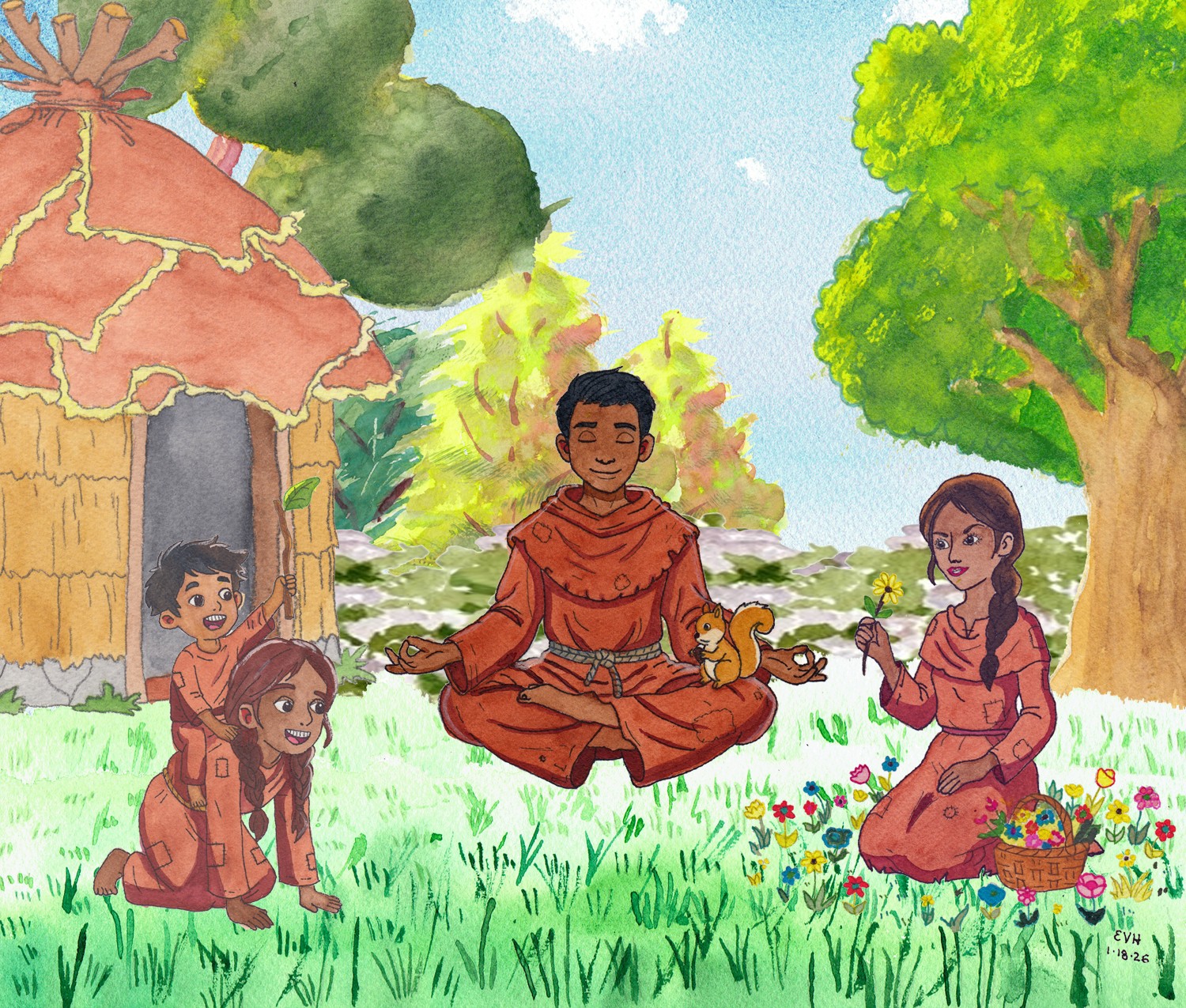 Figure: The happy hermit family.
At that time, in the kingdom of Kāliṇga, in a Brahmin village of Dunniviṭṭha, there lived a brahmin named “Jūjaka.” He obtained a hundred rupees as alms. He deposited them with a certain brahmin family, and then he went out to get more wealth. Because he was away for a long time, the family spent that money. When he returned, he upbraided them. But they could not return the money, so they gave him their daughter named “Amittatāpanā.”
He took the maiden with him to Dunniviṭṭha, in Kāliṅga, and there they lived. Amittatāpanā tended to the brahmin well. Some other brahmins—young men—saw her dutifulness. They reproached their own wives with it. “See how carefully she tends an old man, whereas you are careless of your young husbands!” This made the wives resolve to drive her out of the village. So they would gather in crowds at the river side and everywhere else, reviling her.
Explaining this, the Master said:
“Once in Kāliṇga, Jūjaka, a brahmin spent his life,
Who had Amittatāpanā, quite a young girl, to wife.
“The women who with waterpots down to the river came
Cried shame upon her, crowding up, and roundly cursed her name.
“A ‘foe’ indeed your mother was, a ‘foe’ your father too,
To let an old decrepit man wed a young wife like you.
“Your people brewed a secret plot, a bad, mean, cruel plan,
To let a fine young girl be wed to an old decrepit man.
“A hateful thing your life must be, as youthful as you are,
With an old husband to be wed, nay, death were better far.
“It surely seems, my pretty one, your parents were unkind
If for a fine young girl they could no other husband find.
“Your fire offering and your ninth were offered all for naught
If by an old decrepit man so young a wife was caught.
“Some brahmin or ascetic once no doubt you have reviled,
Some virtuous or learned man, some hermit undefiled,
If by an old decrepit man so young a wife was caught.
“Painful a spear thrust, full of pain the serpent’s fiery bite,
But a decrepit husband is more painful to the sight.
“With an old husband there can be no joy and no delight,
No pleasant talk, his very laugh is ugly to the sight.
“When men and maidens, youth with youth, hold intercourse apart
They make an end of all the woes that harbor in the heart.
“You are a girl whom men desire, you’re young and you are fair,
How can an old man give you joy? Go home and tarry there!”
When she heard their mockery, she went home with her waterpot, weeping. “Why are you weeping?” her husband asked. She replied in this stanza:
“I cannot fetch the water home, the women mock me so,
Because my husband is so old they mock me when I go.”
Jūjaka said:
“You need not fetch the water home, you need not serve me so,
Do not be angry, lady mine, for I myself will go.”
The woman said:
“You fetch the water? No, indeed! that’s not our usual way.
I tell you plainly, if you do, with you I will not stay.
“Unless you buy a slave or maid this kind of work to do,
I tell you plainly I will go and will not live with you.”
Jūjaka said:
“How can I buy a slave? I have no craft, no corn, no pelf,
Come, be not angry, lady mine, I’ll do your work myself.”
(“Pelf” is “money.”)
The woman said:
“Come now, and let me tell to you what I have heard them say.
Out yonder in the Vaṃka hill lives King Vessantara.
“Go, husband, to Vessantara and ask him for a slave,
The prince will certainly consent to give you what you crave.”
Jūjaka said:
“I am an old decrepit man, the road is rough and long,
But do not worry, do not weep—and I am far from strong,
But be not angry, lady mine, I’ll do the work myself.”
The woman said:
“You’re like a soldier who gives in before the fight, but why?
And do you own that you are beat before you go and try?
“Unless you buy a slave or maid this kind of work to do,
I tell you plainly, I will go, I will not live with you.
That will be a most unpleasant thing, a painful thing for you.
“When happy in another’s arms you shall behold me soon,
Dressed gaily at the season’s change, or changes of the moon.
“And as in your declining years my absence you deplore,
Your wrinkles and your hoary hairs will double more and more.”
Explaining this, the Master said:
“And now the brahmin full of fears to his wife’s will gives way,
So then tormented by his love, you might have heard him say,
“’Get me provision for the road, make me some honey cake,
Prepare some wheat bread, too, and set the barley bread to bake.
“’And then an equal pair of slaves with me I’ll bring away,
Who without wearying shall wait upon you night and day.’”
Quickly she prepared the provisions and informed him that it was done. Meanwhile he repaired the weak places about his cottage, secured the door, brought in wood from the forest, drew water in the pitcher, filled all the pots and pans, and donning the garb of the ascetic, he left her with the words, “Be sure not to go out at improper times and be careful until I return.” Then putting on his shoes, he put his bag of provisions over his shoulder, walked around his wife right wise, and departed with streaming eyes.
Explaining this, the Master said:
“This done, the brahmin dons his shoes, then rising presently,
And walking round her towards the right he bids his wife good-bye.
“So went he, dressed in holiness, tears standing in his eyes,
To the rich Sivi capital to find a slave he hies.”
When he came to that city, he asked the assembled people where Vessantara was.
Explaining this, the Master said:
“When further he had come, he asked the people gathered round—
“’Say, where is King Vessantara? Where can the prince be found?’
To him replied the multitude who were assembled round,
“’By such as you he’s ruined, for by giving, giving still,
He’s banished out of all the realm and dwells in Vaṃka hill.
“’By such as you he’s ruined, for by giving, giving still,
He took his wife and children and now dwells in Vaṃka hill.”
“So you have destroyed our king, and now you come here again! Stand still, will you,” and with sticks and clods, kicks and fisticuffs, they chased him away. But he was guided by the gods into the right road for Vaṃka hill.
Explaining this, the Master said:
“So he, upbraided by his wife, in greedy passion’s sway,
Paid for his error in the wood where beasts and panthers prey.
“Taking his staff and begging bowl and sacrificial spoon,
He sought the forest where abode the giver of every boon.
“Once in the forest, came the wolves thronging around his way,
He leapt aside and went confused far from the path astray.
“This brahmin of unbridled greed, finding himself astray,
The way to Vaṃka now quite lost, began these lines to say,
“’Who’ll tell me of Vessantara, the prince all conquering,
Giver of peace in time of fear, the great and mighty king?
“’Refuge of suitors, as the earth to all that living be,
Who’ll tell me of Vessantara, the great and mighty king?
“’All who seek favors go to him as rivers to the sea,
Who’ll tell me of Vessantara, the great and mighty king?
“’Like to a safe and pleasant lake, with water fresh and cool,
With lilies spread, whose filaments cover the quiet pool.
Who’ll tell me of Vessantara, the great and mighty king?
“’Like a great fig tree on the road, which growing there has made
A rest for weary wayfarers who hasten to its shade.
Who’ll tell me of Vessantara, the great and mighty king?
“’Like banyan, sāl, or mango-tree, which on the road has made
A rest for weary wayfarers that hasten to its shade.
Who’ll tell me of Vessantara, the great and mighty king?
“’Who will give ear to my complaint, the forest all around?
Glad I should be, could anyone tell where he may be found!
“’Who will give ear to my complaint, the forest all around?
Great blessing it would be, if one could tell where he may be found.’”
Now the man who had been sent to watch, who was ranging the woods as a forester, heard this lamentable outcry. He thought, “Here is a brahmin crying out about Vessantara’s living place. He cannot be here for any good purpose. He will ask for Maddī or the children, no doubt. Well, I will kill him.” So he approached the man, and as he drew his bow, he threatened him with the words, “Brahmin, I will not spare your life!”
Explaining this, the Master said:
“The hunter ranging in the wood heard this lament, and said,
‘By such as you he’s ruined, for by giving, giving still,
He’s banished out of all the realm and dwells in Vaṃka hill.
“’By such as you he’s ruined, for by giving, giving still,
He took his wife and children and now dwells in Vaṃka hill.
“’A good-for-nothing fool you are, if leaving home you wish
To seek the prince in forests, like a crane that seeks a fish.
“’Therefore, my worthy man, I will not spare your life, and so
My arrow now shall drink your blood when shot from out my bow.
“’I’ll split your head, tear out your heart and liver in a trice,
Like birds to spirits of the road I’ll make you sacrifice.
“’I’ll take your flesh, I’ll take your fat, I’ll take your heart and head,
And you shall be a sacrifice as soon as you are dead.
“’You’ll be a welcome sacrifice, a goodly offering,
And then you’ll not destroy the wife and children of the king.’”
When the man heard these words, he was frightened to death, and so he made a false reply:
“The ambassador’s inviolate, and no man may him kill,
This is a very ancient rule, so listen, if you will.
“The people have repented them, his father misses him,
His mother pines away for grief—her eyes are waxing dim.
“I come as their ambassador, Vessantara to bring,
Hear me and tell me if you know where I may find the king.”
The man was pleased to hear that he had come to fetch Vessantara. He fastened up his dogs and called the brahmin down. He seated him on a pile of twigs and recited this stanza:
“I love the envoy and the prince, and here I give to you
A gift of welcome—leg of deer and pot of honey, too.
Our benefactor how to find I’ll tell you what to do.”
The man gave the brahmin food with a gourd of honey and a roast leg of deer, and then he sent him on his way. He rose his right hand to point out the place where the Great Being lived, and he said:
“Sir brahmin, yonder rocky mount is Gandhamādan hill
Where lives the King Vessantara with wife and children still.
“With brahmin’s dress, with hook and spoon, the ascetic’s matted hair,
Skin clad he lies upon the ground and tends the fire with care.
“See yonder trees with many fruits, green on the mountain side,
While the dark mountain peaks uplift till in the clouds they hide.
“There shrubs, and creepers, chestnut, sāl, and many another tree
Sway in the wind like drunken men for anyone to see.
“High up above the rows of trees the birds in concert sing,
Najjuha, cuckoo, flocks of them, from tree to tree flitting.
“Thronging among the leafy twigs they bid the stranger come,
Welcome the guest, delighting all who make the woods their home,
Where with his children now abides Vessantara the king.
“With brahmin’s dress, with hook and spoon, the ascetic’s matted hair,
Skin clad he lies upon the ground and tends the fire with care.”
Moreover he said, in praise of the hermitage:
“Mango, rose-apple, jackfruit, sāl, all kinds of myrobolan,
Bo, golden tindook, many more, including the banyan.
(“Myrobolan” is dried fruit. “Tindook” is an ebony tree.)
“Plenty of figs, all growing low, all ripe, as sweet as sweet,
Dates, luscious grapes, and honeycomb, as much as you can eat.
“The mango trees are some in flower, some with the fruit just set,
Some ripe and green as any frog, while some are unripe yet.
“A man may stand beneath the trees and pluck them as they grow,
The choicest flavor, color, taste, both ripe and unripe show.
“It makes me cry aloud to see that great and wondrous sight,
Like heaven where the gods abide, the garden of delight.
“Palmyra, date palm, coconut grow in that forest high,
Festoons of flowers garlanded as when the banners fly,
Blossoms of every hue and tint like stars that dot the sky.
Ebony, aloe, trumpet flower, and many another tree,
Acacias, berries, nuts, and all as thick as thick can be.
“Hard by there is a lake all spread with lilies blue and white,
As in the garden of the gods, the Garden of Delight.
“And there the cuckoos make the hills re-echo as they sing,
Intoxicated with the flowers which in their season spring.
“See on the lilies drop by drop the honey nectar fall,
And feel the breezes blowing free from out the south and west,
Until the pollen of the flowers is passing over all.
“Plenty of rice and berries ripe about the lake do fall,
Which fish and crabs and tortoises dart seeking with a zest,
And honey drips like milk or ghee from the flowers one and all.
“A frequent breeze blows through the trees where every scent is found,
And seems to intoxicate with flowers the forest all around.
“The bees about the scented flowers fly thronging with their hum,
There fly the many-colored birds together, all and some,
Cooing and chirping in delight, each with his mate they come.
“’O pretty chicky, happy chap!’ they twitter and they tweet—
‘O lovey dovey, deary dear, my pretty little sweet.’
“Festoons of flowers garlanded as when the banners fly,
Blossoms of every hue and tint, sweet odors wafted by,
Where with his children now abides Vessantara the king.
With brahmin’s dress, with hook and spoon, the ascetic’s matted hair,
Skin clad he lies upon the ground and tends the fire with care.”
In this way the countryman described the place where Vessantara lived. Jūjaka was delighted. He saluted him in this stanza:
“Accept this piece of barley bread all soaked with honey sweet,
And lumps of well-cooked honey cake, I give to you to eat.”
To this the countryman answered:
“I thank you, but I have no need. Keep your provision still.
And take of my provision, then go, brahmin, where you will.
“Straight onward to a hermitage the pathway there will lead,
Where Accata a hermit dwells, black-tooth’d, with dirty head,
With brahmin dress, with hook and spoon, the ascetic’s matted hair,
Skin clad he lies upon the ground and tends the fire with care.
You go there, ask the way of him, and he will give you speed.”
When this he heard, the brahmin walked round Ceta towards the right,
And went in search of Accata, his heart in high delight.
Then Bhāradvāja went along until he came close by
Unto the hermit’s place, to whom he spoke thus courteously,
“O holy man, I trust that you are prosperous and well,
With grain to glean and roots and fruit abundant where you dwell.
“Have you been much by flies and gnats and creeping things annoyed,
Or from wild beasts of prey have you immunity enjoyed?”
The ascetic said:
“I thank you, brahmin—yes, I am both prosperous and well,
With grain to eat and roots and fruit abundant where I dwell.
“From flies and gnats and creeping things I suffer not annoy,
And from wild beasts of prey, I here immunity enjoy.
“In all the innumerable years I’ve lived upon this ground,
No harmful sickness that I know has ever here been found.
“Welcome, O brahmin! Bless the chance directed you this way,
Come enter with a blessing, come, and wash your feet I pray.
“The tindook and the piyal leaves, and kāsumārī sweet,
And fruits like honey, brahmin, take the best I have, and eat.
“And this cool water from a cave high hidden on a hill,
O noble brahmin, take of it, drink if it be your will.”
Jūjaka said:
“Accepted is your offering, and your oblation, sir.
I seek the son of Sañjaya, once banished far away
By Sivi’s people. if you know where he abides, please say.”
The ascetic said:
“You seek the King of Sivi, sir, not with a good intent.
I think your honor’s real desire upon his wife is bent.
“Kaṇhājinā for handmaiden, Jāli for serving-man,
Or you would fetch the mother with her children, if you can,
The prince has no enjoyments here, no wealth or food, my man.”
On hearing this, Jūjaka said:
“I wish no ill to any man, no boon I come to pray,
But sweet it is to see the good, pleasant with them to stay.
“I never saw this monarch, whom his people sent away,
I came to see him, if you know where he abides, please say.”
The man believed him. “Good, I will tell you. Only stay with me here today.” So he entertained him with wild fruits and roots. And on the next day, stretching out his hand, he showed him the road. Then he said:
“The foliage of the pepper tree in that fair spot is seen,
No dust is ever blown aloft, the grass is ever green.
“The grasses like a peacock’s neck, soft cotton to the touch,
Grow never more than inches four, but always just so much.
“Kapittha, mango, rose apple, and ripe figs dangling low,
All trees whose fruit is good to eat in that fine forest grow.
“There sweet and clean and fragrant streams as blue as beryl flow,
Through which disporting up and down the shoals of fishes go.
“A lake lies in a lovely spot, with lilies blue and, white,
Hard by, like that which is in heaven in the Garden of Delight.
“Three kinds of lilies in that lake present them to the sight,
With varied colors, some are blue, some blood red, others white.”
In this way he praised the foursquare lake of lilies and went on to praise Lake Mucalinda:
“As soft as linen are the flowers, those lilies blue and white,
And other herbs grow there, the lake is Mucalinda height.
“And there in number infinite the full-blown flowers you see,
In summer and in winter both as high as to the knee.
“Always the many-colored flowers blow fragrant on the breeze,
And you may hear drawn by the scent the buzzing of the bees.
“All round about the water’s edge are standing in a row
The ebony, the trumpet flower, and tall Kadamba trees.
“Six petals and many another tree with flowers all a-blow,
And leafy shade all standing around about the lake one sees.
“There trees of every shape and size, there flowers of every hue,
All shrubs and bushes, high and low are spread before the view.
“The breezes sweetly waft the scent from flowers white, blue, and red,
That grow about the hermitage wherein the fire is fed.
“Close round about the water’s edge grow many plants and trees,
Which tremble as they echo to the murmurs of the bees.
“The scent of all the lovely blooms that grow about that shore
Will last you if you keep them for a week, or two, or more.
“Three kinds of gourds, all distinct, grow in this lake, and some
Have fruit as big as waterpots, others big as a drum.
“Mustard, green garlic, lilies blue to pick, and flowers full-blown,
Jasmine, sweet sandal, creepers huge about the trees are grown.
“Sweet jasmine, cotton, indigo, and plants of many a name,
Cress, trumpet flower, grow all around like tongues of golden flame.
“Yea, every kind of flower that grows in water or on land,
In and about this lovely lake lo and behold they stand.
“There crocodiles and water beasts abide of every sort,
Red deer and other animals for water do resort.
“Turmeric, camphor, panic seed, the licorice plant, and all
Most fragrant seeds and grasses grow with stalks exceeding tall.
“There lions, tigers, elephants a seeking for a mate,
Deer red and dappled, jackals, dogs, and fawns so swift of gait,
“Yaks, antelopes, and flying fox, and monkeys great and small,
Bears, bulls, and other mighty beasts come flocking one and all.
“Rhinoceros, mongoose, squirrel, boar, dog, jackal, buffalo,
Loris, hare, speckled panther, wolf and lizard, there they go.
“Spiders and snakes and hairy things, and every kind of bird,
Which as they chirp and twitter round all make their voices heard.
“Hawk, woodcock, heron, piper, owl, the cuckoo with his flute,
Partridge, geese, ospreys, pheasants, cranes, and redbacks, follow suit.
“There sweetly singing to their mates the gorgeous colored things,
White-tufted, blue-necked, peacock hued flutter their pretty wings.
“Why should I try their thousand names in detail to rehearse?
Imagine every kind of bird and add them to my verse.
“There a melodious company their thousand songs they make
And fill the air with pleasant noise round Mucalinda Lake.
“The wood is full of elephants, of antelopes and deer,
Where hanging down from all the trees great creepers do appear.
“There mustard grows, and sugar cane, and many kinds of rice,
And beans and other plants and herbs, all comers to suffice.
“Yonder the footpath leads you straight unto his settling ground
Where never hunger, never thirst, and no distaste is found,
Where with his children now abides Vessantara the king.
“With brahmin’s dress, with hook and spoon, the ascetic’s matted hair,
Skin clad he lies upon the ground and tends the fire with care.”
When this he heard, the brahmin walked around him towards the right,
And went to seek Vessantara, his heart in high delight.
Jūjaka went on by the road pointed out to him by Accata the Hermit. He arrived at the foursquare lake. “It is now late evening,” he thought. “Maddī will have returned by now from the forest, and women are always punctual. Tomorrow, when she has gone into the forest, I will go to Vessantara and ask him for the children. And before she comes back, I will be away.” So he climbed a flat-topped hill not far off and lay down in a pleasant spot.
Now at dawn on the next day, Maddī had a dream. Her dream was this. A black man was dressed in two yellow robes. He had red flowers in his ears. He came and entered the hut of leaves. He clutched Maddī by her hair and dragged her out. He threw her down on the ground backwards, and amidst her shrieks, he tore out her two eyes. He cut off her arms and cut open her breast. He tore out her heart, and dripping with blood, he carried it away.
She awoke in fright, thinking, “I have seen an evil dream. I have no one here but Vessantara to interpret my dream so I will ask him about it.” She went to the hut of the Great Being and knocked on the door. “Who’s there?” “I, my lord, Maddī.” “Lady, why have you come here unseasonably and broken our compact?” “My lord, it is not from desire that I come. But I had an evil dream.” “Tell it to me then, Maddī.”
She told it as it had appeared. The Great Being understood what the dream meant. “The perfection of my giving,” he thought, “is to be fulfilled. On this day a suitor will come to ask for my children. I will console Maddī and let her go.” So he said, “Your mind must have been disturbed by uneasy sleep or by indigestion. You have nothing to fear.” With this deceit he consoled her and let her go.
And when the night grew light, she did all that had to be done. She embraced and kissed the children and said, “Last night I had a bad dream. Be careful, my dears!” Then she left them in charge of the Great Being, begging him to take care of them. She took her basket and tools, wiped her tears, and went to the woods for fruits and roots.
But Jūjaka, thinking that she would now be gone, came down from the hill. He went up the footpath towards the hermitage. The Great Being came out of his hut and seated himself on a slab of stone like a golden image. “Now the suitor will come!” he thought. He sat watching the road by which he would come with his children playing at his feet.
As he looked down the road, he saw the brahmin coming. Taking up the burden of his giving, having not done so for seven months, he cried in joy, “Brahmin, please come near!” And he addressed this stanza to the boy Jāli:
“Jāli, arise and stand! Behold a brahmin in my sight!
‘Tis the old time come back again and fills me with delight!”
Hearing this, the boy said:
“Yes, yes, my father, I behold the brahmin whom you see,
He comes as though a boon to ask, our guest he needs must be.”
And with these words, to show him honor, the boy rose up from his seat and went to meet the brahmin. He offered to relieve him of his baggage. The brahmin looked at him and thought, “This must be Jāli, the son of Vessantara. From the very first I will speak harshly to him.” So he snapped his fingers at him, crying, “Go away, go away!” The boy thought, “This is a harsh man, to be sure!” And looking at his body, he perceived the 18 blemishes of a man in him. (It is not clear what these 18 blemishes are.) But the brahmin went up to the Bodhisatta, politely greeted him, and said:
“O holy man, we trust that you are prosperous and well.
With grain to glean and roots and fruit abundant where you dwell.
“Have you been much by flies and gnats and creeping things annoyed,
Or from wild beasts of prey have you immunity enjoyed?”
The Bodhisatta answered politely:
“I thank you, brahmin, and reply, we prosper and are well,
With grain to glean and roots and fruit abundant where we dwell.
“From flies and gnats and creeping things we suffer no annoy,
And from wild beasts of prey we here immunity enjoy.
“Seven months we have lived happy in this forest and have not
Once seen a brahmin, as we now see you, godlike, I wot,
With sacred staff and tinder box, and with the waterpot.
“Welcome, O brahmin! Blessed the chance directed you this way,
Come, enter with a blessing, come and wash your feet, I pray.
“The tindook and the piyal leaves, the kāsumāri sweet,
And fruits like honey, brahmin, take the best I have, and eat.
“And this cool water from a cave high hidden on a hill,
O noble brahmin, take of it, drink if it be your will.”
After these words, the Great Being thought, “This brahmin has not come to this great forest without cause. I will ask him the reason without delay,” and he recited this stanza:
“Now tell me what may be the cause, what can the reason be,
That brings you to this mighty wood? I pray you tell it me.”
Jūjaka said:
“As a great water flood is full and fails not any day,
So you, from whom I come to beg—give me your children, pray!”
On hearing this, the Great Being was delighted in heart. He spoke like one who sets a purse of a thousand gold coins in the outstretched hand,
“I give and shrink not. You shall be their master. But my queen
Went out this morning for our food, at evening she’ll be seen.
“Stay here this night, the morning light shall see you on your way.
She’ll wash them and perfume them both and garland them with flowers.
“Stay here this night, the morning light shall see you on your way.
Decked out with flowers they both shall be, with scents and perfumes sweet.
Take them away and plenty take of fruits and roots to eat.”
Jūjaka said:
“No, mighty monarch, I would go, I do not wish to stay,
I’ll go, lest some impediment should thwart me on the way.
“Women no generous givers are, to thwart they always try,
They know all sorts of cunning spells and always go awry.
“Let him who gives a gift in faith not see his mother’s face,
Or she will find impediments. O king, I’d go apace.
“Give me your children, let them not behold their mother’s face,
For he that gives a gift in faith, his merit grows apace.
“Give me your children, let them not behold their mother’s face.
He who gives wealth to such as I, to heaven he goes apace.”
Vessantara said:
“If you wish not to see my wife, a faithful wife is she!
Let Jāli and Kaṇhājinā their grandsire go and see.
“When these fair children, sweet of speech, shall come within his sight,
He’ll give you wealth in plenty, full of joy and high delight.”
Jūjaka said:
“I fear the spoiling of my goods, O prince, I pray you hear!
The king may deal me punishment, may slay, or sell, I fear.
Without wealth and servants, my wife would mock at me and jeer!”
Vessantara said:
“When these fair children, sweet of speech, shall come within his sight,
The foster-king of Sivi folk, who always does the right,
Will give you wealth in plenty, filled with pleasure and delight.”
Jūjaka said:
“No, no, I will not do this thing which you would recommend,
I’ll take the children, on my wife as servants to attend.”
The children, hearing these harsh words, slunk behind the hut. They ran away from behind there and hid close to a clump of bushes. Even there they seemed to see themselves caught by Jūjaka. Trembling, they could not keep still anywhere. They ran here and there until they arrived at the bank of the square lake. There, wrapping their bark garments tightly around them, they plunged into the water and stood there hidden, their heads beneath the lily leaves.
Explaining this, the Master said:
“In this way Jāli and Kaṇhājinā here and there ran,
In deep distress to hear the voice of the pursuing man.”
And Jūjaka, when he did not see the children, upbraided the Bodhisatta: “Ho Vessantara! You gave me the children just now. But as soon as I told you that I would not go to the city of Jetuttara but would make the children my wife’s attendants, you signaled them and caused them to run away. Meanwhile you just sat there in innocence! There is not such a liar in the world!”
The Great Being was moved. “They have run away, no doubt,” he thought, and he said aloud, “Do not trouble yourself, sir, I’ll find them.” So he got up and went behind the hut. Thinking that they must have fled to the woods, he followed their footprints to the lakeside. There he saw a footprint where they had descended into the water. He surmised that they must have gone into the water. So he called, “Jāli, my boy!” reciting these two stanzas:
“Please come here, my beloved son, my perfect state fulfill,
Come now and consecrate my heart and carry out my will.
“You be my ship to ferry me safe o’er existence’ sea,
Beyond the worlds of birth and gods I’ll cross and I’ll be free.”
“Come, Jāli, my boy!” he cried. But when the boy heard his voice, he thought, “Let the brahmin do with me what he will. I will not quarrel with my father!” He raised his head, parted the lily leaves, and came out of the water. He threw himself on the Great Being’s right foot, embracing the ankle as he wept. Then the Great Being said, “My boy, where is your sister?” He answered, “Father, all creatures take care of themselves in time of danger.” The Great Being recognized that the children must have made a bargain together, and he cried out, “Here, Kaṇhā!” reciting two stanzas:
“Please come here, my beloved girl, my perfect state fulfill,
Come now and consecrate my heart and carry out my will.
“You be my ship to ferry me safe o’er existence’ sea,
Beyond the worlds of men and gods I’ll cross and lift me free!”
She also thought, “I will not quarrel with my father.” And out she came. Falling on her father’s left foot, she clasped his ankle and wept.
Their tears fell upon the Great Being’s feet, colored like a lily leaf. And his tears fell on their backs which had the color of golden slabs. Then the Great Being raised up his children and comforted them, saying, “My son Jāli, don’t you know that I have gladly given you away? So do that so my desire may attain fulfilment.”
And then and there he put a price on the children as one puts a price on cattle. To his son he said, “Son Jāli, if you wish to become free, you must pay the brahmin a thousand gold coins. But your sister is very beautiful. If any person of low birth should give the brahmin any amount to make her free, he would break her birthright. No one but a king can give all things by the hundred. Therefore, if your sister would be free, let her pay the brahmin a hundred male and a hundred female slaves, with elephants, horses, bulls, and gold pieces, all a hundred each.”
In this way he put a price on the children.
Then he comforted them and took them back to the hermitage. He took water from his waterpot, and calling the brahmin to come near, he poured out the water, praying that he might attain omniscience. “Dearer than my son a hundredfold, a thousandfold, a hundred thousandfold is omniscience!” he cried, making the earth resound, and to the brahmin he gave this precious gift of his children.
Explaining this, the Master said:
“The foster-king of Sivi land then took his children both,
And gave this gift most precious to the brahmin, nothing loth.
“Then was there terror and affright, and the great earth did quake,
What time the king with folded hands bestowed the children both.
Then there was terror and affright, and the great earth did shake,
When Sivi’s king his children gave the brahmin, nothing loth.”
When the Great Being had made the gift, he was joyful, thinking how he had made a good gift. And Jūjaka went into the jungle. He bit off a creeper, and he bound the boy’s right hand to the girl’s left with it. Then he drove them away beating them with the ends of the creeper.
Explaining this, the Master said:
“The cruel brahmin bit a length of creeper off, which done,
He with the creeper bound their hands and dragged the children on.
“And then the brahmin, staff in hand, holding the creeper tight,
Beat them and drove them on and on before their father’s sight.”
Where he struck them, the skin was cut, and the blood ran. When struck they staggered against each other back-to-back. But in a rugged place the man stumbled and fell. With their tender hands the children slipped off the light bond, and they ran away weeping to the Great Being.
Explaining this, the Master said:
“The children thus at liberty then from the brahmin fly,
The boy looks on his father’s face, the tears are in his eye.
“Then like a fig-leaf in the wind the little boy did quake,
Embracing threw his arms around his father’s feet, and spake.
“’Father, will you dispose of us while mother is away?
O do not give us till she come! Till she returns, O stay!
“’And will you then dispose of us while mother is away?
O wait until she shall return, then give us if you will!
Then let the brahmin sell us both, then let the brahmin kill!
“’His foot is huge, his nails are torn, his flesh hangs sagging down,
Long underlip and broken nose, all trembling, tawny-brown,
“’Pot-bellied, broken-backed, with eyes that chew an ugly squint,
All spots and wrinkles, yellow-haired, with beard of bloody tint.
“’Yellow, loose-jointed, cruel, huge, in skins of goats bedight,
A crooked and inhuman thing, a most terrific sight.
“’A man, or monstrous cannibal?Aand can you tamely see
This goblin comes into the wood to ask this boon of thee?
“’And is your heart a piece of stone fast bound about with steel,
To care not when this greedy man, who can no pity feel,
Binds us, and drives us off like cows? At least I would appeal.
“’That sister Kaṇha, who as yet no trouble knows, may stay,
Now crying like a sucking fawn lost from the herd away.’”
To this the Great Being answered not one word. Then the boy said, lamenting on account of his parents:
“I care not for the pain of death, that is the lot of all,
Ne’er more to see my mother’s face, ‘tis this that does appall.
“I care not for the pain of death, that is the lot of all,
Ne’er more to see my father’s face, ‘tis this that does appall.
“Long will my parents mourn and weep, long will they nurse their woe,
At midnight and at dawn their tears will like a river flow,
No more to see Kaṇhājinā, whom they had cherished so.
“Those clusters of rose-apple trees which droop around the lake,
And all the fruitage of the woods this day we do forsake.
“Fig-tree and jack-fruit, banyan broad and every tree that grows,
Yea! all the fruitage of the woods this day we do forsake.
“There stand they like a pleasant park, there cool the river flows,
The place where once we used to play, this day we do forsake.
“The fruit that once we used to eat, the flowers we used to wear,
That yonder grow upon the hill, this day we do forsake.
“And all the pretty little toys that once we played with there,
The horses, oxen, elephants, this day we do forsake.”
In despite of these lamentations, Jūjaka came and drove him away with his sister.
Explaining this, the Master said:
“The children to their father said as they were led away,
‘O father! Wish our mother well, and happy be your day!
“’These oxen, horses, elephants wherewith we used to play,
Give them to mother, and they will somewhat her grief allay.
“’These oxen, horses, elephants wherewith we used to play,
When she looks on them, will shortly somewhat her grief allay.”
Now great pain arose in the Great Being because of his children. His heart grew hot within him. He trembled violently, like an elephant seized by a maned lion, like the moon swallowed in Rāhu’s jaws. (“Rāhu” is the god who causes eclipses.) Not strong enough to endure it, he went into the hut, tears streaming from his eyes. He wept pitifully.
Explaining this, the Master said:
“The warrior prince Vessantara thus gave his gift, and went,
And there within his shaded forest he sadly did lament.”
What follow are the verses of the Great Being’s lamentation.
“O when at morning or at eve for food my children cry,
Oppressed by hunger or by thirst, who will their want supply?
“How will their little trembling feet along the roadway go,
Unshod? Who’ll take them by the hand and lead them gently so?
“How could the brahmin feel no shame, while I was standing by,
To strike my harmless innocents? A shameless man I say!
“No man with any sense of shame would treat another so,
Were it a servant of my slave, and I brought very low.
“I cannot see him, but he scolds and beats my children dear,
While like a fish caught in a trap, I’m standing helpless here.”
These thoughts came into the Great Being’s mind because of his affection for the children. He could not cast away the pain to think how the brahmin cruelly beat his children. He resolved to go after the man and kill him and to bring the children back. But no, he thought, that would be a mistake. To give a gift then to repent because of the children’s trouble would be very great. That was not the way of the righteous. And the two following stanzas contain the reflections that throw light on that matter.
“He bound his sword upon his left, he armed him with his bow,
I’ll bring my children back again, to lose them is great woe.
“But even if my children die ‘tis wicked to feel pain,
Who knows the customs of the good, yet asks a gift again?”
Meanwhile Jūjaka beat the children as he led them along. Then the boy said lamenting:
“How true that saying seems to be that men are wont to tell,
Who has no mother of his own is fatherless as well.
“Life’s nothing to us, let us die. We are his chattels now,
This cruel greedy violent man, who drives us like his cow.
“These clusters of rose-apple trees, which droop around the lake,
And all the lushness of the woods, O Kaṇhā, we forsake.
“Fig-tree and jack-fruit, banyan tree, and every tree that grows,
Yea all the many kinds of fruit, O Kaṇhā, we forsake.
“There stand they like a pleasant park, there cool the river flows,
The place where once we used to play, O Kaṇhā, we forsake.
“The fruit that once we used to eat, the flowers we used to wear,
That yonder grow upon the hill, O Kaṇhā, we forsake.
“And all the little pretty toys that once we played with there,
The horses, oxen, elephants, O Kaṇhā, we forsake.”
Once again the brahmin fell down in a rough place. The cord fell from his hand, and the children, trembling like wounded fowls, ran away without going back to their father.
Explaining this, the Master said:
“Now Jāli and Kaṇhājinā, thus by the brahmin led,
Somehow got free, and then away and on and on they fled.”
But Jūjaka quickly got up and followed them, cord and stick in hand, spitting like the fire at the world’s end. “Very clever you are indeed,” he said, “at running away.” And he tied their hands and brought them back.
Explaining this, the Master said:
“And so the brahmin took his cord, and so his staff he took,
And brought them back with beating, while the king was forced to look.”
As they were led away, Kaṇhājinā turned back and lamented to her father.
Explaining this, the Master said:
“Then spoke Kaṇhājinā and said, “My father, please do see—
As though I were a home-born slave this brahmin thrashes me!
“Brahmins are men of upright life, no brahmin he can be.
A goblin sure in brahmin-shape, that leads us off to eat.
And can you stay and see us led to be a goblin’s meat?”
As his young daughter lamented, trembling as she went, dire grief arose in the Great Being. His heart grew hot within him. His nose was not large enough, so he sent forth hot pantings from his mouth. Tears fell from his eyes like drops of blood. Then he thought, “All this pain comes from affection, and no other cause. I must quiet this affection and be calm.” In this way, by the power of his knowledge, he did away with that keen pang of sorrow and sat still as usual.
Before they had yet reached the base of the mountains, the girl went on lamenting:
“Sore are these little feet of mine, hard in the way we go,
The brahmin drives us on and on, the sun is sinking low.
“On hills and forests, and on those that dwell in them, we call,
We reverently bow to greet the spirits, one and all
“That haunt this lake, its plants and roots and creepers, and we pray
To wish our mother health, but us the brahmin drives away.
If she would follow after us, let her make no delay.
“Straight leads unto the hermitage this path by which we go,
And if she will but follow this, she soon will find us so.
“You gatherer of wild fruits and roots, you of the knotted hair,
To see the empty hermitage will cause you great despair.
“Long stayed our mother on her quest, great store she must have found,
Who knows not that a cruel man and greedy has us bound,
A very cruel man, who now like cattle drives us round.
“Ah, had our mother come at eve, and had they chanced to meet,
Had she given him a meal of fruit with honey mixed, to eat.
:He would not drive us cruelly, when he his meal had spent
Cruel he drove us, and our feet loud echoed as we went!”
So for their mother longing sore the children did lament.
Now given that the king gave his dearly beloved children to the brahmin, the earth resounded with a great uproar that reached to Brahma’s heaven. It pierced the hearts of the deities that lived in the Himalayas. When they heard the children’s lamentation as the man drove them along, they thought to themselves, “If Maddī returns to the hermitage, when she does not see her children, she will ask Vessantara about it. When she hears that they have been given away, her longing will be great. She will go after them, and she will get into great trouble.” So they instructed three of the gods to assume the shape of a lion and a tiger and a leopard and to block her way. They were not to let her go back for all her asking until the setting of the sun so that she might only get back by moonlight. This would keep her safe from the attacks of lions and other wild beasts.
Explaining this, the Master said:
“A lion, tiger, and leopard, three creatures of the brake,
Which heard this lamentation loud, thus each to other spake.
“Let not the princess back return at eve from seeking food,
Lest the wild beasts should slay her in our kingdom of the wood.
“If lion, leopard, or tiger should the noble mother slay,
O where would then Prince Jāli be, O where Kaṇhājinā
The parent and the children both do you preserve this day.”
They agreed and obeyed the words of the gods.
Becoming a lion, a tiger, and a leopard, they lay down near the road by which she must go.
Now Maddī was thinking to herself, “Last night I had a bad dream. I will collect my fruits and roots and get me back to the hermitage.” Trembling she searched for the roots and fruits. The spade fell from her hand, the basket fell from her shoulder, her right eye throbbed. Fruit-trees appeared as barren and barren trees as fruitful. She could not tell whether she was on head or heels. “What can be the meaning,” she thought, “of this strangeness today!” and she said:
“Down falls my spade, a throbbing now in my right eye I feel,
The fruitful trees unfruitful seem, all round me seems to reel!”
And when she turned at evening time to go, the day’s work done,
Wild beasts beset her homeward path at setting of the sun.
“The hermitage is far, I think, the sun is sinking low
And all the food they have to eat is what I bring, I know.
And there my prince sits all alone within the leafy hut,
The hungry children comforting ,and I returning not.
“It is the time of evening meal, O woe is me! ‘tis late,
Thirsting for water or for milk my children me await.
“They come to meet me, standing like calves looking for their dam,
Like wild-goose chicks above the lake—O wretched that I am!
“This is the sole and only path, with ponds and pits around,
And I can see no other road now I am homeward bound.
O mighty monarchs of the woods, O royal beasts, I cry,
Be brothers now in righteousness and let me safe go by!
“I am a banished prince’s wife, a prince of glory fair,
As Sītā did for Rāma, so I for my husband care.
(“Sitā” is the consort of the god “Rāma.”)
When you go home at evening time, your children you can see,
So Jāli and Kaṇhājinā be given once more to me!
“Here are abundant roots and fruits, much food I have to chew,
The half I offer now to you, O let me safely go!
“A king, my father, and a queen, my mother—hear my cry!
Be brothers now in righteousness and let me safe go by!”
Then the gods, seeing the time, saw that it was time to let her go. They rose up and departed.
The Master explained it in this way:
“The beasts that heard her thus lament with great exceeding woe,
In voice of sweet and gentle sound, went off and let her go.”
When the beasts had departed, she returned to the hermitage.
Now it was the night of the full moon, and when she came to the end of the covered walk where she was used to seeing her children, she did not see them. She cried out:
“The children, dusty, close to home, are wont to meet me here
Like calves that seek the mother-cow, like birds above the mere.
“Like little deer, with pricked-up ear, they meet me on the way,
With joy and happiness they skip and frolic in their play.
But Jāli and Kaṇhājinā I cannot see today.
“As goat and lioness may leave their young, a bird her cage,
To seek for food, so have I done their hunger to assuage.
But Jāli and Kaṇhājinā I cannot see today.
“Here are their traces, close by home, like snakes upon the hill,
The little heaps of earth they made all round, remaining still.
But Jāli and Kaṇhājinā I cannot see today.
“All covered up with dust to me my children used to run,
Sprinkled with mud, but now indeed I can see neither one.
“Like kids to welcome back their dam they ran from home away
As from the forest I returned, I see them not today.
“Here they were playing, here this yellow sacred fruit let fall,
But Jāli and Kaṇhājinā I cannot see today.
“These breasts of mine are full of milk, my heart will break withal,
But Jāli and Kaṇhājinā I cannot see today.
“They used to cling about my hips, one hanging from my breast,
How they would meet me, dust-begrimed, at time of evening rest!
But Jāli and Kaṇhājinā I cannot see today.
“Once on a time this hermitage became our meeting-ground,
But now I see no children here, the whole place spins around.
“My children must be dead! The place so silent has become—
The very ravens do not caw, the very birds are dumb.”
Lamenting in this fashion, she went up to the Great Being and set down the basket of fruit. Seeing him sitting in silence with no children with him, she said:
“Why are you silent? How that dream comes to my thought again,
The birds and ravens make no sound, my children must be slain!
“O sir, have they been carried off by some wild beast of prey?
Or in the deep deserted wood have they been led astray?
“O do the pretty prattlers sleep? On errands do they fare?
O have they wandered out afar in frolic or in play?
“I cannot see their hands and feet, I cannot see their hair.
Was it a bird that swooped? Or who has carried them away?”
To this the Great Being made no reply. Then she asked, “My lord, why do you not speak to me? What is my fault?” and said:
“‘Tis like the wound of arrow-shot, and still more bitter smart
(But Jāli and Kaṇhājinā I cannot see today!)
“This is a second wound that you have struck me to the heart,
That I my children cannot see, that you have nought to say.
“And so, O royal prince! This night since you will not reply,
I think my days are done indeed, and you will see me die.”
The Great Being thought that he would assuage his pain for the children by harsh speech, and he recited this stanza:
“O Maddī, royal princess born, whose glory is so great,
You went for food in early morn why do you come so late?”
She replied:
“Did you not hear the lion and the tiger loudly roar
When by the lake their thirst to quench they stood upon the shore?
“As in the woods I walked, there came the sign I knew so well,
My spade fell from my hand, and from my arm the basket fell.
“Then hurt, alarmed, I worshipped all the quarters, one by one,
Praying that good might come of this, my hands outstretched in prayer.
“And that no lion and no pard, hyena, wolf or bear,
Might tear or harry or destroy my daughter or my son.
(A “pard” is a leopard.)
“A lion, tiger, and a pard, three ravening beasts, laid wait
And kept me from my homeward path, so that is why I’m late.”
This was all that the Great Being said to her until sunrise, after which Maddī uttered a long lament:
“My husband and my children I have tended day and night,
As pupil tends a teacher, when he tries to do the right.
“In goatskins clothed, wild roots and fruits I from the forest brought,
And every day and every night for your convenience sought.
“I brought you yellow sacred fruit, my little girl and boy,
And many a ripe woodland fruit, to play and make you joy.
“This lotus root and lotus stalk, of golden yellow hue,
Join with your little ones, O prince, and eat your portion too.
“Give the white lily to your girl, to Jāli give the blue,
And see them dance in garlands decked, O call them, Sivi, do!
“O mighty monarch! Lend an ear while with delightful sound
Kaṇhājinā sings sweetly and enters our settling-ground.
“Since we were banished, joy and woe in common shared has been.
O answer! My Kaṇhājinā and Jāli have you seen?
“How many holy brahmins I must have offended sore,
Of holy life, and virtuous, and full of sacred lore,
That Jāli and Kaṇhājinā I cannot see today!”
To this lament the Great Being answered not one word.
As he said nothing, trembling she sought her children by the light of the moon. And where they used to play, under the rose-apple trees or where not, she sought them, weeping all the while, and saying:
“These clusters of rose-apple trees, that droop around the mere,
And all the fruitage of the woods—my children are not here!
“Fig-tree and jack-fruit, banyan broad, and every tree that grows,
Yea, all the fruitage of the woods—my children are not here!
“There stand they like a pleasant park, there cool the river flows,
The place where once they used to play—but now they are not here.
“The fruit that once they used to eat, the flowers they used to wear
That yonder grow upon the hill—the children are not there!
“And all the little toys that once they played with, there are those,
The oxen, horses, elephants—the children are not there!
“Here are the many hares and owls, the dark and dappled deer,
With which the children used to play, but they themselves not here!
“The peacocks with their gorgeous wings, the herons and the geese,
With which the children used to play, but they themselves not here!”
Not finding her darling children in the hermitage, she entered a clump of flowering plants and looked here and there for them, saying:
“The woodland thickets, full of flowers that every season blow,
Where once the children used to play, but they themselves not here!
“The lovely lakes that listen, when the ruddy geese give call,
When lotus white and lotus blue and trees like coral grow,
Where once the children played, but now no children are at all.”
But nowhere could she see the children.
Then she returned to the Great Being, whom she saw with his face cast down. She said to him:
“The kindling wood you have not split, the fire you have not lit,
Nor brought the water as before, why do you idly sit?
“When I return unto my den my toil is done away,
But Jāli and Kaṇhājinā I cannot see today!”
Still the Great Being sat silent.
Distressed at his silence, she trembled like a wounded fowl. She went again to the places that she had searched before. The she returned and said:
“O husband mine, I cannot see by whom their death has come,
The very ravens do not caw, the very birds are dumb.”
Still the Great Being said no word.
In her longing for the little ones, she searched a third time in the same places, as quick as the wind. In one night the space that she traveled to find them was fifteen leagues. Then the night gave way to the dawn, and at sunrise she went again to the Great Being. She stood before him lamenting.
The Master explained it in this way:
“When she had traveled in the search each forest and each hill,
Back to her husband she returned and stood lamenting still.
“’In hills, woods, caves I cannot see by whom their death has come,
The very ravens do not caw, the very birds are dumb.’
“Then Maddī, dame of high renown, princess of royal birth,
Lamenting with her arms outstretched, fell down upon the earth.”
“She’s dead!” thought the Great Being. He trembled. “Ah, this is no place for Maddī to die! Had she died in Jetuttara city, there would have been great pomp. Two kingdoms would have quaked. But I am alone in the forest, and what can I do?” Great trouble came upon him. Then he recovered himself somewhat, and he determined to do what he could. Rising up, he laid a hand on her heart. It still felt warm. He brought water in a pitcher, and although he had not touched her body for seven months, in his distress he could no longer keep to the ascetic’s oath. With tears in his eyes, he raised her head and laid it on his lap. He sprinkled it with water, and he rubbed her face and bosom as he sat. Then after a little Maddī regained her senses. Then rising up in confusion, she paid obeisance to the Great Being. The she asked, “My lord Vessantara, where have the children gone?” “I have given them,” he said, “to a brahmin.”
The Master explained it in this way:
“He sprinkled her with water as she fell down faint as dead,
And when she had come back again to consciousness, he said.”
She asked him, “My dear, if you had given the children to a brahmin, why did you let me go weeping about all night without saying a word?” The Great Being replied:
“I did not speak at once, because I shrank to cause you pain.
A poor old brahmin came to beg, and so, of giving fain,
I gave the children, do not fear, O Maddī! Breathe again.
“O Maddī, do not grieve too sore, but set your eyes on me,
We’ll get them back alive once more, and happy we shall be.
“Good men should ever give when asked, sons, cattle, wealth, and grain.
Maddī, rejoice! A greater gift than children cannot be.”
Maddī replied:
“I do rejoice! A greater gift than children cannot be.
By giving set your mind at rest, pray do the like again.
“For you, the mighty fostering king of all the Sivi land,
Amidst a world of selfish men gave gifts with lavish hand.”
To this the Great Being replied, “Why do you say this, Maddī? If I had not been able to set my mind at peace by giving my children, these miracles would not have happened to me.” Then he told her about the earth-rumblings and what else had happened. Then Maddī rejoiced, describing the miracles in these words:
“The earth did rumble, and the sound the highest heaven fills,
The lightning flared, the thunder woke the echoes of the hills!
“Then Nārada and Pabbata both greatly did rejoice,
Yea, all the Three and Thirty Gods with Indra, at that voice/
“Thus Maddī, dame of royal birth, princess of high degree,
Rejoiced with him, a greater gift than children none can be.”
In this way the Great Being described his own gift. Maddī repeated the tale, affirming that he had given a noble gift. She sat there rejoicing in the same gift. Then the Master repeated the stanza, “Thus Maddī…”
As they were talking, Sakka thought: “Yesterday Vessantara gave his children to Jūjaka, and the earth did resound. Now suppose a vile creature should come and ask him for Maddī herself. She is incomparable and virtuous. And this vile creature should take her away leaving the king alone. He will be left helpless and destitute. Well, then, I will take the form of a brahmin and beg for Maddī. In this way I will enable him to attain the supreme height of perfection. I will make it impossible for her to be given to anyone else, and then I will give her back.” So at dawn, Sakka went to him.
The Master explained it in this way:
“And so when night was at an end, about the break of day,
Sakka in brahmin’s form to them first early made his way.
“’O holy man, I trust that you are prosperous and well,
With grain to glean, and roots and fruit abundant where you dwell.
“’Have you been much by flies and gnats and creeping things annoyed,
Or from wild beasts of prey have you immunity enjoyed?’”
The Great Being replied:
“Thank you, brahmin—yes, I am both prosperous and well,
With grain to glean, and fruits and roots abundant where I dwell.
“From flies and gnats and creeping things I suffer no annoy,
And from wild beasts of prey I here immunity enjoy.
“I’ve lived here seven sad months, and you the second brahmin found,
Holding a goat-staff in his hand, to reach this forest-ground.
“Welcome, O brahmin! Blessed the chance directed you this way,
Come enter with a blessing, come, and wash your feet, I pray.
“The tindook and the piyal leaves, and kāsumārī sweet,
And fruits like honey, brahmin, take the best I have, and eat.
“And this cool water from a cave high hidden on a hill,
O noble brahmin! take of it, drink if it be your will.”
As they talked pleasantly together, he asked of his coming:
“And now what reason or what cause directed you this way?
Why have you sought the mighty woods? Resolve me this, I pray.”
Then Sakka replied: “O king, I am old, but I have come here to beg for your wife Maddī. Please give her to me,” and he repeated this stanza:
“As a great water-flood is full and fails not any day,
So you, from whom I come to beg—give me your wife, I pray.”
To this the Great Being did not reply. “Yesterday I gave away my children to a brahmin. How can I give Maddī to you and be left alone in the forest!” No, it was as though he was putting a purse of a thousand gold coins in his hand. But he was indifferent, unattached, with no clinging of mind. He made the mountain re-echo with this stanza:
“I am weary, I don’t hide that, yet in my own despite,
I give and shrink not, for in gifts my heart does take delight.”
This said, he quickly drew water in a pitcher and poured it upon his hand. (This was a way of consummating the deal.) He turned Maddī over to the brahmin. At that moment, all the events that had occurred before were seen and heard once more.
The Master explained it in this way:
“Then he took up a water-jar, the king of Sivi land,
And taking Maddī, gave her straight into the brahmin’s hand.
“Then there was terror and affright, then the great earth did quake,
What time he rendered Maddī for his visitor to take.
“The face of Maddī did not frown, she did not chafe or cry,
But looked on silent, thinking, he knows best the reason why.
“’Both Jāli and Kaṇhājinā I let another take,
And Maddī my devoted wife, and all for wisdom’s sake.
“’Not hateful is my faithful wife, nor yet my children are,
But perfect knowledge, to my mind, is something dearer far.’”
Then the Great Being looked upon Maddī’s face to see how she took it. And she, asking him why he looked upon her, cried aloud with a lion’s voice in these words:
“From maidenhood I was his wife, he is my master still,
Let him to whom so he desire or give, or sell, or kill.”
Then Sakka, seeing her excellent resolution, praised her.
The Master explained it in this way:
“And then spoke Sakka, seeing how her wishes did incline,
‘Conquered is every obstacle, both human and divine.’
“The earth did rumble, and the sound the highest heaven fills,
The lightning flares, the thunder wakes the echoes of the hills.
“Now Nārada and Pabbata to hear this mighty voice,
Yea, all the Three and Thirty Gods at this hard feat rejoice.
“‘Tis hard to do as good men do, to give as they can give,
Bad men can hardly imitate the life that good men live.
“And so, when good and evil go to pass away from earth,
The bad are born in hell below, in heaven the good have birth.
“This is the Noble Vehicle, both wife and child were given,
Therefore let him descend no more, but this bear fruit in heaven.”
When Sakka had expressed his approval, he thought, “Now I must not delay. I must give her back and go.” He said:
“Sir, now I give you Maddī back, your fair and lovely wife,
A pair well-matched and fitted for a most harmonious life.
“Like the inevitable bond ‘twixt water and a shell,
So you with Maddī, mind and heart are both according well.
“Of equal birth and family on either parents’ side
Here in a forest hermitage together you abide,
That you may go on doing good where in the woods you dwell.”
This said, he went on, offering a boon:
“Sakka the King of Gods am I, here come your place to see,
You choose a boon, O royal sage, eight boons I give to thee.”
As he spoke, he rose into the air ablaze like the morning sun. Then the Bodhisatta chose his boons:
“Sakka, the lord of all the earth, has given me a boon.
“Please with my father reconcile, let him recall me soon
And set me in my royal seat, this the first boon I crave.
“May I condemn no man to death, though guilty he may be,
Condemned, may I release from death, this second boon I crave.
“May all the people for their help look only unto me,
The young, the old, the middle-aged, this the third boon I crave.
“May I not seek my neighbor’s wife, contented with my own,
Nor subject to a woman’s will, this the fourth boon I crave.
“I pray you, Sakka, grant long life to my beloved son,
Conquering the world in righteousness, this the fifth boon I crave.
“Then at the end of every night, at dawning of the day,
May food celestial be revealed, this the sixth boon I crave.
“May means of giving never fail, and may I give alway
With hearty gladness and content, this the seventh boon I crave.
Once freed, may I be straight advanced to heaven, then that I may
No more be born upon the earth, this the eighth boon I crave.”
When Sakka, King of Gods, had heard his saying, he said this:
“Soon now, the father whom you love, will wish his son to see.”
With this, Sakka went back to his own realm.
Explaining this, the Master said:
“The Mighty One, the King of Gods, this said, Sujampati,
After the giving of the boons straight back to heaven went he.”
Now the Bodhisatta and Maddī lived happily together in the hermitage that Sakka had given them. But Jūjaka, with the children, went on a journey of 60 leagues. The deities watched over the children. When the sun went down, Jūjaka used to tie the children up with willow branches and leave them lying on the ground. But he, in fear of cruel and wild beasts, would climb up a tree and sit in the fork of the boughs. Then a god would go to the children in the form of Vessantara and a goddess in the form of Maddī. They would set the children free. Then they would rub their hands and feet, wash them and dress them, give them food, and put them to rest on a celestial couch. At dawn they would lay them down again in their bonds and would disappear. So with the help of the gods, the children went on their way unhurt.
Jūjaka was also guided by the gods, so that although he intended to go to the kingdom of Kalinga, in fifteen days he arrived at the city of Jetuttara.
That same night, Sañjaya, king of Sivi, had a dream. His dream was this. As he was seated in his royal court, a man came and gave him two blossoms into his hand. He hung one on each ear. The pollen fell from them onto his chest. When he awoke in the morning, he asked his brahmins what it meant. They said, “Some knights of yours, sire, who have been long absent, will return.” So on the next morning, after feasting on many a dainty dish, he sat in his royal court. The deities brought the brahmin and set him in the courtyard of the palace. In a moment the king saw the children. He said:
“Whose face is this that yellow shines, dry as though fire did scorch,
Like some gold bangle—one as though all shriveled with a torch?
“Both like in body, like in marks—who can these children be?
Like Jāli is the boy, and like Kaṇhājinā is she.
“They’re like two little lion cubs that from their cave descend,
And like each other, and they seem all golden as they stand.”
After praising them in these three stanzas, the king sent a courtier to them with instructions to bring them to him. He brought them quickly. Then the king said to the brahmin:
“Good Bhāradvāja, tell me from where have you those children brought?”
Jūjaka said:
“A fortnight since one gave them me, well pleased with what he wrought.”
The king said:
“By what soft speech or word of truth did you make him believe?
From whom these children, greatest of all gifts, did you receive?”
Jūjaka said:
“It was the King Vessantara, in forest lands who lives,
Gave them as slaves, who like the earth to all suitors freely gives.
“‘Twas King Vessantara who gave his own as slaves to me,
To whom all suitors go, as go all rivers to the sea.”
Hearing this, the courtiers spoke disparagingly of Vessantara:
“Were he at home, it were ill done by any king that’s good,
How could he give his children then, when banished in the wood?
“O listen to me, gentles all, that here assembled stand,
How could the king his children give to serve another’s hand?
“Slaves male or female he might give, a horse, a mule, a car,
Or elephants, but how give those who his own children are?”
But the boy—hearing this—could not stomach his father’s blame. And as though raising Mount Sineru with his arm—smitten by the windblast—he recited this stanza:
“How, grandsire, can he give, when none in his possession are,
Slaves male or female, elephants, a horse, a mule, a car?”
The king said:
“Children, I praise your father’s gift, no word of blame I say.
But then how was it with his heart when he gave you away?”
The lad replied:
“All full of trouble was his heart, and it burned hot as well,
His eyes were red like Rohinī, and down the teardrops fell.”
Then Kaṇhājinā spoke. She said:
”Father, this brahmin see—
With creepers, like his homeborn slave, my back he loves to beat.
This is no brahmin, father dear! For brahmins righteous be.
A goblin this in brahmin shape, who drives us off to eat.
How can you see us driven off with all this cruelty?”
(Note that throughout the Buddha’s teaching he plays with the word “brahmin.” The word “brahmin” can be a member of the caste, but it also means “one who is noble.”)
The king, seeing that the brahmin did not let them go, recited a stanza:
“You children of a king and queen, royal your parents are,
Once you would climb upon my hip, why do you stand afar?”
The lad replied:
“We’re children of a king and queen, royal our parents are,
But now a brahmin’s slaves are we, and so we stand afar.”
The king said:
“My dearest children, speak not so, my heart is parched with heat,
My body’s like a blazing fire, uneasy is this seat.
“My dearest children, speak not so, you make me sorrow sore.
Come, I will buy you with a price, you shall be slaves no more.
“Come tell me truly as it is—I will the brahmin pay—
What price your father set on you when he gave you away?”
The lad replied:
“A thousand pieces was my price, to set my sister free,
Of elephants and all the rest, a hundred each fixed he.”
The king ordered that the price for the children be paid.
“Up, bailiff, pay the brahmin quick, and let the price be told,
A hundred male and female slaves, and cattle from the fold,
A hundred elephants and bulls, a thousand pounds in gold.”
The bailiff paid the brahmin quick, at once the price was told,
A hundred male and female slaves, and cattle from the fold,
A hundred bulls and elephants, a thousand pounds in gold.
Then he gave him a seven-storied palace. The brahmin’s pomp was great! He put away all his treasure, and then he went up into his palace. Then he lay down on his fine couch, eating choice meats.
The children were then washed and fed and dressed. The grandfather took one on his hip, the grandmother took the other.
To explain this, the Master said:
“The children bought, well washed and dressed, richly adorned, and fed,
And set on their grandparents’ hips, the king then spoke and said:
“’Jāli, your parents are we trust both prosperous and well,
With grain to glean and roots and fruits abundant where they dwell.
“’Have they been much by flies and gnats and creeping things annoyed,
And have they from wild beasts of prey immunity enjoyed?’”
The lad replied:
“I thank you, king, and answer thus, my parents both are well,
With grain to glean and roots and fruits abundant where they dwell.
“From flies and gnats and creeping things they suffer not annoy,
And from wild beasts of prey, they there immunity enjoy.
“Wild bulbs and radishes she digs, catmint and herbs seeks she,
With jujubes, nuts, and sacred fruit she finds us food alway.
“And when she brings wild fruits and roots, whatever they may be,
We all together come and eat by night and then by day.
“Our mother’s thin and yellow grown by seeking for our food,
Exposed to heat, exposed to wind in the beast-haunted wood.
“Like to a tender lotus flower held in the hand that fades,
Her hair is thin with wandering amid the forest glades.
“Beneath her armpits clotted dirt, her hair in topknot bound,
She tends the fire, and clothed in skins, she sleeps upon the ground.”
In this way he described his mother’s hardships. Then he reproached his grandfather in these words:
“It is the custom in the world that each man loves his son,
But this in one case it would seem your honor has not done.”
The king acknowledged his fault:
“It was ill done of me indeed to ruin the innocent,
When by the people’s voice I drove my son to banishment.
“Then all the wealth that I possess, all that I have in hand,
Be his, and let Vessantara come and rule in Sivi land.”
The lad replied:
“Not for my word will he return, the chief of Sivi land,
Then go yourself and fill your son with blessings from your hand.”
Then to his general-in-chief King Sañjaya said:
“My horses, chariots, elephants, and soldiers go prepare,
And let the people come around, the chaplains all be there.
“The sixty thousand warrior lords armed and adorned so fair,
Dressed up in blue or brown or white, with bloodred crests, be there.
“Like as the spirit-haunted hills, where trees a plenty grow,
Are bright and sweet with plants divine, so here the breezes blow.
“Bring fourteen thousand elephants, with trappings all of gold,
With drivers holding lance and hook, as many horse be told.
“Sindh horses, all of noble breed, and very swift to go,
Each ridden by a henchman bold, and holding sword and bow.
“Let fourteen thousand chariots be yoked and well arrayed,
Their wheels well-wrought of iron bands, and all with gold inlaid.
“Let them prepare the banners there, the shields and coats of mail,
And bows withal, those men of war that strike and do not fail.”
In this way the king described the composition of his army. He gave orders to level the road from Jetuttara all the way to Mount Vaṃka to a width of eight rods and to decorate it. He said:
“Strew lāja flowers all about, and scented garlands throw,
Let there be pious offerings on the way that he shall go.
“Each hamlet bring a hundred jars of wine for those who wish,
And set them down beside the road by which my son shall go.
“Let flesh and cakes be ready there, soup garnished well with fish,
And set them down beside the road by which my son shall go.
“Wine, oil, and ghee, milk, millet, rice, and curds in many a dish,
Let them be set beside the road by which my son shall go.
“Cooks and confectioners be there, and men to sing or play,
Dancers and tumblers, tom-tom men, to drive dull care away.
“The lutes give voice, the harsh-mouth’d conch, and let the people thrum
On timbrels and on tabors and on every kind of drum.”
In this way the king described the preparation of the road.
But Jūjaka ate too much and could not digest it, so he died on the spot.
(!!!)
The king arranged for his funeral. A proclamation was made through the city by beat of the drum, but no relative could be found, and his goods were returned to the king again.
On the seventh day, all the host assembled. The king set out in great ceremony with Jāli as his guide.
The Master this explained as follows:
“Then did the mighty host set forth, the army of the land,
And went towards the Vaṃka hill, while Jāli led the band.
“The elephant of sixty years gave forth a trumpet sound,
Loud trumpeted the mighty beast what time his girth they bound.
“Then rattled loud the chariot wheels, then neighed the horses loud,
As the great army marched along the dust rose in a cloud.
“For every need provided well the host marched with a will,
And Jāli led the army on as guide to Vaṃka hill.
“They entered in the forest wide, so full of birds and trees,
With every kind of flowering plant and any fruit you please.
“There when the forest is in flower, a shower of song is heard,
The twitter here and twitter there of many a bright-winged bird.
“A night and day they marched and came to the end of their long road,
And entered on the district where Vessantara abode.”
On the banks of Lake Mucalinda, Prince Jāli had them intrench a camp. He set 14,000 chariots facing the road by which they came. He set a guard here and there to keep off lions, tigers, rhinoceros, and other wild beasts. There was a great noise of elephants and so forth. The Great Being heard this. He was scared to death. He thought, “Have they killed my father and come here after me!” Taking Maddī with him, he climbed a hill and surveyed the army.
Explaining this, the Master said:
“The noise of this approaching host Vessantara did hear,
He climbed a hill and looked upon the army, full of fear.
“’O listen, Maddī, how the woods are full of roaring sound,
The neighing of the horses hear, the banners see around.
“’Can they be hunters, who with pits or hunting-nets or knives
Seek the wild creatures in the woods with shouts to take their lives?
“’So we, exiled though innocent, in this wild forest land,
Expect a cruel death, now fallen into an enemy’s hand.’”
When she had heard these words, she looked at the army, and convinced that it was their own army, she recited this stanza to comfort him:
“All will be well, your enemies can do no harm to thee,
No more than any flame of fire could overcome the sea.”
So the Great Being was reassured, and with Maddī, he descended from the hill and sat before his hut.
The Master explained this:
“Then King Vessantara quickly descended from the hill,
And sat before his leafy hut and bade his heart be still.”
At that moment, Sañjaya sent for his queen. He said to her, “My dear Phusatī, if we all go together it will be a great shock. So I will first go, alone. When you feel that they are quiet and reassured, you may come with the company.” After a little time, he told Jāli and Kaṇhājinā to come. He turned his chariot to face the road by which he had come. He set a guard in this place and in that, mounted upon his decorated elephant. Then he went to seek his son.
The Master explained it in this way:
“He set his army in array, his car turned to the road,
And sought the forest where his son in loneliness abode.
“Upon his elephant, his robe over one shoulder thrown,
Clasping his upraised hands, he went to give his son the throne.
“Then he beheld the beauteous prince, fearless, composed in will,
Seated before his hut of leaves and meditating still.
“Vessantara and Maddī then their father went to greet,
As they beheld him drawing near, eager his son to see.
Then Maddī made obeisance, laid her head before his feet,
Then he embraced them, with his hand he stroked them pleasantly.”
Then weeping and lamenting for sorrow, the king spoke kindly to them.
“I hope and trust, my son, that you are prosperous and well,
With grain to glean and fruits and roots abundant where you dwell.
“Have you been much by flies and gnats and creeping things annoyed,
And have you from wild beasts of prey immunity enjoyed?”
The Great Being answered his father:
“My lord, the life we had to live a wretched life has been,
We had to live as best we could, to eat what we could glean.
“Adversity breaks in a man, just as a charioteer
Breaks in a horse, adversity, O king, has tamed us here.
“But ‘tis our parents’ absence which has made our bodies thin,
Banished, O king, and with the woods and forests to live in.”
After this he asked the fate of his children.
“But Jāli and Kaṇhājinā, your hapless heirs, whom now,
A brahmin cruel, merciless, drives on like any cow,
If you know anything of these the royal children, tell,
As a physician tries to make a man with snakebite well.”
The king said:
“Both Jāli and Kaṇhājinā, your children, now are bought,
I paid the brahmin, therefore be consoled, my son, fear nought.”
The Great Being was consoled to hear this and spoke pleasantly with his father.
“I hope, dear father, you are well and trouble comes no more,
And that my mother does not weep until her eyes are sore.”
The king replied:
“Thank you, my son, I am quite well, and trouble comes no more,
So, too, your mother does not weep until her eyes are sore.”
The Great Being said:
“I hope the kingdom all is well, the countryside at peace,
The animals all strong to work, the rain clouds do not cease.”
The king replied:
“O yes, the kingdom all is well, the countryside at peace,
The animals all strong to work, the rain clouds do not cease.”
As they talked together, Queen Phusatī, felt sure that they must all be free from anxiety. So she went to her son with a great company.
The Master explained it in this way:
“Now while they talked together thus, the mother there was seen
Approaching to the door afoot, barefooted though a queen.
“Vessantara and Maddī then their mother went to greet,
And Maddī ran and laid her head before her mother’s feet.
“The children safe and sound afar then Maddī did espy,
Like little calves that see their dam loud greetings they did cry.
“And Maddī saw them safe and sound, like one possessed she sped,
Trembling, and felt all full of milk the breasts at which they fed.”
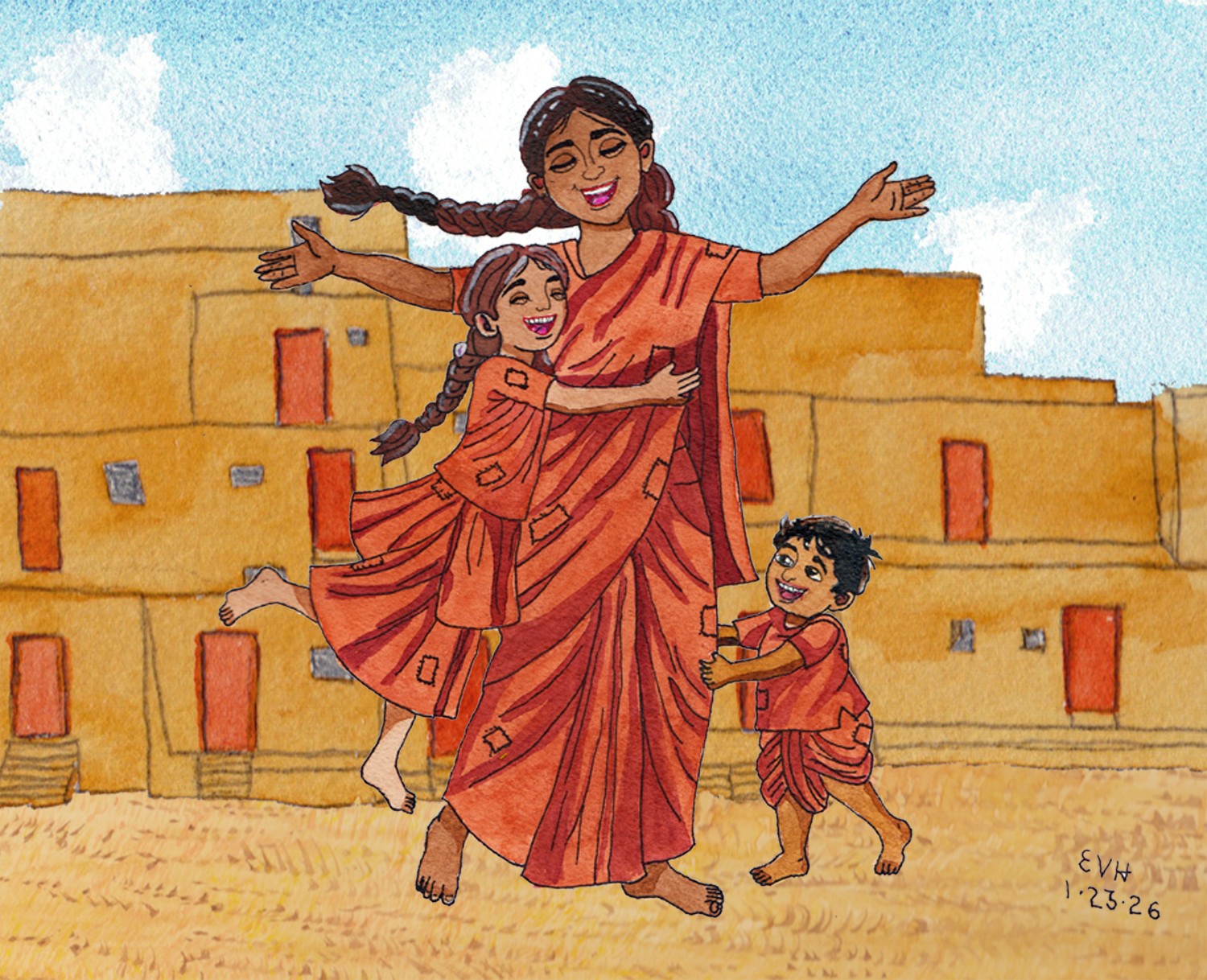 Figure: The happy family is reunited.
At that moment the hills resounded, the earth quaked, the great ocean was troubled, and Sineru, king of mountains, bent down. The six realms of the gods were all one mighty sound. Sakka, king of the gods, saw that six royal personages and their attendants lay senseless on the ground, and not one of them could arise and sprinkle the others with water. So he resolved to produce a shower of rain. This he did, so that those who wished to be wet were wet, and those who did not, not a drop of rain fell upon them, but the water ran off as it runs from a lotus-leaf. That rain was like rain that falls on a clump of lotus-lilies. The six royal persons were restored to their senses, and all the people cried out at the marvel, how the rain fell on the group of kinsfolk, and the great earth did quake.
This the Master explained as follows:
“When these of kindred blood were met, a mighty sound outspake,
That all the hills reechoed round, and the great earth did quake.
“God brought a mighty cloud wherefrom he sent a shower of rain,
When as the King Vessantara his kindred met again.
“King, queen, and son, and daughter-in-law, and grandsons, all were there,
When they were met their flesh did creep with rising of the hair.
The people clapped their hands and loud made to the king a prayer:
“’They called upon Vessantara and Maddī, one and all,
‘Please be our lord, be king and queen, and listen to our call!’”
Then the Great Being addressed his father:
“You and the people, countryfolk and townsfolk, banished me,
When I upon my royal throne was ruling righteously.”
The king replied, to allay his son’s resentment:
“It was ill done of me indeed to ruin the innocent,
When by the people’s voice I drove my son to banishment.”
After reciting this verse, he added yet another, to ask for relief from his own sorrow:
“A father’s or a mother’s pain, or sister’s, to relieve,
A man should never hesitate his very life to give.”
The Bodhisatta, who wanted to resume his royalty, had refrained from saying so to inspire respect. But now agreed, whereupon the 60,000 courtiers—his birth mates—cried out—
“‘Tis time to wash, O mighty king—wash off the dust and dirt!”
But the Great Being replied, “Wait a little.” Then he entered his hut, took off his hermit’s dress, and put it away. Next he came out of the hut and said, “This is the place where I have spent nine months and a half in ascetic practices, where I attained the summit of perfection in giving, and where the earth did quake.” Three times he went about the hut right-wise and made the five-fold prostration before it. Then they attended to his hair and beard. They poured the water of consecration over him while he shone in all his magnificence like the king of the gods. So it is said,
“Then did the King Vessantara wash off the dust and dirt.”
His glory was great. Every place that he looked on quaked. Those skilled in auspicious words uttered them. They played all manner of musical instruments. There was a sound like the noise of thunder over the mighty ocean. They brought the precious elephant richly adorned. And girding himself with a priceless sword, he mounted the precious elephant while the 60,000 courtiers—his birth mates—surrounded him in gorgeous array.
They also bathed Maddī and adorned her and sprinkled her with the water of consecration. As they poured the water they cried aloud, “May Vessantara protect you!” and other words of good omen.
The Master explained it in this way:
“With washen head and goodly robes and ornaments of state,
Girt with his awful sword he rode the elephant his mate.
“And then the sixty thousand chiefs, so beauteous to view,
His birth mates, came about their lord and did obeisance due.
“The women then bathed Maddī, and all together pray—
“Vessantara and Sañjaya preserve you all alway!”
“Thus reestablished, and their past trouble remembering,
There in the pleasant master’s land they made a merry cheer.
“Thus reestablished, and the past trouble remembering,
Happy and glad the lady went with her own children dear.”
So in happiness she said to her children:
“I only ate one meal a day, I slept upon the ground,
That was my vow for love of you until you should be found.
“But now my vow is brought to pass, and now again I pray,
What good so ever we have done preserve you both alway,
And may the great King Sañjaya preserve you both always.
“What good so ever has been done by father or by me,
By that truth grow you never old, immortal do you be.”
Queen Phusatī added, “Henceforth let my daughter-in-law be robed in these robes, and let her wear these ornaments!” These she sent her these in boxes.
This the Master explained this:
“Garments of cotton and of silk, linen and cloth so fine
Her mother-in-law to Maddī sent which made her beauty shine.
“Necklet and bracelet, frontlet-piece, foot-bangle, jeweled zone
Her mother-in-law to Maddī sent, wherewith her beauty shone.
“And when the princess passing fair her jewelry surveyed,
She shone, as shines in Nandana the goddesses arrayed.
“With washen head and ornaments and goodly robes to see,
She shone, like to some heavenly nymph before the Thirty-Three.
“As when in Cittalatā Grove the wind a plantain sways,
The princess of the beauteous lips looked lovely as that tree.
“Like as a brilliant-feathered bird that flies the airy ways,
She with her pretty pouting lips and beauty did amaze.
“They brought a fine young elephant, a mighty and a strong,
Which neither spear nor battle din could fright, whose tusks were long.
“She mounts upon the elephant, so mighty and so strong,
Which neither spear nor battle din could fright, whose tusks were long.”
So in great pomp the two proceeded to the camp. King Sañjaya and his innumerable host amused themselves in hill sports and woodland sports for a whole month. During that time, by the Great Being’s glory, no harm was done in all that great forest by wild beast or bird.
The Master explained it:
“By glory of Vessantara, through all that mighty wood,
No beast or bird did any harm to the others, all did good.
“And when he was to go away, they all with one consent,
Birds, beasts, and all the creatures of the wood, together went,
But silent were all pleasant sounds when he had left the wood.”
After a month’s merry-making, Sañjaya summoned his captain-in-chief and said, “We have stayed a long time in the forest. Is the road ready for my son’s return?” He replied, “Yes, my lord, it is time to go.” He sent word to Vessantara, and with his army, they departed. With all his host they followed the road that had been prepared from the heart of Vaṁka hill to the city of Jetuttara.
The Master explained this as follows:
“The royal road was newly made, with flowers and bunting fair arrayed
From where he lived in forest glade down to the town Jetuttara.
“His sixty thousand mates around, and boys and women places found,
Brahmins and Vesiyas, homeward bound unto the town Jetuttara.
“There many an elephant mahout, the charioteers and men afoot,
With all the royal guard to boot were going to Jetuttara.
“Warriors that skulls or breatsplates wore, of mailed men with swords good store,
To guard the prince went on before down to the town Jetuttara.”
The king traveled this journey of 60 leagues in two months. He then entered Jetuttara. The city was decorated to receive him. He went up to the palace.
The Master explained this:
“Then they entered the fair city, with walls and arches high,
With songs and dances, food and drink in plentiful supply.
“Delighted were the country folk and people of the town
To welcome back to Sivi land their prince of high renown.
“All waved their kerchiefs in the air to see the giver come,
Now is a jail-delivery proclaimed by beat of drum.”
So King Vessantara set free all creatures, down to the very cats. And on the day that he entered the city, in the evening, he thought, “When day dawns, the suitors who have heard of my return will come. And what shall I give them?” At that moment Sakka’s throne grew hot. He pondered what to do. Then he brought down a rain of the seven kinds of jewels like a thundershower, filling the back and front of the palace with them waist-high, and over all the city knee-deep. On the next day, he allotted this or that place to various families and let them pick up the jewels. To the the rest he had collected and placed in his home treasure. And in his treasuries he always had enough to give in future.
This the Master explained as follows:
“When as Vessantara came back, Sivi’s protector king,
The god a shower of precious gold upon the place did bring.
“So when Vessantara the prince his generous gifts had given,
He died at last, and fully wise, he passed away to heaven.”
When the Master had ended this discourse of Vessantara with its thousand stanzas, he identified the birth: “At that time, Devadatta was “Jūjaka,” the lady Cincā was “Amittatāpanī,” Channa was “Cetaputta,” Sāriputta was the ascetic “Accuta,” Anuruddha was “Sakka,” King Suddhodana was “King Sañjaya,” Mahāmāyā was “Phusatī,” Rāhula’s mother was “Queen Maddī,” Rāhula was “Prince Jāli,” Uppalavaṇṇā was “Kaṇhājinā,” the followers of Buddha were the rest of the people, and I was King Vessantara.”
(Devadatta was the Buddha’s cousin and enemy, Cincā was a female ascetic manipulated by rival heretics to falsely accuse the Buddha of impregnating her, Channa was the Buddha’s charioteer in his lay life and a monk, Sāriputta was one of the Buddha’s two chief disciples, Anuruddha was the Buddha’s cousin and a monk, Suddhodana was the Buddha’s father, Mahāmāyā was the Buddha’s mother, “Rāhula’s mother” was “Yasodhara,” the Buddha’s wife in lay life, Rāhula was the Buddha’s son and a monk, and Uppalavaṇṇā was one of the Buddha’s most gifted nuns.)
