The Noble Eightfold Blog
The Buddhist Cosmology
by Eric Van Horn
Copyright © 2025 Eric K. Van Horn
for free distribution
You may copy, reformat, reprint, republish, and redistribute this work in any medium whatsoever without the author’s permission, provided that: (1) such copies, etc. are made available free of any charge; (2) any translations of this work state that they are derived herefrom; (3) any derivations of this work state that they are derived and differ herefrom; and (4) you include the full text of this license in any copies, translations or derivations of this work. Otherwise, all rights reserved.
“But how is it, Master Gotama, are there gods?”
“It is known to me to be the case, Bhāradvāja, that there are gods.” — [MN 100.42]
There are two ways in which the Buddhist cosmology is expressed. One of them is a simpler one and can be thought of as a general classification. The other one is more complicated and fits into the framework of the first one.
In the simpler formulation, Buddhism recognizes six realms. Three of these are higher rebirths, and three of them are lower rebirths:
1. The god realm, heavenly realm
2. The human realm
3. The realm of the asuras, demigods, or titans
4. The realm of hungry ghosts or spirits
5. The animal realm
6. The hell realm
The more complicated cosmology seems to have evolved over time. The Pāli Canon does not give a complete description of it anywhere. It was formalized in the centuries after the Buddha’s death. He never gave a discourse on the topic. However, many of the realms described here show up in his discourses such as the Mahasamaya Sutta. The rest of them come from later works like the Abhidhamma and the Visuddhimagga.
This expanded cosmology contains 31 realms plus the unconditioned realm, making 32. Thirty-two is a sort of magic number in ancient India. For example, they believed that a great man would have 32 marks. So the inference is that the cosmology was modified to fit that number.
A few years ago I heard a talk by Bhikkhu Bodhi on the Buddhist cosmology, and midway through it someone asked him, rather incredulously, “Do you think this is true?” His response was “I think something like this is true.” That is the way to think of it. It is not necessarily literal fact, but something like this is true.
Practically, the most important point is that we live in these realms, being born and reborn repeatedly. Each time we are reborn according to our karma, and more precisely the karma that manifests at the time of rebirth.
The Realms of Existence
The word "eon" is the English translation of the Sanskrit word "kalpa" (Pāli: "kappa""). In both Hinduism and Buddhism, a kalpa is a life of the universe (i.e., the time between the creation and recreation of a universe). In Western scientific terms this is the time between big bangs.
A celestial year is 360 celestial days. A celestial day equals 50 human years in the lowest heaven (“the four great kings”) and doubles with each level. In other words, it’s a long time.
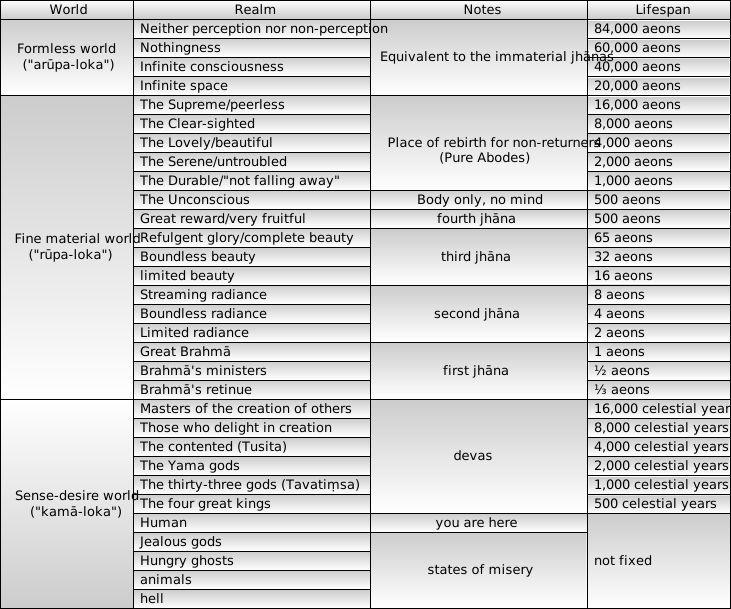
So starting from the top down, if—when you die—you have mastered the eighth jhāna, the sphere of neither perception nor non-perception, you will be reborn into the highest formless world. You will be there for 84,000 eons. And so on down the line to the heavenly realm of Brahmā’s retinue. This is the lowest heavenly realm that corresponds to a mastery of jhāna. Thus there is a mapping between the human mind and human consciousness and the highest 20 heavenly realms.
Just below that are the six heavenly realms of the devas. Devas are similar to humans, but happier, longer-lived, and more powerful. Because devas are close to human beings in the hierarchy, there are people who can see them. Bhikkhu Bodhi says that at the monastery in Sri Lanka where he was, there was a valley next to the monastery where lots of devas lived. Some of the monks could see them. Devas also know where they are not welcome and where human beings are not well-behaved. You are unlikely to find devas in highly materialistic societies. You are more likely to find them in the jungles of Thailand or the backwoods of Bhutan.
Going below the human realm, you can see the places where you don’t want to go. These realms also map to human consciousness. Hell maps to anger in human consciousness. You probably know people who are angry all the time. This is the hell realm manifesting in a human life. The amount of time someone spends in a hell realm depends on their karma. A basically good person who has some bad karma manifesting may be there for a brief time. Someone who is especially cruel will be there for a very long time, perhaps eons.
There are those who believe that Christians got their notion of hell from Buddhism. You may have heard that in Jesus’ lost 40 days in the desert, he went to India where Buddhism influenced him. Buddhism was in its heyday in India at that time. It had been in India for about 400 years by Jesus’ time, and it was well-established by then. Many early Christians, including St. Augustine, believed in reincarnation.
The primary characteristic of the animal realm is that animals only behave according to their nature. Lions are lions and monkeys are monkeys; alligators are alligators. You also see this at play in the human world where some people do not exercise any filters or judgment in their behavior. One of the qualities that we cultivate in our practice is the ability to exercise choice and not to be victims of our thoughts, emotions, and impulses.
Hungry ghosts (Pāli: "peta"") have unquenchable desire. They are usually depicted with huge stomachs and very small throats; their hunger is never satisfied. This is a metaphor for all types of desire. You may know people like this; no matter how much they have, it is never enough. People like this are never happy; they are never contented. They are hungry ghosts living in the human realm, and they may be reborn in the hungry ghost realm.
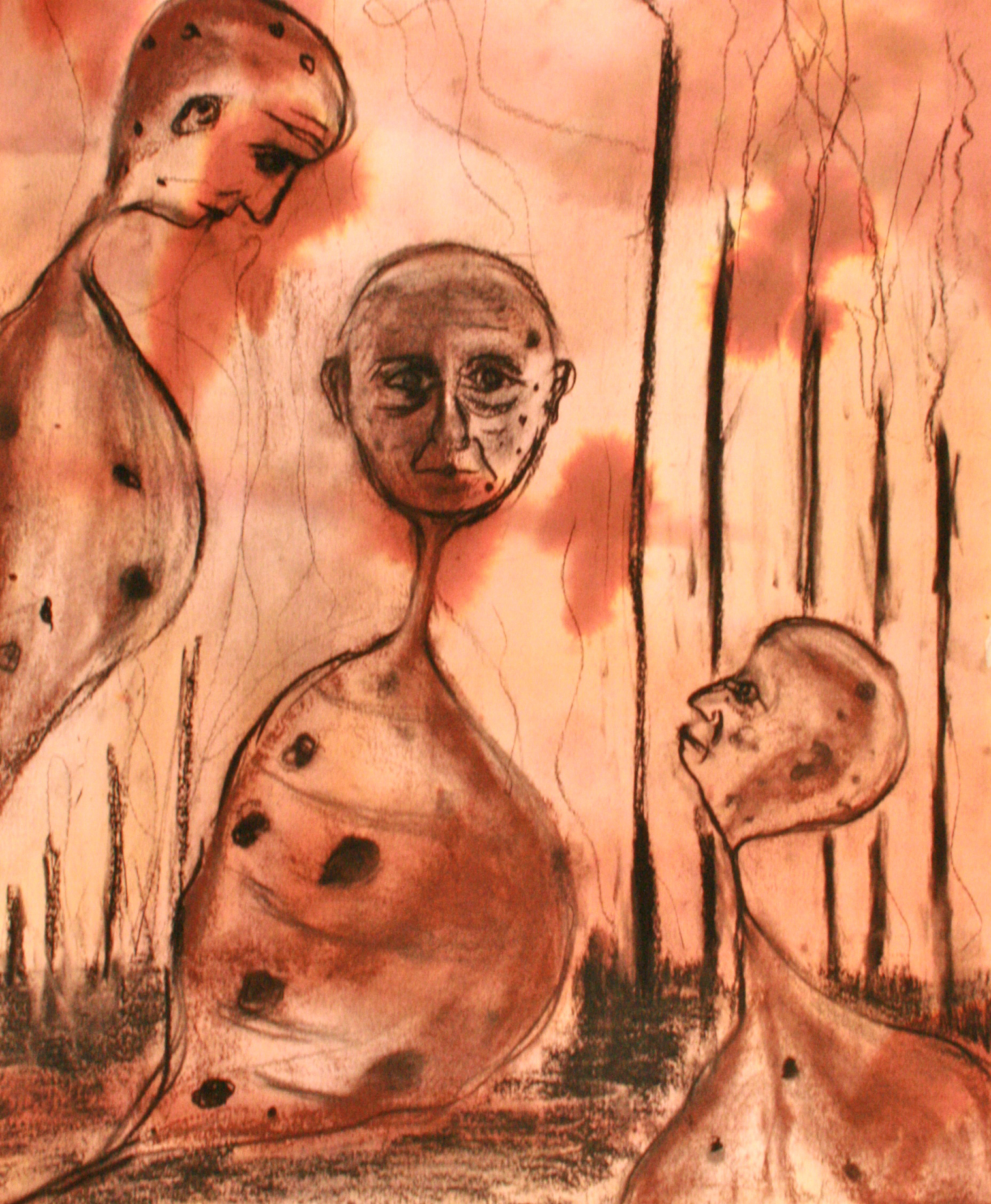
Hungry ghosts play an important part in the Buddha’s teaching. The foundation of the path is generosity. Generosity is the feeling that you have more than enough, so much so that you can give some away. All our conditioned experience—the prison of saṃsara in which we find ourselves—is because we are constantly feeding, wanting, craving and clinging, and generosity is the antidote for that.
Finally there are the asuras, the jealous gods: The jealous gods (Pāli: "asura"") are self-absorbed, egotistical, violent, angry with everyone, always looking for a fight. They are addicted to their passions. The Zen patriarch Zhiyi says this about the asuras:
“Always desiring to be superior to others, having no patience for inferiors and belittling strangers; like a hawk, flying high above and looking down on others, and yet outwardly displaying justice, worship, wisdom, and faith—this is raising up the lowest order of good and walking the way of the Asuras.” — [Wikipedia, “Asura (Buddhism)”]
I want to make special mention of two of the heavenly realms because they show up frequently in the Canon. The first is the "Tusita" heaven (Sanskrit: "Tuṣita""). "Tusita" literally means “contented.” That is how it is labeled in the table. It is the fourth of the deva realms and is the heaven about the Yama realm. It is where the Buddha existed before being reborn in the human realm where he became the Buddha. The Buddha’s famous lay disciple Anāthapiṇḍika and the Buddha’s birth mother Maya Devi were reborn there. Contentment is one of the factors of the second jhāna. If you ever enter the second jhāna, this may give you a sense of what it is like to be in the Tusita heaven.
The second one is the "Tāvatiṃsa" (Sanskrit: "Trāyastriṃśa"") heaven. This is also called “the heaven of the thirty-three gods.” The Buddha visited Maya Devi there to teach her the Dharma. (Maya Devi died a week after giving birth to him.) She had descended from the Tusita heaven to meet him there. It is believed that the Buddha manifested in the Tāvatiṃsa heaven before his final rebirth in the human realm.
There are a couple of ways to make sense of this. First, I don’t think it is too hard to see into the lower realms of hell, the animal realm, and the (hungry) ghost realm. And of course we have pretty good evidence for the human realm.
Above that we have the heavenly realms. It starts with the heavenly realms of the devas. Above that are the heavenly realms of Brahmā, the supreme god. And above that are the immaterial realms, the ones that map to the immaterial jhānas. So that is a simpler way to think about them.
But another way to think about them is something you may have already discerned, and that is how they map to human consciousness. Hell maps to anger. The animal realm maps to reactivity and impulse. The hungry ghost realm maps to lust and craving.
The heavenly realms map to happy, joyful, blissful qualities. Beings are reborn there according to their good qualities and their virtue.
The danger is, of course, that when we are in a higher realm, there will be the inevitable fall. This is why we strive to free ourselves from saṃsara and the rounds of rebirth. That is one of the most important lessons to take from this understanding of the cosmology.
