
Jataka 545
Vidhurapaṇḍita Jātaka
The Wise Vidhura
as told by Eric Van Horn
originally translated by H.T. Francis and R.A. Neil, Cambridge University
originally edited by Professor Edward Byles Cowell, Cambridge University
This story has some particularly poetic passages. One is a charming argument—of sorts—between three friends and kings about who has greater virtue. The wise Vidhura resolves the matter to the satisfaction of all, and they praise his wisdom.
The first is a lengthy one in which the Buddha instructs his family, friends, and colleagues on how to be a good minster to the king. This is at the beginning of section V. Admittedly, it can sound a bit like propaganda by the King’s Society on how to behave towards them and to be loyal to them. But there is also an underlying message of devotion. This, of course, assumes that the king is a good one. But in this case, I think we can assume that to be true.
The second one is when Vidhura teaches the four duties of a good man to his captor, the Yakkha Puṇṇaka. This Dharma teaching turns Puṇṇaka from someone of evil intent into a much kinder person. The third is the interaction between the Vidhura and—first—the Nāga king Varuṇa and then his queen, Vimalā. They both express surprised that Vidhura is not afraid of them. But he teaches the Dharma, and they both yield to his wisdom.
Enjoy.
“You are pale and thin and weak.” The Master told this story while he was living in Jetavana. It is about the Perfection of Wisdom. One day the monks started a discussion in the Dharma Hall. They said, “Sirs, the Master has great and wide wisdom. He is ready and quick-witted. He is sharp and keen-witted and able to crush the arguments of his opponents. Using the power of his wisdom, he overthrows the subtle questions expounded by Khattiya sages (Khattiya was the warrior class) and reduces them to silence. Then he establishes them in the three Refuges (Buddha, Dharma, and Saṇgha) and the moral precepts, causing them to enter on the path that leads to immortality.”
The Master entered and asked what was the topic that the monks were discussing. When he heard what it was, he said, “It is not wonderful, brothers, that the Tathāgata—having attained the Perfection of Wisdom—should overthrow the arguments of his opponents and convert Khattiyas and others. For in the earlier ages, when he was still seeking supreme knowledge, he was wise and able to crush the arguments of his opponents. Yet, truly, in the time of Vidhurakumāra (a wise minister), on the summit of the Black Mountain, which is sixty leagues in height, by the force of wisdom I converted the Yakkha general, Puṇṇaka. I reduced him to silence and made him give his own life as a gift.” And so saying, he told them this story from the past.
I.
Once upon a time in the Kuru kingdom in the city of Indapatta, a king named “Dhanañjaya-korabba” ruled. He had a minister named “Vidhurapaṇḍita” who taught his views about temporal and spiritual matters. He had a sweet tongue and great eloquence in speaking about the law. He transfixed all the kings of Jambudīpa (India) with his sweet discourses concerning the law as elephants are fascinated by a favorite lute. He did not travel to their kingdoms. He lived in that city in great glory, teaching the Dharma to the people with all the power of a Buddha.
Now there were four rich brahmin householders in Benares. They were friends who had seen the misery of sensual desires. They went to the Himalaya and embraced the ascetic life. And having entered the transcendental faculties (faith, energy, mindfulness, concentration, and wisdom) and the mystical meditations (jhāna), they lived there a long time there, feeding on the forest roots and fruits. And then, as they went on their rounds to procure salt and sour condiments, they went to beg in the city of Kālacampā in the kingdom of Aṇga.
There, four householders who were friends were pleased with their deportment. They paid them respect, and taking their begging vessels, they waited on them with choice food, each in his own house. Then they took their promise (to stay) and arranged a home for them in their garden.
So the four ascetics, having taken their food in the houses of the four householders, went off to pass the day. One went to the heaven of the Thirty-three, another to the world of the Nāgas, another to the world of the Supaṇṇas (garuḍas), and the fourth to the park Migācira that belonged to the Koravya king.
Now the one who spent his day in the world of the gods, after beholding Sakka’s glory, described it in full to his attendant. Likewise, so did the ones who spent the day in the Nāga and Supaṇṇa world, and so, too, the one who spent his day in the park of the Koravya king Dhanañjaya. Each described in full the glory of that respective king. So these four attendants desired these heavenly realms, and having performed gifts and other works of merit, at the end of their lives, one was born as Sakka, another was born with a wife and child in the Nāga world, another was born as the Supaṇṇa king in the palace of the Simbali lake, and the fourth was conceived by the chief queen of King Dhanañjaya. The four ascetics were born in the Brahma world.
The Koravya prince grew up, and on his father’s death, he assumed his kingdom and ruled in righteousness. But he was famed for his skill in dice. He listened to the instruction of Vidhurapaṇḍita. gave alms, kept the moral law, and observed the fast. One day when he had undertaken the fast, he went into the garden determined to practice pious meditation. He seated in a pleasant spot and performed the duties of an ascetic.
Sakka, likewise, having undertaken to keep the fast, found that there were obstacles in the world of the gods. So he went into that very garden in the world of men. And having seated himself in a pleasant spot, he also performed the duties of an ascetic.
Likewise, Varuṇa, the Nāga king, undertook to keep the fast. Likewise, he found that there were obstacles in the Nāga world. So he went into that same garden. And having seated himself in a pleasant place, he performed the duties of an ascetic.
And finally, the Supaṇṇa king, also having undertaken to keep the fast, found that there were obstacles in the Supaṇṇa world. So he went into that same garden. And having seated himself in a pleasant spot, he performed the duties of an ascetic.
Then these four, having risen from their places at evening time stood on the bank of the royal lake. They came together and looked at one another. They were filled with their old kindly affection. They rekindled their former friendships and sat down with a pleasant greeting. Sakka sat down on a royal seat, and the others seated themselves as befitted the dignity of each. Then Sakka said to them, “We are all four kings. Now what is the greatest virtue of each?” Varuṇa, the Nāga king, replied, “My virtue is superior to that of you three.” And when they asked why, he said, “This Supaṇṇa king is our enemy, whether before or after we are born. Yet even when I see him as such a destructive enemy of our race, I never feel any anger. Therefore, my virtue is superior.” And he then uttered the first stanza of the Catuposatha Jātaka (Jātaka 441):
“The good man who feels no anger towards one who merits anger, and who never lets anger arise within him, he who even when angered does not allow it to be seen, him they indeed call an ascetic.”
“These are my qualities. Therefore, my virtue is superior.”
The Supaṇṇa king, hearing this, said, “This Nāga is my chief food. But even though I see such food at hand, I endure my hunger and do not commit evil for the sake of food. Therefore, my virtue is superior.” And he uttered this stanza:
“He who bears hunger with a pinched belly, a self-restrained hermit who eats and drinks by rule and commits no evil for the sake of food, him they indeed call an ascetic.”
Then Sakka, the king of the gods, said, “I left behind various kinds of heavenly glory, all immediate sources of happiness, and I came to the world of mankind to maintain my virtue. Therefore, my virtue is superior.” And he uttered this stanza:
“Having abandoned all sport and pleasure, he utters no false word in the world. He is averse to all outward pomp and sensual desire. Such a man they indeed call an ascetic.”
In this way Sakka described his virtue.
Then King Dhanañjaya said, “Today I abandoned my court and my harem with 16,000 dancing girls so I could practice an ascetic’s duties in a garden. Therefore, my virtue is superior.” And he added this stanza:
“Those who with full knowledge abandon all that they call their own and all the workings of lust, he who is self-restrained, resolute, unselfish, and free from desire, him they indeed call an ascetic.”
In this way they each declared their own virtue as superior. Then they asked Dhanañjaya, “O king, is there any wise man in your court who could solve this doubt?” “Yes, O kings, I have Vidhura-paṇḍita. He holds a post of unequalled responsibility and declares civil and ecclesiastical law. He will solve our doubts. We will go to him.” They at once consented.
So they all went out of the garden and proceeded to the hall for holy assemblies. And, having ordered it to be adorned, they seated the Bodhisatta on a high seat. They offered him a friendly greeting, sat down on one side, and said, “O wise sir! A doubt has risen in our minds. Please solve it for us:”
“We ask you, the minister of lofty wisdom. A dispute has arisen in our discussion. Please consider and solve our questions today. Through you, let us escape from our doubt today.”
Hearing their words, the wise man replied, “O kings, how shall I know what you said well or ill concerning your virtue as you uttered the stanzas in your dispute?” And he added this stanza:
“Those wise men who know the real state of things and who speak wisely at the proper time, how shall they, however wise, draw out the meaning of verses which have not been uttered to them? How does the Nāga king speak, how Garuḷa, the son of Vinatā? Or what says the king of the Gandhabbas? Or how speaks the most noble king of the Kurus?”
Then they uttered this stanza to him:
“The Nāga king preaches forbearance, Garuḷa, the son of Vinatā, gentleness, the king of the Gandhabbas preaches abstinence from sensual lust, and the most noble king of the Kurus preaches freedom from all hindrances to holy perfection.”
Having heard their words, the Great Being uttered this stanza:
“All these sayings are well spoken. There is nothing here uttered amiss. And he in whom these are properly fitted like the spokes in the nave of a wheel, he, who is endowed with these four virtues, is called an ascetic indeed.”
In this way the Great Being declared the virtue of each of them to be one and the same. When they heard him, the four were well pleased. They uttered this stanza in his praise:
“You are the best. You are incomparable. You are wise, a guardian and knower of the law. Having grasped the problem by your wisdom, you remove all doubts with your skill as the ivory-workman the ivory with his saw.”
All the four were pleased with his response to their question. Then Sakka rewarded him with a robe of heavenly silk, Garuḷa with a golden garland, Varuṇa the Nāga king with a jewel, and King Dhanañjaya with a thousand cows. Then Dhanañjaya addressed him in this stanza:
“I give you a thousand cows and a bull and an elephant, and these ten chariots drawn with thoroughbred horses, and 16 excellent villages, being well pleased with your solution of the question.”
Then Sakka and the rest, having paid honor to the Great Being, departed to their own realms. Here ends the section of the fourfold fast.
II.
Now the queen of the Nāga king was Lady Vimalā. When she saw that there was no jeweled ornament around his neck, she asked him where it was. He replied, “I was pleased at hearing the moral discourse of Vidhura-paṇḍita, the son of the Brahmin Canda. So, I presented the jewel to him. And not only I, but Sakka honored him with a robe of heavenly silk. The Supaṇṇa king gave him a golden garland, and King Dhanañjaya gave him a thousand oxen and many other things besides.” “He is, I suppose, eloquent in the Dharma.” “Lady, what are you talking about? It is as if a Buddha had appeared in Jambudīpa! A hundred kings in all Jambudīpa, being caught in his sweet words, do not return to their own kingdoms, but remain like wild elephants fascinated by the sound of their favorite lute. This is the quality of his eloquence!”
When she heard this account of his preeminence, she longed to hear him preach about the Dharma. She thought in herself, “If I tell the king that I long to hear him teach the Dharma, and I ask him to bring him here, he will not bring him to me. What if I pretend to be ill and complain of a sick woman’s longing?” So she gave a sign to her attendants, and she took to her bed.
The king went to visit her, but he did not see her. He asked the attendants where Vimalā was. They replied that she was sick. He went to see her. He sat on the side of her bed and rubbed her body as he repeated a stanza:
“Pale and thin and weak, your color and form is not like this before. O Vimalā, answer my question. What is this pain of the body that has come upon you?”
She told him in the following:
”There is an affection in women. It is called a longing, O king. O monarch of the Nāgas, I desire Vidhura’s heart brought here without guile.”
He replied to her:
“You long for the moon or the sun or the wind. The very sight of Vidhura is hard to get. Who will be able to bring him here?”
When she heard his words, she exclaimed, “I will die if I do not obtain this.” She turned around in her bed and showed her back and covered her face with the end of her robe. The Nāga king went to his own chamber and sat on his bed and pondered how determined Vimalā was on obtaining Vidhura’s heart. “She will die if she does not obtain the flesh of his heart. How can I get it for her?”
Now his daughter Irandatī, a Nāga princess, arrived in all her beauty and ornaments to pay her respects to her father. She saluted him and stood on one side. She saw that his countenance was troubled, and she said to him, “You are greatly distressed. What is the reason?”
“O father, why are you full of care? Why is your face like a lotus plucked by the hand? Why are you sad, O king? Do not grieve, O conqueror of enemies.”
Hearing his daughter’s words, the Nāga king answered:
“Your mother, O Irandatī, desires Vidhura’s heart. But the very sight of Vidhura is hard to get. Who will be able to bring him here?”
Then he said to her, “Daughter, there is no one in my court who can bring Vidhura here. Give life to your mother and seek out some husband who can bring Vidhura.”
So he dismissed her with a half-stanza, suggesting improper thoughts to his daughter:
“Seek out a husband who can bring Vidhura here.”
And when she heard her father’s words, she went out into the night and gave passionately of her desire.
As she went, she gathered all the flowers in the Himalaya that had color, scent, or taste. And having adorned the entire mountain like a precious jewel, she spread a couch of flowers on it. Then she did a pleasant dance, and she sang a sweet song:
“What gandhabba or demon, what Nāga, kimpurasa or man, or what sage, able to grant all desires, will be my husband the livelong night?”
(Gandhabbas are celestial musicians. Kimpurasas are mythical creatures, usually an animal or spirit.)
Now at that time the nephew of the great king Vessavana, the Yakkha general “Puṇṇaka,” was riding on a magic Sindh horse. It was three leagues in length. And hastening over the red arsenic surface of the Black Mountain to a gathering of the Yakkhas, he heard that song of hers. The voice of a woman he had heard in his previous life pierced his skin and nerves and penetrated to his very bones. And being fascinated by it, he turned back, seated as he was on his Sindh horse. He comforted her, saying, “O lady, I can bring you Vidhura’s heart by my knowledge, holiness, and calmness. Do not be anxious about it.” And he added this verse:
“Be comforted. I will be your husband. I will be your husband. O you of faultless eyes, truly my knowledge is such. Be comforted. You shall be my wife.”
Then Irandatī answered, with her thoughts following the old experience of a wooing in a former birth. “Come, let us go to my father. He will explain the matter to you.”
Adorned, clad in bright raiment, wearing garlands, and anointed with sandal, she seized the Yakkha by the hand, and they went into her father’s presence.
And Puṇṇaka, having taken her back, went to her father, the Nāga king, and asked for her as his wife:
“O Nāga chief, hear my words, receive a fitting present for your daughter. I ask for Irandatī. Give her to me as my possession. A hundred elephants, a hundred horses, a hundred mules and chariots, a hundred complete wagons filled with all sorts of gems, take all these, O Nāga king, and give me your daughter Irandatī.”
Then the Nāga king replied:
“Wait while I consult my kinsmen, my friends, and acquaintances. Any business done without consultation leads to regret afterwards.”
Then the Nāga king, having entered his palace, spoke these words as he consulted his wife, “This Puṇṇaka, the Yakkha, asks me for Irandatī. Should we give her to him in exchange for much wealth?”
Vimalā answered:
“Our Irandatī is not to be won by wealth or treasure. If he brings the sage’s heart here by his own worth, the princess shall be won by that wealth. We ask for no further treasure.”
Then the Nāga Varuṇa went out from his palace, and consulting with Puṇṇaka, he addressed him:
“Our Irandatī is not to be won by wealth or treasure. If you bring the sage’s heart here by your own worth, the princess will be won by that wealth. We ask for no further treasure.”
Puṇṇaka replied:
“He who some call a sage, others will call a fool for they utter different views. Who is he who you call a sage, O Nāga?”
The Nāga king answered:
“If you have heard of Vidhura the minister of the Koravya king Dhanañjaya, bring that sage here and let Irandatī be your lawful wife.”
Hearing Varuṇa’s words, the Yakkha sprang up greatly pleased. He said to his attendant, “Bring me my thoroughbred fully harnessed.”
With ears of gold and hoofs of ruby, and mail-armor of molten gold, the man brought the Sindh horse thus adorned. Puṇṇaka mounted him. Then he went through the sky to Vessavana and told him of the adventure. There he described the Nāga world in this way:
“Puṇṇaka, having mounted his horse, a charger fit for bearing the gods, himself richly adorned and with his beard and hair trimmed, went through the sky.”
Puṇṇaka, greedy with the passion of desire, longing to win the Nāga maiden Irandatī, went to the glorious king. He said to Vessavana Kuvera:
“There is the palace Bhogavatī called the Golden Home, the capital of the snake kingdom erected in its golden city.
Watch-towers which mimic lips and necks, with rubies and cat’s eye jewels. There are palaces built of marble and rich with gold and covered with jewels inlaid with gold.
There are Mangoes, tilaka-trees and rose-apples, sattapaṇṇas, mucalindas and ketakas, piyakas, uddālakas and sahas, and sinduvāritas with their wealth of blossom above.
Champacs, Nāgamālikās, bhaginīmālās, and jujube trees, all these different trees bending with their boughs, lend their beauty to the Nāga palace.
There is a huge date palm made of precious stones with golden blossoms that do not fade, and there lives the Nāga king Varuṇa, endowed with magical powers and born of supernatural birth.
There lives his queen Vimalā with a body like a golden creeper, tall like a young kālā plant, fair to see with her breasts like nimba fruits.
She is fair-skinned and painted with lac dye, like a kaṇikāra tree blossoming in a sheltered spot, like a nymph dwelling in the deva world, like lightning flashing from a thick cloud.
Bewildered and full of a strange longing, she desires Vidhura’s heart. I will give it to them, O king. They will give me Irandatī for it.”
As he dared not go without Vessavana’s permission, he repeated these stanzas. But Vessavana did not listen to him because he was busy settling some dispute about a palace between two sons of the gods. Puṇṇaka, knowing that his words were not heard, remained near until one of the two disputants proved victorious in the contest. Vessavana, having decided the dispute, took no thought of the defeated candidate, but said to the other, “Go and live in your palace.”
Puṇṇaka called some sons of the gods as witnesses, saying, “You see that I am sent by my uncle.” He ordered his steed to be brought and mounted it, and then he set out.

The Teacher then described what took place:
“Puṇṇaka, having bidden farewell to Vessavana Kuvera, the glorious lord of beings, thus gave his command to his servant standing there. ‘Bring my thoroughbred, with ears of gold, hoofs of ruby, and mail-armor of molten gold, harnessed.’ Puṇṇaka mounted the god-bearing steed, well-adorned, and with his beard and hair well-trimmed, went through space into the sky.”
As he went through the air he pondered, “Vidhura-paṇḍita has a great retinue, and he cannot be taken by force. But Dhanañjaya Koravya is renowned for his skill in gambling. I will conquer him in play and so seize Vidhura-paṇḍita. Now there are many jewels in his house. He will not play for any poor sum. I will have to bring a jewel of great value. The king will not accept a common jewel. Now there is a precious jewel of price belonging to the universal monarch. It is in the Vepulla Mountain near the city Rājagaha. I will take that and entice the king to play. In that way, I will defeat him.” And so he did.
The Teacher declared the whole story:
“He went to pleasant Rājagaha, the far-off city of Aṇga. It was rich in provisions and abundant with food and drink. Like Masakkasāra, Indra’s capital, filled with the notes of peacocks and herons, resonant, full of beautiful courts, and with every kind of bird like the mountain Himavat covered with flowers. So Puṇṇaka climbed Mount Vepulla with its heaps of rocks inhabited by kimpurisas. He sought the glorious jewel. And at last, he saw it in the middle of the mountain.
When he saw the glorious precious gem flashing light, gleaming splendidly with its beauty, shining like lightning in the sky, he seized the precious lapis lazuli, the jewel of priceless value. Then he mounted his peerless steed, himself of noble beauty, and he rushed through space in the sky.
He went to the city Indapatta. There he landed in the court of the Kurus. The fearless Yakkha summoned the hundred warriors who were gathered there.
“Who wishes to conquer the prize of kings from us? Or who will we conquer in the contest of worth? What peerless jewel will we win? Or who will win our best of treasures?”
In these four lines he praised Koravya.
Then the king thought to himself, “I have never before seen a hero like this who uttered such words. Who can it be?” He asked him in this stanza:
“In what kingdom is your birthplace? These are not the words of a Koravya. You surpass us all in your form and appearance. Tell me your name and family.”
He reflected, “This king asks my name. Now I am the servant “Puṇṇaka.” But if I tell him that I am Puṇṇaka, he will say, “He is a servant. Why does he speak to me so audaciously?” And he will despise me. I will tell him my name from my last past birth.” So he uttered a stanza:
“I am a youth named ‘Kaccāyana,’ O king. They call me one of no mean name. My family and friends are in Aṇga. I have come here for the sake of play.”
Then the king asked him, “What will you give me if you are conquered in play? What have you got?” And he uttered this stanza:
“What jewels has the youth, which the gamester who conquers him may win? A king has many jewels. How can you, a poor man, challenge them?”
Then Puṇṇaka answered:
“This is a fascinating jewel of mine. It is a glorious jewel that brings wealth, and the gamester who conquers me shall win this peerless steed that plagues all enemies.”
When the king heard him, he replied
“What will one jewel do, O youth? And what value will one thoroughbred have? Many precious jewels belong to a king, and many peerless steeds swift like the wind.”
III.
When he heard the king’s speech, he said, “O king, why do you say this? There is one horse, and there are also a thousand and a hundred thousand horses. There is one jewel, and there are also a thousand jewels. But all the horses put together are not equal to this one. See how swift he is.”
So saying, he mounted the horse and galloped it along the top of a wall. The city wall was seven leagues long. At first, it seemed as if it was surrounded by horses striking neck against neck. And then neither horse nor Yakkha could be distinguished. A single strip of red cloth tied on his belly seemed to be spread out all around the wall.
Then he dismounted from the horse, telling the king that he had now seen the steed’s swiftness. Then he told him to see something else. He made the horse gallop in the city garden on the surface of the water. He leapt without wetting his hoofs. Then he made him walk on the leaves of the lotus beds, and when he clapped his hand and stretched out his arm, the horse came and stood upon the palm of his hand.
Then he said, “This is indeed a jewel of a horse, O king.” “It is indeed, O youth.” “Well, let the jewel of a horse be put aside for a moment. Now see the power of the precious jewel.”
“O greatest of men, behold this peerless jewel of mine. In it are the bodies of women and the bodies of men. The bodies of beasts are in it and the bodies of birds, the Nāga kings and Supaṇṇas, all are created in this jewel.
“An elephant host, a chariot host, horses, foot-soldiers, and banners. Behold this complete army created in the jewel— elephant-riders, the king’s bodyguard, warriors fighting from chariots, warriors fighting on foot, and troops in battle array. Behold all created in this jewel.
“Behold created in this jewel a city furnished with solid foundations and with many gateways and walls, and with many pleasant spots where four roads meet. Pillars and trenches, bars and bolts, watchtowers and gates. Behold all created in the jewel.
“See various troops of birds in the roads under the gateways, geese, herons, peacocks, ruddy geese and ospreys, cuckoos, spotted birds, peacocks, jīvajīvakas—birds of every sort—behold gathered together and created in the jewel.
(“Jīvajīvakas” are fruits that can prolong life.)
“See a marvelous city with grand walls, making the hair stand erect with wonder, pleasant with banners upraised, and with its sands all of gold. See the hermitages divided regularly in blocks and the different houses and their yards, with streets and blind lanes between.
“Behold the drinking shops and taverns, the slaughterhouses and cooks’ shops, and the harlots and wantons, created in the jewel. The garland weavers, the washermen, the astrologers, the cloth merchants, the gold workers, the jewelers— Behold created in the jewel.
“See drums and tabours, conchs, tambours and tambourines and all kinds of cymbals created in the jewel.
“Cymbals, and lutes, dance and song well executed, musical instruments and gongs, behold created in the jewel.
“Jumpers and wrestlers, too, are here, and a sight of jugglers, and royal bards and barbers, behold created in the jewel.
“Crowds are gathered here of men and women. See the seats tiers beyond tiers created in the jewel.
“See the wrestlers in the crowd striking their doubled arms, see the strikers and the stricken, created in the jewel.
“See on the slopes of the mountains troops of various deer, lions, tigers, boars, bears, wolves, and hyenas, rhinoceroses, gayals, buffaloes, red deer, rurus, antelopes, wild boars, niṃkas and hogs, spotted kadalī—deer, cats, rabbits, all kinds of hosts of beasts, created in the jewel.
(A “gayal” is an ox. A “ruru” is a type of antelope. A “niṃka” is a honey bear. A “kadali” is a deer.)
“Rivers well-situated, paved with golden sand, clear with flowing waters and filled with quantities of fishes. Crocodiles, sea-monsters are here and porpoises and tortoises, pāṭhīnas, pāvusas, vālajas, and muñjarohitas.
(A “pāṭhīna” is a catfish. A “pāvusa” is a type of fish found during the rainy season. A “vālaja” is also a type of catfish. A “muñjarohita” is a small, silver fish that feeds on the sea floor.)
“Behold created in the jewel all kinds of trees, filled with various birds, and a forest with its branches made of lapis lazuli.
“See, too, lakes well-distributed in the four quarters, filled with quantities of birds and abounding with fish with broad scales. See the earth surrounded by the sea, abounding with water everywhere, and diversified with trees—all created in the jewel.
“See the Videhas in front, the Goyāniyas behind, the Kurus and Jambudīpa all created in the jewel.
(The “Videhas” are from the country “Videha.” “Goyāniya” is the “Western continent” in the Buddhist cosmology. “Jambidīpa” is the “Southern continent” where humans live.)
“See the sun and the moon, shining on the four sides, as they go round Mount Sineru—created in the jewel.
(“Mount Sineru” is the mythical center mountain in the Buddhist cosmology.)
“See Sineru and Himavat and the miraculous sea and the four guardians of the world—created in the jewel.
(“Himavat” is the Himalaya Mountains.)
“See parks and forests, crags and mountains, pleasant to look at and full of strange monsters—all created in the jewel.
“Indra’s gardens Phārusaka, Cittalatā, Missaka, and Nandana, and his palace Vejayanta—behold all created in the jewel.
(“Phārusaka” translates as “rough and evil park.” It is a grove inhabited by gods in Buddhist cosmology, such as the Tavatiṃsa heaven. “Cittalatā” is a celestial garden. “Misska” is a mountain in Sri Lanka. “Nandana” is a mythical heavenly garden where celestial beings reside. “Vejayanta” is a celestial palace in the Tāvatimsa heaven, ruled by Sakka, the King of Devas.)
“Indra’s palace Sudhamma, the heaven of the Thirty-three, the heavenly tree Pāricchatta in full flower, and Indra’s elephant Erāvaṇa—behold created in the jewel. See here the maidens of the gods risen like lightning in the air, wandering about in the Nandana—all created in the jewel.
(“Sudhamma” is a celestial meeting hall in the Tavatiṃsa Heaven. The “Pāricchatta tree” is a celestial tree in the Buddhist cosmology known for its immense size, fragrance, and blooms that signal immense joy in the heavenly realms.)
“See the heavenly maidens bewitching the sons of heaven, and the sons of heaven wandering about—all created in the jewel.
“Behold more than a thousand palaces covered with lapis lazuli, all created with brilliant colors in the jewel. And the beings of the Tāvatiṃsa heaven and the Yāma heaven and the Tusita heaven, and those of the Paranimmita heaven—all created in the jewel. See here pure lakes with transparent water covered with heavenly coral trees and lotuses and waterlilies.
“In this jewel are ten white lines and ten beautiful lines dark blue, twenty-one brown, and fourteen yellow. Twenty golden lines, twenty silver, and thirty appear of a red color. Sixteen are black, twenty-five are of the color of madder. These are mixed with bandhuka flowers and variegated with blue lotuses.
“O king, best of men, look at this bright flame-like jewel, perfect in all its parts. This is the destined prize for him who wins.”
IV.
Puṇṇaka, having thus spoken, went on to say, “O great king, if I am overcome by you in play, I will give you this precious jewel. But if I win, what will you give me?”
“Except my body and white umbrella, let all that I have be the prize.”
“Then my lord, do not delay. I have come from a far distance. Let the gaming room be prepared.”
So the king gave orders to his ministers. They quickly got the hall ready. They prepared a carpet of the finest cloth for the king and seats for the other kings. They appointed a suitable seat for Puṇṇaka. Then they told the king that the time had come. Then Puṇṇaka addressed the king in a verse:
“O king, proceed to the appointed goal. You do not have such a jewel. Let us conquer by fair dealing and by the absence of violence, and when you are conquered, pay down your stake.”
Then the king replied, “O youth, do not be afraid of me as the king. Our victory or defeat shall be by fair dealing and by the absence of violence.” Then Puṇṇaka uttered a verse, calling the other kings to witness that the victory was to be gained by fair dealing only:
“O lofty Pañcāla and Surasena, O Macchas, and Maddas, with the Kekakas—let them all see that the contest is without treachery. No one is to interfere in our assembly.”
Then the king—attended by a hundred kings—took Puṇṇaka, and they went into the gaming hall. They sat down on suitable seats and placed the golden dice on the silver board. Then Puṇṇaka said quickly, “O king, there are twenty-four throws in playing with dice, they are called mālika, sāvaṭa, bahula, santi, bhadra, etc. (The meaning of these terms is unclear.) Choose whichever pleases you.”
The king assented and chose the bahula. Puṇṇaka chose sāvaṭa. Then the king said, “O youth, you play the dice first.” “O king, the first throw does not fall to me. You should play first.” The king consented.
Now in his last existence, his mother was his guardian deity. And by her power the king won in play. She was standing close by, and the king remembered the goddess singing the song of play. He turned the dice in his hand and threw them up into the air. By Puṇṇaka’s power the dice fell so the king would lose. But the king used his skill, and recognizing that the dice were falling against him, he seized them. And mixing them together in the air, he threw them again in the air. But he detected that they were again falling against him and seized them as they were.
Then Puṇṇaka thought to himself, “This king, even though he is playing with a Yakkha like me, mixes the dice as they fall and so takes them up. How can this be?” Then he recognized the power of the guardian goddess. He opened his eyes wide as if he were angry and started at her. This frightened her and she fled, taking refuge, trembling, at the top of the Cakkavāla Mountain (a mountain in the Himalayas).
As a result, when the king threw the dice a third time, he knew that they would fall against him. He could not put out his hand and seize them because of Puṇṇaka’s power, and so they fell against the king. Then Puṇṇaka threw the dice, and they fell favorably to him. Then knowing that he had won, he clapped his hands with a loud noise and said, “I have won! I have won! I have won!” That sound resounded through all Jambudīpa.
The Teacher described the event as follows:
“The king of the Kurus and the Yakkha Puṇṇaka entered wild with the intoxication of play. The king played the losing throw, and the Yakkha Puṇṇaka played the winning throw. The two met there in contest in the presence of the kings and amidst the witnesses. The Yakkha conquered the mightiest of men, and the tumult that arose there was loud.”
The king was displeased at being conquered, and Puṇṇaka repeated a verse to comfort him:
“Victory and defeat belong to one or another of the contending parties, O king. You have lost the great prize. Being worsted, pay down the price now.”
Then the king entreated him to take his prize in the following verse:
“Elephants, oxen, horses, jewels and earrings, whatever gems I have in the earth, take the best of wealth, O Kaccāna. Take it and go wherever you wish.”
Puṇṇaka answered:
“Elephants, oxen, horses, jewels and earrings, whatever gems you have in the earth, Vidhura, the minister, is the best of them all. He has been won by me. Give him to me.”
The king said:
“He is my minister, my refuge and help, my shelter, my fortress and my defense. That minister of mine is not to be weighed against wealth. That minister of mine is like my life.”
Puṇṇaka answered:
“There would be a long contest between you and me. Let us go to him and ask him what he wishes. Let him decide this matter between us. Let what he determines be the judgment of us both.”
The king replied:
“Truly you speak the truth, Oh youth. You speak no injustice. Let us go at once and ask him. In this way we will both be satisfied.”
So the king took the hundred kings, and Puṇṇaka, and they went gladly in haste to the court of justice. The sage rose from his seat, saluted the king, and sat on one side. Then Puṇṇaka addressed the Great Being and said, “O wise man, you are firm in justice. You will not utter a falsehood, even for the sake of life. Such is the echo of your fame which has spread through the whole world. I will know today whether you are truly firm in justice.” And so saying, he uttered a verse:
“Have the gods truly sent you among the Kurus as the councilor Vidhura, firm in justice? Are you the slave or the kinsman of the king? What is your value in the world, Vidhura?”
Then the Great Being thought to himself, “This man asks this question. But I cannot tell him whether I am a kinsman of the king or whether I am superior to the king or whether I am nothing to the king. In this world, there is no protection like the truth. One must speak the truth.”
So he uttered two verses to show that he was no kinsman to the king nor his superior, but only one of his four slaves:
“Some are slaves from their mothers. Others are slaves bought for money. Some come of their own will as slaves. Others are slaves driven by fear. These are the four sorts of slaves among men. I am a slave from my birth. My prosperity and my sorrow come from the king. I am the king’s slave even if I go to another. He may give me by right to you, O young man.”
When he heard this, Puṇṇaka was excessively pleased. He clapped his hands and said:
“This is my second victory today. When asked, your minister answered the question. Truly the best of kings is unjust. It has been decided. Yet you do not give it to me.”
Hearing this the king was angry with the Great Being. He said, “Disregarding one who can confer honor like me, you prefer this young man who catches your eye.” Then he turned to Puṇṇaka and said, “If he is a slave, take him and go.” And he uttered the following stanza:
“As he has answered our question, ‘I am a slave and not a kinsman,’ then take, O Kaccāna, this best of treasures. Take him and go where you will.”
But when the king had spoken, he reflected, “The young man will take the sage and go where he pleases. After he is gone, I will find it hard to have a sweet discussion about holy things. What if put him in his proper place and ask him a question about a householder’s life?” So he said to him, “O sage, after you are gone, I will find it hard to have a sweet discussion about holy things. Will you sit down in a well-decorated dais, and—taking your proper position—answer a question for me about the householder’s life?” The Great Being assented. He sat down in a well-decorated dais. He answered the question that the king asked. This was the question:
“O Vidhura, how does prosperity come to him who lives as a householder in his own house? How shall he find favor among his own people? How shall he be free from suffering? And how shall one who speaks truth escape all sorrow when he reaches the next world?”
Then Vidhura, full of wisdom and insight, he who sees the real aim and presses steadily onward, he who knows all doctrines, uttered these words:
“Let him not have a wife in common with another. Let him not eat a dainty meal alone. Let him not deal in idle conversation, for this does not strengthen wisdom. Virtuous, faithful to his duties, not careless, quick to discern, humble, not hard-hearted, compassionate, affectionate, gentle, skilled in winning friends, ready to give generously, wise in conduct in accordance with the circumstance. Let him continually satisfy the monks and brahmins with food and drink. Let him long for righteousness and be a pillar of the sacred text, ever ready to ask questions. Let him reverentially attend to the virtuous learned. In this way there will be a prosperous life for one who lives as a householder in his own house. In this way there will be kind favor for him among his own people. In this way he will be free from suffering. And in this way one who speaks truth will escape all sorrow when he reaches the next world.”
Then the Great Being descended from his seat and saluted the king. Likewise, the king paid him great respect. Then the king went away to his own place, surrounded by the hundred kings.
When the Great Being returned, Puṇṇaka said to him:
“Come. I will be off now. You were given to me by the king. Attend only to this command. This is the ancient law.”
The sage Vidhura replied:
“I know it, O youth. I was won by you. I was given to you by the kin. Let me host you for three days in my home while I attend to my sons.”
When Puṇṇaka heard this, he thought to himself, “The sage has spoken the truth. This will be a great benefit to me. If he had asked to lodge me for seven days or even for a fortnight, I would at once have assented.” So he answered:
“Let that benefit be for me, too. Let us live there for three days. Do, sir, whatever needs to be done in your home. Instruct your sons and your wife so they may be happy after you have gone.”
So saying, Puṇṇaka went with the Great Being to his home.
The Teacher described the incident in this way:
“Gladly assenting and eagerly longing, the Yakkha went with Vidhura, and the best of the holy ones introduced him into his home, attended by elephants and thoroughbred steeds.”
Now the Great Being had three palaces for the three seasons. One of them was called “Koñca,” (“heron”) another “Mayūra,” (“peacock”) and the third “Piyaketa.” (“Piyaketa” is a proper name.) He said this verse about them:
“He went there to Koñca, Mayūra, and Piyaketa, each of which had a most pleasant aspect. They were furnished with an abundance of food and plenty to eat and to drink, like Indra’s own palace Masakkasāra.”
After his arrival, he was given a sleeping chamber and a raised platform in the seventh story of the decorated palace. A royal couch was spread and every kind of dainty thing to eat and drink set out. He presented 500 women like daughters of the gods to him. He said, “Let these be your attendants. Stay here without a care.” And then he went to his own room.
When he had gone, these women took their different musical instruments and performed all kinds of dances as they attended on Puṇṇaka.
The Teacher described in this way:
“These women were adorned like nymphs among the gods. They dance and sing and address him, each better in her turn.
The guardian of the Dharma, having given him food and drink and fair women, next—thinking only of his highest good—brought him into the presence of his wife.
His wife was adorned with sandal and liquid perfumes and stood like an ornament of purest gold. He said to her “Come. Listen, lady. Call your sons here, oh fair one with eyes of the hue of copper.”
Anujjā said to her daughter-in-law, fair-eyed and with nails like copper, “O Cetā, who wears your bracelets as an armor and are like a blue waterlily, go. Call my sons here.”
She gave her assent and traveled the whole length of the palace. She assembled all the friends as well as the sons and daughters, saying, “Your father wishes to give you an exhortation. This will be your last sight of him.”
When the young prince Dhammapāla-kumāra heard this, he began to cry. He went before his father surrounded by his younger brothers. When the father saw them, he was unable to maintain his composure. He embraced them with eyes full of tears. He kissed their heads and pressed his eldest son to his heart. Then he raised him up from his bosom. Then he went out of the royal chamber, sat down in the middle of the couch on the raised platform and delivered his address to his thousand sons.
The Teacher described in this way:
“The guardian of the Dharma, without trembling, kissed his sons on their foreheads when they drew near. He addressed them with these words, “I have been given by the king to this young man. I am subject to him. But today I am free to seek my own pleasure. He will now take me and go wherever he will. I have come to instruct you, for how could I go if I had not given you salvation? If Janasandha, the king who lives in Kurukhetta, should earnestly ask you, ‘What do you think was ancient even in ancient time? What did your father teach first and foremost?’ And if he were then to say, ‘You are all of an equal position with me. Which of you here is not more than a king? Make a respectful salutation and say to him, ‘Say not so, O monarch, this is not the law. How shall the baseborn jackal be of equal position with the royal tiger?’”
Having heard this discourse of his, the sons and daughters and all the kinsmen, friends, servants, and common folk were unable to maintain their composure. They uttered a loud cry, and the Great Being consoled them.
V.
Then, having gone before all those kinsmen and seeing that they were silent, he said, “Children, do not grieve. All material things are impermanent. Honor ends in misfortune. Nevertheless, I will tell you a way to obtain honor, namely, a king’s court. Listen to it with your minds earnestly intent.” Then through the Buddha’s magic power, he made them enter a royal court.
The Teacher described it in this way:
“Then Vidhura, having addressed his friends and his enemies, his kindred, and his intimates, with his mind and will detached from all things, said, ‘Come, dear ones. Sit down and listen to me as I tell of a royal dwelling, how a man who enters a king’s court may attain honor. When he enters a king’s court, he does not win honor while he is unknown. Nor does one ever win it who is a coward, or the foolish man, or the thoughtless. When the king finds out his moral qualities, his wisdom and his purity of heart, then he learns to trust him and hides not his secrets from him.
“’When he is asked to carry out some business, like a well-fixed balance, with a level beam, and evenly poised, he must not hesitate. If like the balance, he is ready to undertake every burden, he may dwell in a king’s court.
“’Whether by day or by night, the wiser man should not hesitate when set upon the king’s business. Such a person may dwell in a king’s court. The wise man who, when set upon the king’s business, whether by day or by night, undertakes every request, he is the one who may dwell in a king’s court.
“’He who sees a path made for the king and carefully prepared for him and refrains from entering it himself, even if advised to do so, he is the one who may dwell in a king’s court. Let him on no account ever enjoy the same pleasures as the king. Let him follow behind in everything. Such a person may dwell in a king’s court.
“’Let him not put on a garment like the king’s or garlands or ointments like his. Let him not wear similar ornaments or practice a tone of voice like his. Let him always wear a different attire. Such a person may dwell in a king’s court.
“’If the king sports with his ministers or is surrounded by his wives, let the minister not make any allusion to the royal ladies. He who is not uplifted, or fickle, who is prudent and keeps his senses under control, he who is possessed of insight and resolution, such a person may dwell in a king’s court.
“’Let him not sport with the king’s wives or talk with them privately. Let him not take money from his treasury. Such a one may dwell in a king’s court. Let him not think too much of sleep, or drink strong drink to excess, or kill the deer in the king’s forest. Such a one may dwell in a king’s court.
“’Let him not seat himself on the king’s chair or couch or seat or elephant or chariot, thinking himself a privileged person. Such a one may dwell in a king’s court. Let him prudently keep not too far from the king or too near to him, and let him stand ready before him, telling something for his lord to hear. The king does not count as a common person. The king must not be paired with anyone else. Kings are easily vexed as the eye is hurt if touched by a barley bristle. Let not the wise man, thinking himself to be held in honor, ever venture to speak roughly to the suspicious king. If he gets his opportunity, let him take it, but let him not trust in kings. Let him be on his guard as if there were a fire. Such a one may dwell in a king’s court.
“’If the ruler favors his son or his brother with a gift of some villages or towns or some people in his kingdom as clients, let him quietly wait in silence and not speak of him as prudent or faulty.
“’If the king increases the pay of his elephant driver or his life guardsman, his chariot soldier or his foot soldier through hearing some story of their exploits, let him not interfere to hinder it. Such a one may dwell in a king’s court. The wise man will keep his belly small like the bow (i.e, the bow must not be kept bent into too great a curve), but he will bend easily like the bamboo. Let him not go contrary to the king so he may dwell in a king’s court. Let him keep his belly small like the bow and let him have no tongue like the fish. Let him be moderate in eating, brave and prudent. Such a one may dwell in a king’s court.
“’Let him not visit a woman too often, fearing the loss of his strength. The foolish man is a victim to cough, asthma, bodily pain and childishness. Let him not laugh too much or keep always silent. He should utter, when the right time comes, a concise and measured speech. Not given to anger, not ready to take offence, truthful, gentle, no slanderer, let him not speak foolish words. Such a one may dwell in a king’s court.
“’Trained, educated, self-controlled, experienced in business, temperate, gentle, careful, pure, skillful. Such a one may dwell in a king’s court. Humble in behavior towards the old, ready to obey, full of respect, compassionate, and pleasant to live with, such a one may dwell in a king’s court. Let him keep at a distance from a spy sent by a foreign king to intermeddle. Let him look to his own lord alone and no other king. Let him pay respect to monks and brahmins who are virtuous and learned. Let him carefully wait on them. Such a one may dwell in a king’s court.
“’Let him satisfy virtuous and learned monks and brahmins with food and drink. Such a one may dwell in a king’s court. Let him draw near and devotedly attend on virtuous and learned monks and brahmins, desiring thereby his own true good.
“’Let him not seek to deprive monks or brahmins of any gift previously bestowed on them, and let him in no way hinder mendicants at a time of distributing alms. One who is righteous, endowed with wisdom, and skilled in all business arrangements and well-versed in times and seasons, such a one may dwell in a king’s court.
“’One who is energetic in business, careful and skillful, and able to conduct his affairs successfully, such a one may dwell in a king’s court.
“’Repeatedly visiting the threshing floor, the house, the cattle and the field, he should have the corn carefully measured and stored in his granaries. He should have it carefully measured for cooking in his home. Let him not employ or promote a son or a brother who is not steadfast in virtue. Such children are no true members of one’s own body. They are to be counted as if they were dead. Let him cause clothing and food for sustenance to be given to them and let them sit while they take it. Let him employ in offices of authority servants and agents who are established in virtue and are skillful in business and can rise to an emergency. One who is virtuous and free from greed and devoted to his king, never absent from him and seeking his interest, such a one may dwell in a king’s court.
“’Let him know the king’s wish and hold fast to his thoughts. Let his action never be contrary to him. Such a one may dwell in a king’s court. He will rub him with perfumes and bathe him. He will bend his head low when washing his feet. When smitten, he will not be angry. Such a one may dwell in a king’s court.
“’He will make his salutation to a jar full of water or offer his reverential greeting to a crow. Yea, he will give to all petitioners and be ever prudent and preeminent. He will give away his bed, his garment, his carriage, his house, his home, and shower down blessings like a cloud on all beings. This, sirs, is the way to dwell in a king’s court. This is how a man is to behave himself and so to gain the king’s favor and to obtain honor from his rulers.’”
VI.
Three days went by as he instructed his sons, wives, friends, and others. Then, knowing that the task was accomplished, early in the morning, after having eaten his meal of various dainties, he said, “I will take my leave of the king and depart with the young man.” So he went to the king’s palace surrounded by a company of kinsmen. He saluted the king and stood on one side and uttered his words of wise, practical counsel.
The Teacher has described it in this way:
“Having instructed the company of his kindred, the wise one, surrounded by his friends, went up to the king. Having saluted his feet with his head and paid reverential homage, Vidhura clasped his hands and addressed the king: ‘This youth, wishing to employ me according to his will, is leading me away. I will speak for the sake of my kindred. Hear what I say, O enemy-conqueror. Will you be pleased to look to my sons and whatever property I may have in my house so that when I am gone my company of kinsmen may not perish? As when the earth trembles, that which is upon it likewise trembles, and as when the earth is firm, it all remains firm so I see that my kindred fall in my fall. This I perceive was my error.’”
When the king heard this, he said, “O sage, your going does not please me. Do not go. I will send for the young man on some pretext. Then we will kill him and hush it up.” And in illustration of this he repeated a stanza:
“You cannot go. This is my resolve. Having smitten and slain this Kātiya fellow, live here. This is what seems best to me. Do not go away, O you possessed of such vast wisdom.”
When the Great Being heard this, he exclaimed, “Such an intention is not worthy of you,” and he added:
“Do not set your mind on unrighteousness. Be devoted to temporal and spiritual good. Shame on an action that is ignoble and wicked, which when a man has done, he goes afterwards to hell.
“This is not righteousness. This is not what should be done. A king, O lord of men, is the supreme authority of a poor slave who sets him to kill or to burn or kills by its own act. I have no wrath against him, and I depart.”
So saying the Great Being respectfully saluted the king. He exhorted the king’s wives and his officers. Then he went out from the palace while they, unable to retain their composure, burst out into a bitter cry. All the inhabitants of the city exclaimed, “The sage is going with the young man. Come, we will see him as he departs.” They gazed upon him in the king’s court. Then they, too, said to one another, “do not sorrow. All material things are impermanent. Be diligent in almsgiving and other good works.” Then they returned and went to their homes.
The Teacher described it in this way:
“Having embraced his eldest son and controlled the anguish in his heart, with eyes filled with tears, he entered the palace.”
Now in the palace there were a thousand sons, a thousand daughters, a thousand wives, and seven hundred courtesans. And with these and the other servants and attendants and relations and friends lying prostrate everywhere, the palace appeared like a sāl grove (a sāl is a type of tree) with its trees strewn about by the fury of the great wind that heralds the end of the world.
The Teacher described it in this way:
“The sons and wives of Vidhura lie prostrate in the palace like sāl trees shaken and shattered by the wind.
“A thousand wives, and 700 female slaves wailed stretching out their arms in the palace of Vidhura. The ladies of the harem and the princes, the Vesiyas and brahmins wailed stretching out their arms in the palace of Vidhura. Elephant drivers, the soldiers of the bodyguard, chariot riders and foot soldiers wailed stretching out their arms in the palace of Vidhura. The people of the country and the towns gathered. They wailed, stretching out their arms in the palace of Vidhura.”
The Great Being, having comforted the vast assembly and performed all that remained to be done, exhorted the ladies of the harem and pointed out all that needed to be told. Then he went to Puṇṇaka and announced to him that he had done everything that was to be done.
The Teacher has described it in this way:
“Having done all that was to be done within the house and having instructed all the people, his friends and counsellors and companions, his wives, sons and relations, and having arranged the outside work that demanded attention, and having informed them of the stores in the house, the treasure and the debts that were to be paid, he spoke to Puṇṇaka. ‘You have lived in my house for three days. I have done all that needed to be done in my home. I have instructed my sons and my wives. Let us now act according to your will, O Kaccāna.’”
Puṇṇaka replied:
“If, you attest of your own will, you have instructed your sons, your wives, and your dependents, then alas! You stand here as one about to cross. This is a long journey before you. Take hold, without fear, of the tail of your noble steed. This is your last sight of the world of the living.”
Then the Great Being said to him:
“Of whom should I be afraid when I have done no evil to anyone by body, speech, or thought. How could I come to misfortune?”
So the Great Being, uttering a loud shout, fearless like an undismayed lion, said, “This is my robe. Do not remove it without my permission.” And then, guided by his own perfect resolution, and having wrapped his robes tightly, he disentangled the horse’s tail. He seized it firmly with both hands. He pressed the horse’s thighs with his two feet and said to him, “I have seized the tail. Proceed, O youth, as you will.”
At that moment Puṇṇaka signaled the horse, and he bounded into the sky, carrying the seer.
The Teacher has described it in this way:
“The prince of horses bearing Vidhura went up into the sky and soon reached the Black Mountain without coming in contact with the boughs of trees or the rocks.”
While Puṇṇaka went off, taking the Great Being with him, the seer’s sons and the other spectators went to Puṇṇaka’s dwelling. But when they did not find the Great Being, they lamented with loud and repeated cries, falling as if their feet had been cut off.
When they saw and heard the Great Being as he went up without any cause into the sky, and they had uttered their lamentations, they all went wailing to the king’s gate accompanied by all the citizens. The king, hearing the loud sound of lamentation, opened his window and asked why they lamented. They replied, “O sire, that was no brahmin youth, but a Yakkha who came disguised as a Brahmin and carried off the seer. Without him there is no life for us. If he does not return in seven days, we will collect timber in hundreds, thousands of carts, and will all enter the fire.”
When the king heard their words, he replied, “With his sweet voice, the sage will soon beguile the youth with his holy discourse. He will make him fall at his feet, and he will soon come back and bring smiles to your tearful faces. Do not sorrow.” And he repeated a stanza:
“The seer is wise and learned and skillful. He will soon set himself free. Fear not, he will come back.”
Meantime Puṇṇaka, after he had set the Great Being on the top of the Black Mountain, thought to himself, “As long as this man lives, there is no chance of prosperity for me. I will kill him. I will take his heart’s flesh, and then I will go to the Nāga world and give it to Vimalā. And having obtained his daughter Irandatī in this way, I will rise to the world of the gods.”
The Teacher described it in this way:
“When he had gone there, he thought to himself, ‘Rational beings exist in various gradations. I have no possible use for his life. I will kill him and take his heart.’”
Then again he thought, “What if without killing him by my own hand I were to cause him to die by assuming a frightful shape?”
So he assumed the form of a frightful demon. He went up to him and threw him down. He seized him in his mouth and acted as if he were about to devour him. But not a hair of the Great Being stood on end. Then he assumed the shape of a lion and of a furious elephant. He threatened to attack him with teeth and tusks. And when the Great Being still showed no fear, he assumed the appearance of a great serpent as big as a great trough-shaped canoe. He went up to him hissing and coiling his body round him. It covered his head with its hood, but he showed no signs of alarm.
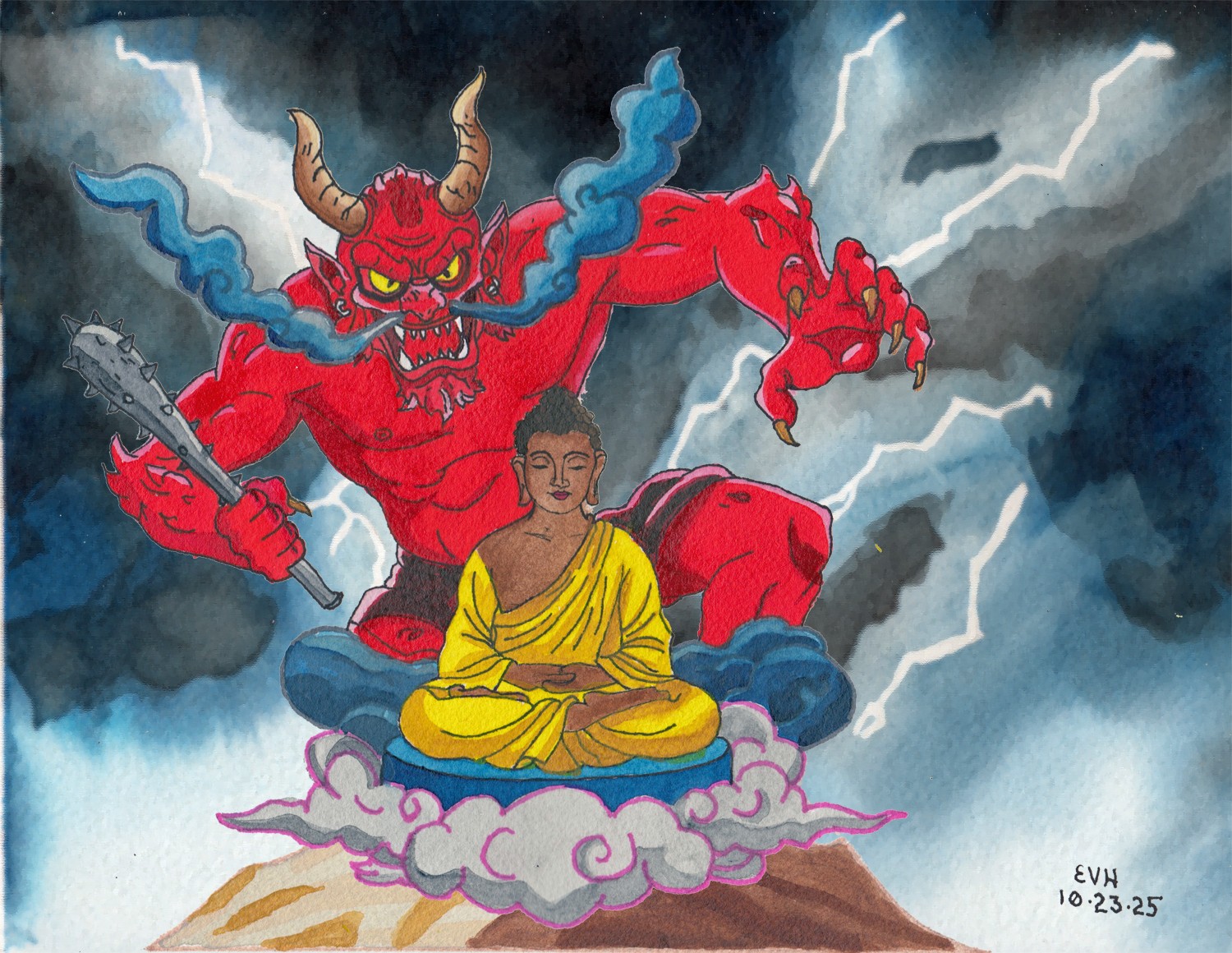
Figure: Puṇṇaka becomes a frightful demon.
Then he said, “As he stands on the top of a mountain and falls down, I will shatter him into fragments by the fall.” So he stirred up a mighty wind. But it did not stir the end of one of his hairs.
Then he set him on the top of a mountain and stood in the form of an elephant. He shook to and fro like a wild date palm tree. But even then, he could not stir one hair of his head from its place.
Then he said, “I will make his heart burst by terror at some frightful sound.” So he entered the inside of the mountain. And uttering a tremendous roar, he filled heaven and earth with one mighty sound. But still the Great Being showed no alarm, for he knew that the youth had come in the form of a Yakkha and a lion and an elephant and a Nāga. He knew he had shaken the mountain with the wind and rain, and that he had entered the mountain and uttered the great roar. He knew this was still only a man and nothing else.
Then the Yakkha thought to himself, “I shall not be able to kill him by these attacks. I can only destroy him by my own hand.” So he set the Great Being on the top of a mountain. Then he went to the mountain’s foot, rose up from the center of the mountain as though he were inserting a white thread into a perforated gem, and with a roar, he seized the Great Being violently and whirled him round. He threw him head downwards into the sky where there was nothing that he could lay hold of. It has been described in this way:
”Having gone there and entered the mountain, Kātiyāna, with an evil mind, held him with his head downwards in the open expanse of the world. While he hung there as if on the precipice of hell, frightful to see and most difficult to traverse, he—the greatest of all the Kurus in action—addressed Puṇṇaka, undismayed: “You are wicked in your nature. And even though you assumed for a time a noble form, you are utterly depraved even though you wore the guise of one restrained. You are performing a cruel and monstrous deed. There is nothing good in your nature. What is your reason for killing me? Why do you want to see me thrown down this precipice? Your appearance suggests you are something superhuman. Tell me, what kind of a god are you?”
Puṇṇaka answered:
“Perhaps you have heard of the Yakkha ‘Puṇṇaka.’ He is a minister of King Kuvera. There is an earth-ruling Nāga called Varuṇa, mighty, pure, and endowed with beauty and strength. I desire his younger sister, the Nāga maiden named ‘Irandatī.’ For the love of that fair damsel, I have set my mind on killing you, O sage.”
The Great Being reflected, “This world is ruined by misunderstanding. Why should the wooer of a Nāga maiden want my death? I will learn the truth of the matter.” So he uttered a stanza:
“Do not be deceived, O Yakkha. Many people are destroyed by misunderstanding. What has your love for that fair maiden to do with my death? Come. Tell me.”
Then Puṇṇaka said to him:
“In my love for the daughter of that mighty Nāga, I consulted her family. And when I sought her hand, my father-in-law told me that they knew that I was moved by an honorable passion. ‘We will give you the damsel, endowed with beautiful body and eyes, fair-smiling and with her limbs perfumed with sandal wood, if you bring us the sage’s heart won in fair fight. The maiden is to be won by this prize. We ask for no other gift.’ So I have not been deceived. Listen, O you doer of right actions. There is nothing I misunderstand. The Nāgas will give me the Nāga maiden Irandatī for your heart, won in fair fight. It is for this that I am intent on killing you. It is in this way that I need your death. If I threw you into hell, I would kill you and take your heart.”
When the Great Being heard this, he thought, “Vimalā has no need of my heart. Varuṇa, after he had heard the discourse on Dharma law and honored me with his jewel, must have gone home and described my power in teaching the Dharma. Vimalā must have had a great longing to hear my words. Puṇṇaka must have been ordered by Varuṇa, through a misunderstanding, and by this he has brought about this calamity. Now, my character as a sage consists in my power to bring to light and to discover absolute truths. If Puṇṇaka kills me, what good will it do? ‘Come,’ I will say to him, ‘Young man, I know the Dharma as followed by good men. Before I die, put me on the top of the mountain and hear the law of good men from me. And afterwards, do what you will.’ And after having declared the law of good men to him, I will let him take my life.” So he uttered this stanza as he hung with his head downwards:
“Hold me upright, O Kātiyāna, if you need my heart. I will declare all the laws of the good man to you this day.”
Then Puṇṇaka reflected, “This law has never have been declared before to gods or men. I will hold him up and hear the law of good men.” So he lifted the Great Being up and set him on the summit of the mountain.
The Teacher described it in this way:
“Puṇṇaka, having quickly placed the best of the performers of good actions among the Kurus upon the mountain’s summit, asked the Teacher of lofty wisdom, as he sat looking at a pipul tree, ‘I have brought you up from the precipice. I need your heart this day. Tell me, then, today all the laws of the good man.’”
The Great Being said:
“You have saved me from the precipice. If You need my heart, I will declare all the laws of the good man to you this day.”
Then the Great Being said, “My body is dirty. I will bathe.” The Yakkha consented. So he brought some water, and when he was bathing, he gave the Great Being some heavenly cloth and perfumes. And after he was adorned and dressed, he gave him some heavenly food. When he had eaten, the Great Being caused the top of the Black Mountain to be covered with decorations. Then he prepared a richly decorated seat. And being seated there, he uttered a stanza, describing the duty of the good man with a Buddha’s triumphant mastery:
“O youth, follow the path already traveled. Put away the soiled hand. Never be treacherous to your friends or fall into the power of unchaste women.”
The Yakkha was unable to comprehend these four rules. So he asked:
“How does one follow the path already traveled? How does one burn the wet hand? Who is the unchaste woman? Who is treacherous to his friend? Tell me the meaning.”
The Great Being replied:
“Let a man follow the actions of whoever invites him to a seat when he comes as a stranger and has never been seen before. They call him the wise one who follows in the path already traveled.
“In any house a man lives even for one night and receives food and drink there, let him not conceive an evil thought against him in his mind. He who is treacherous to his friend burns the innocent hand. Let a man not break a bough of that tree under whose shadow he sits or lies. The wretch is treacherous to his friend. Let a man give this earth filled with riches to the woman who he has chosen even if she despises him if she gets the opportunity. But do not fall into the power of unchaste women. In this way a man follows the path already traveled. In this way he burns the wet hand. This is the unchaste woman. This is one who is treacherous to his friend. Such a man is righteous. Abandon unrighteousness.”
In this way the Great Being taught the four duties of a good man to the Yakkha with a Buddha’s triumphant mastery. And when he heard them, Puṇṇaka reflected, “In these four propositions, the sage is only asking for his own life for he welcomed me before he knew me. I lived in his house for three days, receiving great honor from him. In doing him this wrong, I do it for a woman’s sake. I am, moreover, in every way treacherous to my friends. If I injure the sage, I will not follow the duty of a good man. Why do I need the Nāga maiden? I will carry him to Indapatta and gladden the weeping faces of its inhabitants, and I will seat him in the convocation hall there.”
Then he spoke aloud:
“I lived in your house for three days. I was served with food and drink. You were my friend. I will let you go, O seer of excellent wisdom. You can leave at your own will to your own home. Yea, let all that concerns the Nāga race perish. I have had enough of the Nāga maiden. By your well-spoken words, you are free, O seer, from my threatened blow today.”
The Great Being replied, “O youth, do not send me away to my own home. Take me to the Nāga dwelling.” And he uttered this stanza:
“Come, Yakkha. Take me to your father-in-law and act kindly towards me. I will show him a royal Nāga palace that he has never seen before.”
Puṇṇaka said:
“The wise man should not look on anything that is not for a man’s wellbeing. Why then, O seer of excellent wisdom, do you wish to go among your enemies?”
The Great Being answered:
“Truly, I know it all. The wise man should not look on it. But I have never at any time committed evil, and therefore, I do not fear the coming of death.
“Moreover, by my teaching the law, such a cruel being as yourself was won over and softened. Now you say, ‘I have had enough of the Nāga maiden. Go to your own home.’ It is now my task to soften the Nāga king. Take me there now.”
When he heard this, Puṇṇaka consented. The Great Being then said:
“Come, you will see that world of unequalled glory where the Nāga king lives amidst dance and song like King Vessavana in Nalinī (one of the Four Heavenly Kings in the deva realm). Filled with troops of Nāga maidens, gladdened constantly with their sports day and night, abounding with garlands and covered with flowers, it shines like the lightning in the sky. Filled with food and with drink, with dance and song and instruments of music, filled with maidens richly attired, it shines with dresses and ornaments.”
Then Puṇṇaka placed him, the best doer of good actions among the Kurus, on a seat behind him, and carried the illustrious sage to the palace of the Nāga king.
When he reached that place of unrivalled glory, the sage stood behind Puṇṇaka. And the Nāga king, beholding the harmony between them, addressed his son-in-law as he had done before.
“You did go to the world of men, seeking the sage’s heart. Have you returned here with success, bringing the sage of unequalled wisdom?”
Puṇṇaka replied:
“He who you desire has come. He is my guardian in duty, won by righteous means. Behold him as he speaks before you. A dialog with the good brings happiness.”
The Nāga king uttered a stanza as he saw the Great Being:
“This mortal, seeing me who he had never seen before and pierced with the fear of death, does not speak to me in terror. This is not like a wise man.”
The Great Being addressed the Nāga king while he conceived an idea, even though he had not said that he would not pay him respect. The Great Being knew by his wisdom how best to deal with all creatures:
“I am not terrified, O Nāga, nor am I pierced with the fear of death. The victim should not address his executioner, nor should the latter ask his victim to address him.”
Then the Nāga king uttered a stanza in the Great Being’s praise:
“It is as you say, O sage. You speak the truth. The victim should not address his executioner, nor should the latter ask his victim to address him.”
Then the Great Being spoke kindly to the Nāga king:
“This splendor and glory and this might and Nāga birth of yours are subject to death and not immortal. I ask you this question, O Nāga king. How did you obtain this palace? Was it gained without a cause or as the development of a previous condition? Was it made by yourself or given to you by the gods? Explain this to me, O Nāga king. How did you win this palace.”
The Nāga king replied:
“It was not gained without a cause, nor was it the development of a previous condition. It was not made by me or given by the gods. This palace of mine was gained by my own virtuous deeds.”
The Great Being answered:
“What holy vow was it, what practice of piety? Of what good action was this the fruit, this splendor and glory and might and Nāga birth of yours and this great palace, O Nāga?”
The Nāga king replied:
“I and my wife in the world of men were both full of faith and bountiful. My house was made into a drinking-hall, and priests and brahmins were cheered there. Garlands and perfumes and ointments, lamps and couches and resting-places, raiment and beds and food and drink, I virtuously gave away as free gifts. That was my vow and practice of piety. This is the fruit of that good conduct, this splendor and glory and Nāga birth and this great palace, O seer.”
The Great Being said:
“If you have gained this palace in this way, you know about the fruit of holy actions and rebirth. Therefore, practice virtue with all diligence so you may live again in a palace.”
The Nāga king replied:
“There are no priests or brahmins here to whom we may give food and drink, O holy one. Tell me this thing, I pray. How may I again live in a palace?”
The Great Being said:
“There are snakes who have been born here, sons and wives and dependents. Commit no misdeeds towards them in word or deed at any time. In this way, O Nāga, innocence in word and deed, so shall you live here all your life in a palace and then depart to the world of the gods.”
The Nāga king, having heard the holy discourse of the Great Being, thought to himself, “The sage cannot stay for very long away from his home. I will show him to Vimalā and let her hear his good words. This will calm her longing desire, and I will gratify King Dhanañjaya. Then it will be time to send the sage home.” So he said:
“Truly that best of kings is mourning your absence, whose intimate minister you are. Having once regained you, though at present distressed and sick, a man will regain happiness.”
The Great Being praised the Nāga:
“You do, indeed, utter the holy words of the good, a peerless piece of right doctrine. In such crises of life as these, the character of men like me is made known.”
Then the Nāga king—still more delighted—uttered a stanza:
“Say, were you taken for nothing? Did he conquer you in a game? He says that he won you fairly. How did you come under his power?”
The Great Being replied:
Puṇṇaka won the game of dice with he who was my lord and king. Being conquered, he gave me to Puṇṇaka, so I was won fairly and not by wrong.”
The great Nāga was delighted and overjoyed when he heard these noble words of the sage. He seized the lord of lofty wisdom by the hand and then went into the presence of his wife, “He for whom, O Vimalā, you grew pale and food lost the gleam in your eyes, this sun, for the sake of whose heart this trouble came upon you, listen well to his words, for you will never see him again.”
When she saw the lord of great wisdom, Vimalā folded the fingers of her hands in reverence, and she addressed the best of the Kurus with her whole soul full of delight:
“This mortal, standing before me—whom he had never seen before and pierced with the fear of death—does not speak to me in his terror. This is not like a wise man.”
“I am not terrified, O Nāgī, nor am I pierced with the fear of death. The victim should not address his executioner, nor should the latter ask his victim to address him. “
In this way the Nāga maiden asked the sage the same question that the Nāga Varuṇa had asked him before. And the sage—by his answer—satisfied her as he had in the same way satisfied Varuṇa.
The sage, seeing that the Nāga king and the Nāga maiden were both pleased with his answers, undaunted in soul and with not one hair erect with fear, then addressed Varuṇa: “Fear not, O Nāga, here I am. Whatever use this body may be to you, whatever it can do by its heart and its flesh, I will carry out according to your will.”
The Nāga king replied:
“The heart of sages is their wisdom. We are delighted this day with your wisdom. Let him whose name implies perfection take his bride today and let him put you in possession of the Kurus.”
(The wise man’s full name is “Vidhurapaṇḍita.” “Paṇḍita” means “a wise man.”)
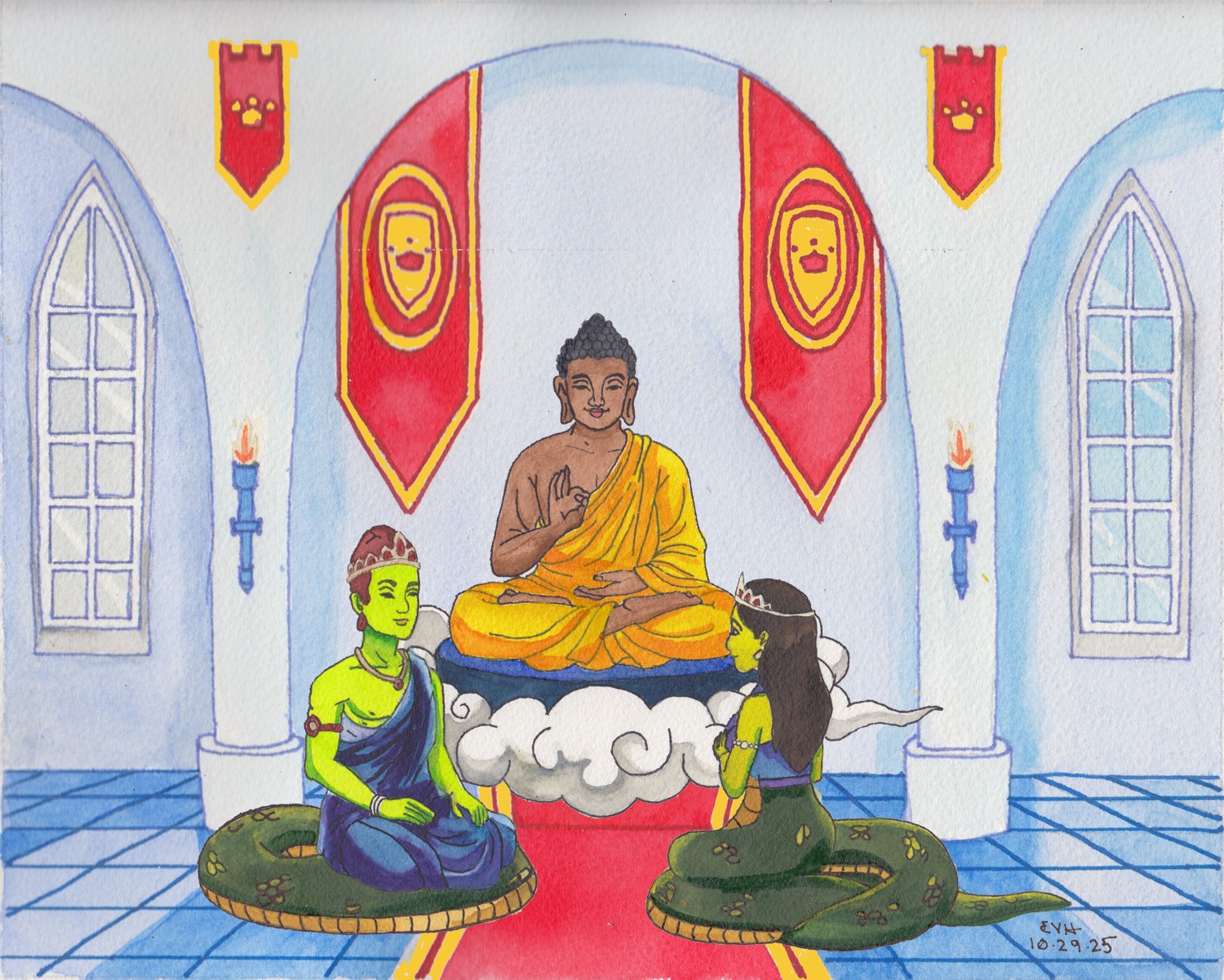
Figure: Vidhura teaches the Nāga king and queen.
Having thus spoken, Varuṇa gave Irandatī to Puṇṇaka, and in his joy, he poured out his heart to the Great Being.
The Great Being described the matter in this way:
“Puṇṇaka, delighted and overjoyed, won the Nāga maiden Irandatī full of joy. Then he addressed he who was the best of the Kurus in action: ‘You have given me a wife. I will do what is due to you, O Vidhura. I give this pearl of jewels, and I will return you today in possession of the Kurus.’”
Then the Great Being praised him in another stanza:
“May friendship with your beloved wife be everlasting. And in your joy with a happy heart, give me the jewel and carry me to Indapatta.” Then Puṇṇaka placed the best of the Kurus on a seat before him and carried him, the lord of supreme wisdom, to the city Indapatta. Swift as the mind of man may travel, his speed was even swifter still, and Puṇṇaka bore the best of the Kurus to the city Indapatta.
Then he said to him: “Behold the city Indapatta before you, with its pleasant mango groves and districts. I have a wife, and you have returned to your home.”
Now on that very morning the king had a dream, and this was what he saw. At the door of the king’s palace there stood a great tree whose trunk was wisdom, and whose branches and boughs were like the virtues, and its fruits the five sacred products of the cow (milk, ghee, curds, buttermilk, and butter). It was richly adorned with elephants and horses. And a great multitude with folded hands were worshipping it with all reverence. Then a black man, clothed with red cloth and wearing earrings of red flowers and bearing weapons in his hand, cut the tree down by the roots despite the protests of the multitude. He dragged it off and went away. Then he came back and planted it again in its old place before departing.
Then the king—as he comprehended the dream—said to himself, “The sage Vidhura and no one else is like the great tree. That youth and no other, who carried off the sage, is like the man who cut the tree down by the roots despite the protests of the multitude. Truly he will come back and set him at the door of the Dharma Hall and depart. We shall behold the sage again today.”
So joyfully he ordered the whole city to be decorated and the Dharma Hall to be prepared, and a pulpit in a pavilion adorned with jewels. He surrounded himself with a hundred kings, along with their counsellors, and a multitude of citizens and country people. He counseled them all by saying, “Fear not. You will see the sage again today.” He seated himself in the Dharma Hall, waiting for the sage’s return.
Then Puṇṇaka brought the sage down and seated him in the middle of the assembly at the door of the Dharma Hall. Then he departed with Irandatī and returned to his own celestial city.
The Teacher described it in this way:
“Puṇṇaka—of noble race—set down him, the best of the Kurus in action, in the middle of the religious assembly. Then he mounted his noble steed and sped in the sky through the air. When the king saw him, he was filled with delight. He sprang up and embraced him with his arms, and without a moment’s hesitation, he seated him on a throne amid the congregation.”
Then after exchanging friendly greetings with him, he welcomed him affectionately and uttered a stanza:
“You guide us like a ready-furnished chariot. The Kurus rejoice at seeing you. Tell me this, how was it that this young man let you go?”
The Great Being replied:
“He who you call a young man, O great king, is no common man, O best of heroes. If you have heard of the Yakkha Puṇṇaka, it was he, the minister of King Kuvera. There is a Nāga king named Varuṇa, mighty, endowed with strength and a noble presence. Now Puṇṇaka loves his younger daughter, the Nāga maiden Irandatī. He laid his plan for my death for the sake of that fair maiden whom he loved. In this way he obtained his wife. Then I was allowed to depart, and the jewel was won.
“The Nāga king, being pleased with my solution of his question as to the four ends of men, paid me the honor of giving me a jewel. And when he returned to the Nāga world, his queen Vimalā asked him where the jewel was. He described my skill in teaching the Dharma, and she, desiring to hear such a discourse, feigned a longing for my heart. The Nāga king, not understanding her real wish, said to his daughter Irandatī, ‘Your mother has a longing for Vidhura’s heart. Find a noble who is able to bring it for her.’
“As she sought one, she saw the Yakkha Puṇṇaka who was the son of Vessavana’s sister. And, as she knew that he was in love with her, she sent him to her father. He said to him, ‘If you can bring me Vidhura’s heart, you will win her.’ So he brought the gem that might have belong to a universal monarch from the mountain Vepulla. He played dice for me, and having won me from his play, he spent three days in my house.
“Then he made me hold his horse’s tail. He thrashed me against the trees and mountains in Himavat, but he could not kill me. Then he rushed forward on a whirlwind in the seventh sphere of the winds, and he set me on the top of the Black Mountain sixty leagues high. There he assailed me as a lion and in other shapes, but he could not kill me. Then at last—at his request—I told him how I could be killed. Then I proceeded to tell him the duties of the good man. And when he heard them, he was pleased and no longer wished to bring me there. Then I took him and went to the Nāga world. There I taught the Dharma to the king and to Vimalā, and all the court was highly pleased
After I had stayed there six days, the king gave Irandatī to Puṇṇaka. He was delighted when he gained her. He honored me with many jewels as a present. Then, at the king’s command, he mounted me on a magic horse created by his will. He sat in the middle seat with Irandatī behind. He brought me here and put me down in the middle of the court. Then he returned with Irandatī to his own city.
“In this way, O king, for the sake of that fair maiden who he loved, he planned for my death. But through me, he obtained his wife. When the king had heard my discourse on the Dharma, he was pleased and let me depart. I received this jewel from Puṇṇaka. It grants all desires, and that is worthy of a universal emperor. I accepted it, O monarch.”
And so saying, he gave the jewel to the king.
Then the king, in the morning, wanting to tell the citizens the dream that he had seen, told them the history as follows:
“There grew a tree before my gates. Its trunk was wisdom and its boughs the moral virtues. It ripened into all that was natural and developed. Its fruits were the five products of the cow, and it was covered with elephants and cattle. But while it resounded with dance, song, and musical instruments, a man came and cut it up from the roots and carried it away. He later came to this palace of ours to pay homage to this tree.
“Let all who are joyful show it today. Bring your presents in abundance and pay your homage to this tree.
“Whatever captives there may be in my realm, let them be set free from their captivity, just as this tree has been delivered from its captivity. So let them release others from bondage.
“Spend this month in celebration. Hang up your ploughs. Feast the brahmins with flesh and rice. Let them drink in private, and still seem total abstainers, with their full cups flowing over. Let them invite their friends on the highway. Keep a strict watch in the kingdom so that none may injure his neighbor. Pay your homage to this tree.”
When he had thus spoken, he said:
“The queens, the princes, the Vesiyas, and the brahmins brought much food and drink to the sage.
“Riders on elephants, bodyguards, riders in chariots, foot soldiers, brought much food and drink to the sage. The people of the country and the city—gathered in crowds—brought much food and drink to the sage. The vast assembly were filled with joy, beholding the sage after he had returned. When the sage returned, there was a triumphant waving of cloths.”
After a month, the festival came to an end. The Great Being, as fulfilling a Buddha’s duties, taught the great assembly the Dharma. He counselled the king. And in this way, he fulfilled his span of life and so became destined for heaven. Abiding in his teaching and following their king, all the inhabitants of the Kura kingdom gave gifts. They performed good works. And at the end of their lives, they went to swell the hosts of heaven.
The Master, having brought his lesson to an end, said, “Not only now but formerly also did the Buddha, having obtained complete wisdom, show himself skilled in adapting means to ends.” Then he identified the birth: “At that time the sage’s father and mother were the royal family. The eldest queen was Rāhula’s mother. The eldest son was Rāhula. Varuṇa—the Nāga king—was Sāriputta. The garuḷa king was Moggallāna. Sakka was Anuruddha. The king Dhanañjaya was Ānanda, and I was the wise Vidhura.”
