Jataka 544
Mahānāradakassapa Jātaka
The Story of Nārada Kassapa
as told by Eric Van Horn
originally translated by H.T. Francis and R.A. Neil, Cambridge University
originally edited by Professor Edward Byles Cowell, Cambridge University
In this story the theme is to refute the notion that our actions do not have consequences. A king is wrongly advised in this way. But he has a kind and wise daughter who advises him otherwise. Eventually a Bodhisatta and Brahma god named Nārada takes on a human form and descends into the human realm to support her case. So in this story, the king and his two foolish advisors are men, and the wise person is a woman. Yay!
“There was a king of the Videhas.” The Master told this story while he was living in the Laṭṭhivana pleasure garden. It is about the conversion of Uruvela-Kassapa. Now the Teacher—by whom the glorious reign of Dharma was begun—converted the ascetics Uruvela-Kassapa and the rest. After that he went to the pleasure garden of Laṭṭhivana. It was surrounded by a thousand bhikkhus who had previously been ascetics. He did this to persuade the King of Magadha (King Bimbisara) to fulfill his promise (to give the pleasure garden to the Saṇgha).
The Magadha king arrived with an attending company of twelve myriads. He seated himself after saluting the Buddha. Then a dispute arose among the brahmans and the householders of his train: “Has Uruvela-Kassapa placed himself under the spiritual guidance of the great samana, or has the great samana placed himself under the spiritual guidance of Uruvela-Kassapa?”
Then the Blessed One thought to himself, “I will show them that Kassapa has placed himself under my spiritual guidance,” and he uttered this stanza:
What was it that you saw, O inhabitant of Uruvelā, that you—renowned for your asceticism—abandoned your sacred fire? I ask you, Kassapa, this question, “How is it that your fire sacrifice has been deserted?”
(Kassapa had been a fire worshipper.)
Then the elder, who understood the Buddha’s intention, replied in this stanza:
“The sacrifices only speak of forms and sounds and tastes and sensual pleasures and women. And knowing that all these things, being found in the elements of material existence, are repugnant, I took no more delight in sacrifices or offerings.”
And to show that he was a disciple, he laid his head upon the Buddha’s feet and said, “The Blessed One is my teacher, and I am his disciple.” So saying, he rose into the air seven times to the height of a palm tree, two palm trees, and so on to seven palm trees. Then he descended and saluted the Blessed One and sat down on one side.
When they saw that miracle, the great multitude uttered the glories of the Teacher, saying, “O great is the power of Buddha. Even though he was filled with a firm conviction of his own, and though he believed himself to be a saint, Uruvela-Kassapa burst the bonds of missteps and was converted by the Tathāgata.” The Teacher said, “It is not wonderful that I—who have now attained wisdom—should have converted him. In a past time when I was the Brahma named Nārada and still subject to passion, I burst this man’s bonds of missteps and made him humble.” And so saying, at the request of the audience, he told them this story from the past.
In the past at Mithilā in the kingdom of Videha there ruled a just king of righteousness. His name was “Aṇgati.” Now in the womb of his chief queen a fair and gracious daughter was conceived. Her name was “Rujā.” She possessed great merit because she had recited mantras for 100,000 ages. All of the king’s other 16,000 wives were barren.
This daughter became very dear and engaging to him. Every day he would send her 25 baskets full of various flowers and delicate clothing, bidding her to adorn herself with them. He used to send her 1,000 gold coins, bidding her to give alms every two weeks (presumably on Uposatha days) as there was abundance of food and drink.
Now he had three ministers: Vijaya, Sunāma, and Alāta. And one day a feast came around on the full moon of the fourth month. The city and the palace were decorated like the city of the gods. The king properly bathed and anointed himself and put on all sorts of ornaments. Then he stood with his ministers on a terrace at an open window. He saw the round moon mounting up into the clear sky, and he asked his ministers, “Pleasant indeed is this clear night. With what amusement shall we divert ourselves?”

The Teacher explained the matter:
“There was a Khattiya king of the Videhas named Aṇgati. He possessed many carriages, wealth, and a vast army. One day, on the fifteenth night of the fortnight, when the first watch was over, on the full moon of the fourth month of the rains, he gathered his ministers together: Vijaya, and Sunāma, and the general Alātaka. They were all wise, fathers of sons, wearing a smile, and full of experience. The Videha king questioned them, “Let each of you utter his wish. This is the full moon of the fourth month. It is moonlight without any darkness. With what diversion shall we pass the time away tonight?”
Having been addressed by the king, each spoke in accordance with the desire of his heart.
The Teacher explained the matter:
Then the general Alāta spoke to the king: “Let us gather a gay gallant army together. Let us go forth to battle with a countless host of men. Let us bring those who have kept themselves independent under your power. This is my opinion. Let us conquer what is still unconquered.”
Hearing the words of Alāta, Sunāma said this: “All your enemies, O king, are already together here. They have laid aside their strength and behave themselves with submission. Today is the chief festival. Making war does not please me. Let them bring us meat and drink and all kinds of food. O king, enjoy your pleasure in dance and song and music.”
Hearing the words of Sunāma, Vijaya said this, “All pleasures, O great king, are already at your side. These are not hard to find. You can always rejoice in all your desires. But even if they are always attained, this resolution is approved by me. Let us wait on some samana or brahmin who is learned in sacred lore, one who versed in the text and its meaning, someone who may remove our doubt today as to the object of our desire.”
Having heard the words of Vijaya, King Aṅgati said, “This saying of Vijaya is what pleases me, also. Let us wait on some samana or brahmin learned in sacred lore, one who versed in the sacred text and its meaning, one who may remove our doubt today as to the object of our desire. Let us all carry out this resolution. But on what teacher shall we wait? Who, today, versed in the sacred text and its meaning, will remove our doubt as to the object of our desire?”
Having heard the words of Videha, Alāta replied, “There is a naked ascetic in the deer park. He is commended by all as wise. His name is Guṇa. He is of the Kassapa family. He is well-known, a man of varied discourse, and with a large following of disciples. Wait on him, O king. He will remove our doubt.”
Having heard the words of Alāta, the king commanded his charioteer, “We will go to the deer park. Bring the chariot here yoked.”
So they yoked his chariot. It was made of ivory and had silver decorations. The chariot was bright and clean, white and spotless like a clear night in its appearance. Four Sindh horses were yoked to it. They were white as lilies, swift as the wind, and well-trained. They wore gold wreaths. The chariot was adorned with a white umbrella. The chariot itself was white. The horses were white, and the fan was white. As he sat in it, the Videha king and his counsellors shone like the moon. Many wise and strong men—armed with spears and swords—mounted on horses and followed the king of heroes.
Having quickly traveled the distance, the Videha and his ministers descended from the chariot. They approached Guṇa on foot. And even though the brahmins and wealthy men who were already gathered at the place left him no room, the king did not order them to be moved.”
Surrounded by that mixed assembly, the king sat on one side and made his greeting.
The Teacher explained the matter:
Then the king sat down on one side on a soft mattress. The mattress was covered with soft, variegated squirrel skins. It had a soft cushion over them. The king, having been seated, addressed Guṇa with the compliments of friendship and civility: “Are your bodily needs provided for? Are your vital airs (“Prana,” or “energy”) not wasted? Is your mode of life comfortable? Do you get an adequate supply of alms? Are your movements unimpeded? Is your sight unimpaired?”
Guṇa courteously answered the Videha, who was so attentive to his duties: “All my wants are provided for, and those two, last-mentioned points are as I would wish them. And as well, how are you? Are your neighbors not too strong for you? Do you have good health as you need? Does your chariot carry you well? Are you free of any sicknesses that can afflict the body?”
Having received this kindly greeting, the king sought to know the truth. He asked him about the meaning and text of the law and the rules of right conduct. “How, O Kassapa, should a mortal fulfill the law towards his parents, how towards his teacher, and how towards his wife and children? How should he behave towards the aged, how towards samanas and brahmins. How should he deal with his army, how with the people in the country? How should he practice the law and eventually attain to heaven? And how do some—on account of unrighteousness—fall down into hell?”
Because there were no omniscient buddhas, paccekabuddhas, buddhist disciples, or sages, the king asked his successive royal questions. They were well deserving to be asked. But he was reduced to asking them of a poor, naked mendicant who knew nothing and was as blind as a child. And he, having been asked, could give no proper answer to the question. So he seized the opportunity with a “Hear, O king,” and then declared his own false doctrine. Guṇa was like one who strikes an ox when it is traveling or throws refuse into another’s food vessel.
The Teacher explained the matter:
Having heard the Videha king’s words, Kassapa replied: “Hear, O king, a true, infallible utterance. There is no fruit, good or evil, in following the Dharma. There is no other world, O king. Who has ever come back here from there? There are no ancestors. How can there be father or mother? There is no teacher. Who will tame what cannot be tamed? All beings are equal and alike. There are none who should receive or pay honor. There is no such thing as strength or courage. How can there be vigor or heroism.
All beings are predestined, just as the stern rope must follow the ship. Every mortal gets what he is to get. What then is the use of giving? There is no use, O king, in giving. The giver is helpless and weak. Gifts are enjoined by fools and accepted by the wise. Weak fools who think themselves wise give to the prudent.”
Having described the uselessness of giving, he went on to describe the powerlessness of wicked deeds to produce consequences in the hereafter:
There are seven aggregates indestructible and uninjuring: fire, earth, water, air, pleasure and pain, and the soul. Of these seven, there is none that can destroy or divide, nor are they ever to be destroyed. Weapons pass harmless among these aggregates. He who carries off another’s head with a sharp sword does not divide these aggregates. How then should there be any consequence from evil doing? All beings become pure by passing through 84 great eons. Until that period arrives, not even the self-restrained becomes pure. Until that period arrives, however much they have followed virtue, they do not become pure, and even if they commit many wicked deeds, they do not go beyond that limit. One by one we are purified through the 84 great eons. We cannot go beyond our destiny any more than the sea beyond its shore.
(An eon is a life of the universe.)
In this way the advocate of annihilation enforced his own doctrine by his vehemence without offering any evidence:
Having heard Kassapa’s words, Alāta replied, “What you say appeals to me, too. I also remember having gone through a former birth. I was a cow killing huntsman named “Piṇgala” in a city. I committed many wicked acts in wealthy Benares. I killed many living creatures: buffaloes, hogs, and goats. Passing from that birth, I was then born into the prosperous family of a general. Truly there are no evil consequences for wickedness. I did not go to hell.”
Now there happened to be a slave clothed in rags named “Bījaka.” He was keeping the fast, and he had come to listen to Guṇa. When he heard Kassapa’s words and Alāta’s reply, he heaved many a hot sigh and burst into tears. The Videha king asked him, “Why do you weep? What have you seen or heard? Why do you show such pain?”
Bījaka replied, “I have no pain to bother me. Listen to me, O king. I, too, remember a former birth. It was a happy one. My name was “Bhavaseṭṭhi.” I lived in the city of Sāketa. I was devoted to virtue and purity. I gave alms. I was esteemed by brahmins and rich men. I can remember no single evil deed that I committed. But when I passed from that life I was conceived in the womb of a poor prostitute and was born to a miserable life. But as miserable as I am, I keep a tranquil mind. I give half of my food to whoever wants it. I fast every fourteenth and fifteenth day, and I never hurt living creatures. I abstain from theft. But all the good deeds that I do produce no fruit. As Alāta says, I think that virtue is useless. I lose my game in life as an unskillful dice player. Alāta wins as he has done, just like a skilled player. I see no door by which I may go to heaven. It is for this that I weep when I heard what Kassapa said.”
Having heard Bījaka’s words, King Aṇgati said, “There is no door to heaven. Simply wait for destiny. Whether your lot be happiness or misery, it is only gained through destiny. All will reach deliverance from rebirth. Do not be eager for the future. I, too, have been fortunate in former births and devoted to brahmins and rich men. But while I was busy administering the laws, I had no enjoyment.”
Having spoken, he took his leave.
“O venerable Kassapa, all this long time I have been heedless, but now at last, I have found a teacher. From now on, following your teaching, I will take my delight only in pleasure. I will not let discourses on virtue bother me again. Stay where you are. I will now leave. We may yet see one another again and meet in the hereafter.”
So saying, the king of Videha went home.
When the king first visited Guṇa, he saluted him respectfully and then asked his question. But when he went away, he went without any salutation. Because Guṇa was untrue to his name (literally “virtue”), through his own unworthiness, he received no salutation, nor did he get alms.
(Notice that Guṇa’s argument that virtue has no value resulted in his not getting alms!)
So after the night had passed and the next day had arrived, the king gathered his ministers together and said to them, “Prepare all the elements of enjoyment. From now on, I will only follow the pursuit of pleasure. No other business is to be mentioned before me. Let someone else carry on the administration of justice.” And he gave himself up entirely to the pursuit of pleasure.
The Teacher explained the matter:
When the night turned to day, Aṇgati summoned his ministers into his presence and addressed them: “In the Candaka palace let them always provide pleasures ready for me. Let no one come with messages concerning public or secret matters. Let Vijaya, Sunāma, and the general Alātaka—all three well skilled in law—sit in judgment on these matters.” Having said this, the king thought only of pleasure and busied himself no more in the company of brahmins and wealthy men.
Then on the fourteenth night, the dear daughter Rujā said to her nurse mother, “Adorn me quickly with my jewels. Let my female companions wait on me. Tomorrow is the sacred fifteenth day. I will go into the royal presence.” They brought her a garland and precious sandalwood, gems, shells, pearls, and precious things and garments of various dyes. Her many attendants surrounded her as she sat on a golden chair. They adorned her, shining in her beauty.
Then amid her train, blazing with all kinds of ornaments, Rujā entered the palace Candaka as lightning enters a cloud. Having drawn near the king and saluted him with all due respect, she sat down on one side on a chair inlaid with gold.
The king, when he saw her surrounded by her train as if a company of heavenly nymphs had visited him, addressed her: “Do you enjoy yourself in the tank within the precincts of the palace? Do they always bring you all sorts of delicate food? Do you and your maidens gather all kinds of garlands and build gardens for yourselves continually, intent upon sport? Do you want for anything? Let them bring it at once. Ask what you will, impetuous one, even though it be as hard to get as the moon.”
Hearing his words Rujā answered her father:
“O king, in my lord’s presence every desire of mine is gained. Tomorrow is the sacred fifteenth day. Let them bring me 1,000 gold coins so I may give them as a gift to the mendicants.”
Hearing Rujā’s words King Aṇgati replied:
“Much wealth has been wasted by you idly and without fruit. You keep the fast days and neither eat nor drink. This idea of the duty of fasting comes from destiny. There is no merit because you abstain. While you live with us, Rujā, do not give away food. There is no world other world than this. Why trouble yourself for no reason?”
Bright in her beauty, when Rujā heard his words, she answered him, knowing as she did the past and the future law:
“I have heard in time past, and I have seen it with my own eyes. One who follows children himself becomes a child. The fool who associates with fools plunges deep into folly. It is fitting for Alāta and Bījaka to be deceived. But you are a king full of learning, wise and skilled in the conduct of affairs. How have you fallen into such a low doctrine, one worthy of children? If a man is purified by the mere course of existence, then Guṇa’s own asceticism is useless. Like a moth flying into the lighted candle, the idiot has adopted a naked mendicant’s life. Having accepted the idea that all will at last be purified through rebirth, in their great ignorance many corrupt their actions. And being caught fast in the effects of former misdeeds, they find it hard to escape as the fish from the hook.”
“I will tell you a parable, O king, for your benefit. The wise sometimes learn the truth by a parable. As the ship of the merchants, heavy through taking on too large a cargo, sinks overladen into the sea, so a man, accumulating misdeeds little by little, sinks overladen into hell. Alāta’s present cargo, O king, is not what he is collecting now. For whar he is now taking on board, he will hereafter sink to hell. Formerly Alāta’s deeds were righteous, and it is because of them that he enjoys this prosperity. That merit of his is being spent, for now he is intent upon misdeeds. Having forsaken the straight road, he is running headlong in a crooked path.”
“As the balance properly hung in the weighing house causes the end to swing up when the weight is put on, so does a man cause his fate to rise at last if he gathers together every piece of merit little by little, like that slave Bījaka intent on merit and thinking too much of heaven.”
“In the sorrow that the slave Bījaka now suffers, he receives the fruit of misdeeds that he formerly committed. That misdeed is melting away since he is devoted to moral virtue, but do not let him enter Kassapa’s devious paths.”
Then she proceeded to show the evil of practicing misdeeds and the good results of following worthy friends:
“Whatever friend a king honors, whether he be good or evil, devoted to vice or to virtue, the king falls into his power. As is the friend whom he chooses for himself and follows, such he himself becomes. Such is the power of intimacy. One in constant companionship affects his fellow, a close comrade his associate, just as a poisoned arrow defiles a pure quiver. Do not let the wise become the friend of the wicked for fear of contamination. If a man ties up stinking fish with a band of kusa grass, the grass will acquire a putrid smell. Such is intimacy with a fool. But if a man binds up myrrh in a common leaf, it will acquire a pleasant odor. Such is intimacy with the wise. Therefore, knowing the maturity of his own actions like the ripeness of a basket of fruit, do not let the wise man follow the wicked. Follow the good, for the wicked lead to hell, while the good bring us to heaven.”
The princess, having spoken on righteousness in these six stanzas, declared the sorrows that she had undergone in her past births:
“I, too, remember seven births that I have experienced. And when I go from my present life, I shall yet pass through seven future ones. My seventh former birth, O king, was as the son of a smith in the city Rājagaha in Magadha. I had an evil companion, and I committed much evil. We went about corrupting other men’s wives as if we had been immortal. Those actions remained laid up like fire covered with ashes. By the effect of other actions, I was born in the land of Vaṃsa in a merchant’s family in Kosambī, great and prosperous and wealthy. I was an only son, continually fostered and honored. There I followed a friend who was devoted to good works. He was wise and full of sacred learning. He grounded me in what was good. I fasted through many a fourteenth and fifteenth night. That action remained laid up like a treasure in water. But the fruit of the evil deeds that I had done in Magadha came around to me at last like a noxious poison. I passed from there for a long time, O king, into the Roruva hell. I endured the effects of my own works. When I remember, it still grieves me. After spending a wretched time there through a long series of years, I became a castrated goat in Bheṇṇākaṭa. I carried the sons of the wealthy on my back and in a carriage. It was the fated consequence of my going after other men’s wives.”
“After that I was born in the womb of a monkey in a forest. On the day of my birth, they showed me to the leader of the herd. He exclaimed, ‘Bring my son to me.’ He violently seized my testicles with his teeth and bit them off despite my cries.”
She explained this in verse.
“Passing from this birth, O king, I was born as a monkey in a great forest. I was mutilated by the fierce leader of the herd. This was the fated consequence of my going after other men’s wives.”
Then she went on to describe the other births:
“I was next born, O king, as an ox among the Dasaṇṇas. I had been castrated, but I was swift and fair to look at, and for a long time I hauled a carriage. This was the fatal consequence of my going after other men’s wives. When I passed from that birth, I was born into a family among the Vajjī people. But I was neither a man nor a woman for it is a very hard thing to be born as a man. This was the fatal consequence of my going after other men’s wives. Next, O king, I was born in the Nandana wood. I was a nymph of a lovely complexion in the heaven of the Thirty-three, dressed in garments and ornaments of various hues and wearing jeweled earrings. I was skilled in dance and song. I was an attendant in Sakka’s court. While I stayed there, I remembered all these births as well as the seven future births which I shall experience when I go from here. The good that I did in Kosambī has come around in its turn, and when I pass from this birth, I shall be born only among gods or men. For seven births, O king, I shall be honored and worshipped, but until the sixth is past, I shall not be free from my female sex.”
(This can be viewed two ways. One is that being a woman is an inferior birth. However, it can also mean that women in ancient India were badly treated because of their gender. This is why being reborn female is considered disadvantageous.)
“But there is my seventh birth, O king. There I will be a prosperous son of the gods. I shall be born at last as a male deity in a divine body. Even today they are gathering garlands from the heavenly tree in Nandana, and there is a son of the gods, named Java, who is seeking a garland for me. These 16 years of my present life are only as one moment in heaven. A hundred mortal autumns are only as one heavenly day and night. In this way our actions follow us even through countless births, bringing good or evil. No action is ever lost.”
Then she declared the supreme Dharma:
“He who desires to rise continually from birth to birth, let him avoid another’s wife like a man with washed feet avoids the swamp. He who desires to rise continually from birth to birth, let him worship the Lord as his attendants worship Indra. He who wishes for heavenly enjoyments, a heavenly life, glory, and happiness, let him avoid misdeeds and follow the threefold law (virtue, concentration, and wisdom). Watchful and wise in body, word, and thought, he follows his own highest good, whether he is born as a woman or a man. Whoever is born glorious in the world and nursed in all pleasures, without doubt in former time had a virtuous life. All beings separately abide by their own deserts. Do you think, O king, what caused you to own these wives of yours like heavenly nymphs, beautifully adorned and dressed with golden nets?”
In this way she counselled her father.
The Teacher explained the matter:
In this way the maiden Rujā pleased her father. She taught the bewildered one the true road and devoutly declared the Dharma.
Having proclaimed the Dharma to her father all night from early morning, she said to him, “O king, listen not to the words of a naked heretic, but receive the words of some good friend like me. I tell you that there is this world and there is another world (a world other than the human realm) and that there are fated consequences to every good or evil action. Do not rush on by a wrong road.”
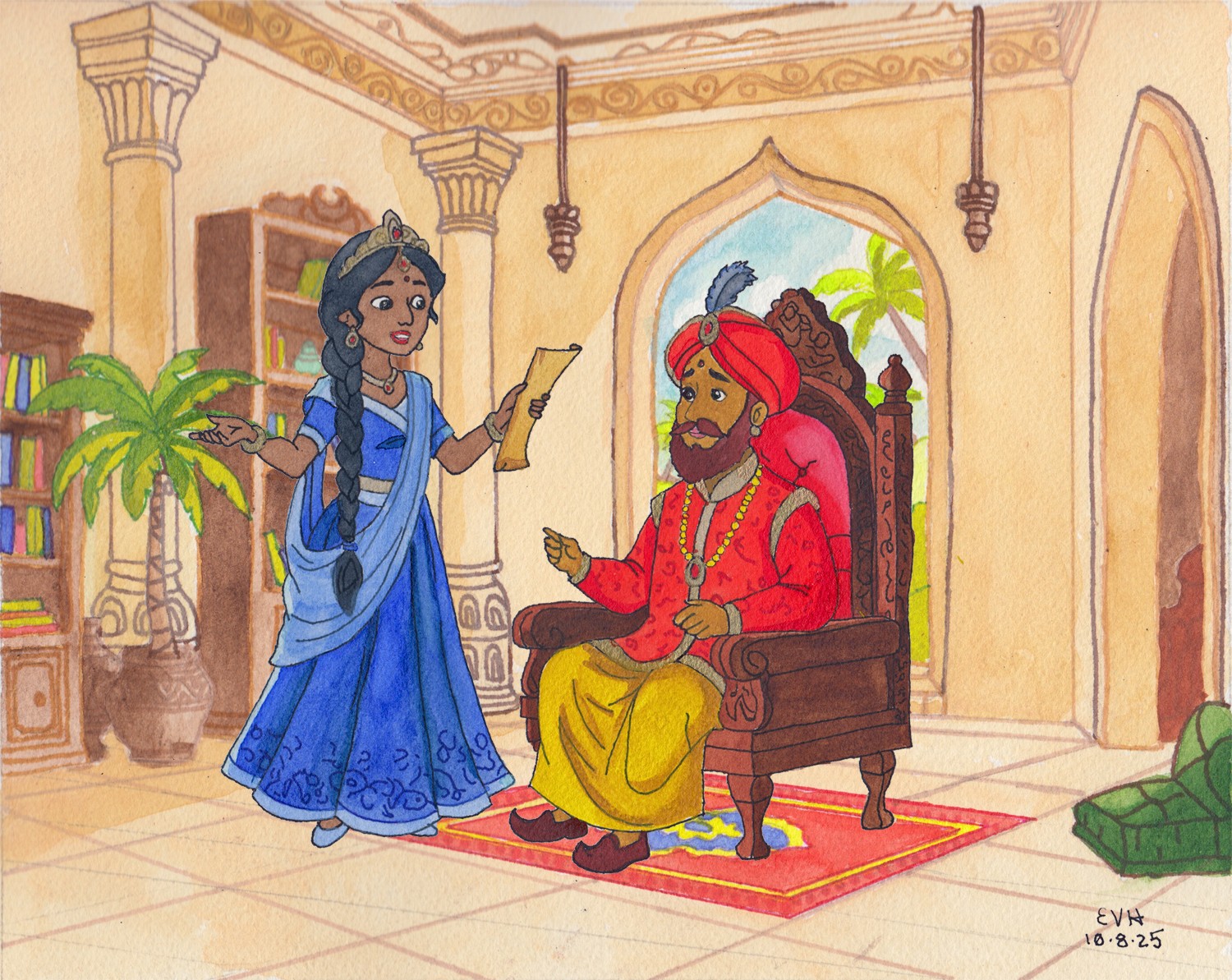
Figure: The wise princess tries to dissuade her father.
Still she could not dissuade her father from his false doctrine. He was pleased when he heard her sweet words, for all parents naturally love their dear children’s speech. But they also do not give up their old opinions. So, too, there arose a stir in the city. “The king’s daughter Rujā is trying to drive away heretical views by teaching the Dharma,” and the multitude was well-pleased. “The wise princess will set him free from false teaching today and will inaugurate prosperity for the citizens.”
But although she could not make her father understand, she did not lose heart. She resolved that she would bring her father true happiness by some means or other. She placed her joined hands on her head, and after having made her obeisance in the ten directions, she offered reverence, saying, “In this world there are righteous samanas and brahmins who support the world. There are the powerful deities. There are the great Brahma deities. Let them come and convince my father to give up his heresy. And if they have no power in themselves, then let them come by my power and virtue and drive away this heresy and bring about the welfare of the whole world.”
Now the Great Brahma of that time was a Bodhisatta named Nārada. Bodhisattas in their mercy, compassion, and sovereignty cast their eyes over the world from time to time to behold the righteous and the wicked beings. As he was looking over the world that day, he saw the princess entreating the deities in her desire to deliver her father from heresy. He thought to himself, “Except me, no one can drive away false teaching. I must go today and show kindness to the princess and bring happiness to the king and his people. In what guise shall I go? Ascetics are dear and venerable to men. Their words are considered worthy to be received. I will go in the garb of an ascetic.”
So he assumed a pleasing human form. He had a complexion like gold. His hair was matted and a golden needle thrust into the tangle. He put on a tattered dress that was red outside and within. He hung a black antelope’s hide made of silver and decorated with golden stars over one shoulder. He took a golden begging bowl hung with a string of pearls and laid it on his shoulders. He carried a golden pole curved in three places. And taking up a coral waterpot by a string of pearls, he went with this garb through the heavens shining like the moon in the firmament. The he entered the terrace of the Canda palace and stood in the sky in front of the king.
The Teacher explained it:
Then Nārada came down to men from the Brahma world, and surveying Jambudīpa, he beheld King Aṇgati. Then he stood on the palace before the king, and Rujā, having beheld him, saluted the divine sage who had come.
Then the king, being rebuked by the Brahma’s glory, could not remain on his throne, but came down and stood on the ground and asked him the cause of his coming and his name and family.
The Master explained it:
Then the king, alarmed in his mind, having come down from his seat spoke to Nārada. He asked, “From where have you come, you of heavenly aspect, like the moon illumining the night. Tell me your name and family. What do they call you in the world of men?
Then he thought to himself, “This king does not believe in another world. I will tell him about another world,” so he uttered a verse:
“I come from the gods like the moon illumining the night. I will tell you my name and family as you ask. They know me as Nārada and Kassapa.”
Then the king thought to himself, “By and bye I will ask him about another world. I will now ask him about the purpose of this miracle.”
“Seeing that you appear in this marvelous fashion, I ask you, O Nārada, what does it mean. What is the purpose of this miracle?”
Nārada replied:
“Truth, righteousness, self-command, and liberality,—these were my notorious virtues in old days. By these same virtues—diligently followed—I go swift as thought wherever I desire.”
Even while he was speaking the king—unable to believe in another world from the obstinacy of his evil doctrines—exclaimed, “Is there such a thing as reward for good actions?” and he repeated a stanza:
“You utter a marvel when you talk of the might brought by good actions. If these things are as you say, Nārada, this question, being asked, do you answer me truly.”
Nārada replied:
“Ask me, O king. This is your business. I feel this doubt of yours. I will surely solve it for you by reasoning, by logic, and by proofs.”
The king said:
“I ask you about this matter, O Nārada. Do not give me a false answer to my question. Are there really gods or ancestors? Is there another world as people say?”
Nārada answered:
“There are indeed gods and ancestors. There is another world as people say. But men who are greedy and infatuated with pleasure do not know of another world in their delusion.”
When the king heard this, he laughed and uttered a verse:
“If you believe this, Nārada, that there is in another world, a dwelling place for the dead, then give me 500 gold coins, and I will give you 1,000 in the next world.”
Then the Great Being replied, reproving him amid the assembly:
“I would give you the 500 if I knew that you were virtuous and generous. But how could you give me 1,000 gold coins in the next world if you—the merciless one—were living in hell? Here, when a man rejects virtue, is a lover of wicked deeds, idle, and cruel, wise men do not entrust a loan to him. There is no return from such a debtor. When men know that another is skillful, active, virtuous, and generous, they invite him to borrow by the respect with which they hold him. When he has done his business, he will bring back what he has borrowed.”
Having been rebuked, the king did not have an answer.
The delighted multitude, shouted, “O princess, you are a being of miraculous power. You will deliver the king from his false doctrines this day.” The whole city was filled with excitement.
Then by the power of the Great Being, there was not a person within the range of the seven leagues over which Mithilā extends who did not hear his teaching of the Dharma. Then the Great Being reflected, “This king has grasped his false doctrines very firmly. I will frighten him with the fear of hell and make him give them up. Then I will comfort him with the heaven of the gods.” So he said to him, “O king, if you do not give up these doctrines, you will go to hell with its endless torments.” And he began to give an account of the different hells:
“When you go there, you will see yourself dragged by flocks of ravens and devoured by them as you live in hell. Your body will be torn by crows, vultures, and hawks, and it will be dripping with blood. How could anyone press you for 1,000 gold coins in the next world?”
Having described the raven hell, he said, “If you do not live there, then you will live in a hell in the space between three spheres.” (The three spheres are the Desire Realm, the Form Realm, and the Formless Realm.) And he uttered a stanza to describe it:
“Blind darkness is there, and no moon or sun, a hell evermore tumultuous and dreadful. it is not known as either night or day. Who would wander seeking money in such a place?”
Having described that intermediate hell at full length, he said, “O king, if you do not abandon your false doctrines, you will not only suffer this, but other torments as well.” And he uttered a stanza:
“Two dogs Sabala and Sāma of giant size, mighty and strong, devour him who is driven here with their iron teeth and goes to another world.
“A similar rule applies to the subsequent hells. Therefore, all these worlds, together with their guardians, are to be described in a prose version of the various gāthās as in the preceding narrative.
“As he lives in hell, devoured by cruel beasts of torture, with his body torn and dripping blood, who would press him for 1,000 gold coins in the next world?
“With arrows and well-sharpened spears, the Kāḷūpakāḷas as enemies stab and wound him in hell who before committed evil.
(The “Kāḷūpakāḷas” are the guardians of that hell realm.)
“As he wanders in hell stabbed in belly and side, and with his entrails mangled, his body torn and dripping blood, who would press him for 1,000 gold coins in the next world?
“Heaven rains down spears, arrows, javelins and spikes and various weapons, flames fall like burning coals, it rains missiles of rock on the cruel man.
“An intolerable hot wind blows in hell, not even a transient pleasure is felt there. Rushing about, sick, with no refuge, who would press him for 1,000 gold coins in the next world?
“Hurrying along yoked in chariots, treading along the fiery ground, urged on with goads and sticks, who would press him for 1,000 gold coins in the next world?
“As he climbs a fearful blazing mountain, studded with razors, his body gashed and dripping with blood, who would press him for 1,000 gold coins in the next world?
“As he climbs a dreadful blazing heap of burning coals like a mountain, with his body all burned, and miserable, and weeping, who would press him for 1,000 gold coins in the next world?
“There are lofty thickets like heaps of clouds, full of thorns, with sharp iron spikes that drink the blood of men, women and men who go after other people’s wives have to climb it, driven on by the servants of Yama bearing spears in their hands.
“As he climbs the infernal silk cotton tree all covered with blood, his body gashed and flayed, sick and racked with pain, panting with deep hot sighs and atoning for his former misdeeds, who would ask him for his old debt?
“There are lofty forests like heaps of clouds, covered with swords for leaves, armed with iron knives that drink the blood of men. As he climbs the tree with iron leaves, cut with sharp swords, his body gashed and dripping blood, who would press him for 1,000 good coins in the next world?
When he escapes from that hell of iron, leaves and falls into the river Vetaraṇī, who would ask him for his old debt?
(The Vetaraṇī is a river in hell.)
“On flows the river Vetaranī, cruel with boiling water and covered with iron lotuses and sharp leaves. As he is hurried along, covered with blood and with his limbs all cut, in the stream of Vetaranī where there is nothing to rest upon, who would ask him for his debt?”
When the king heard this description of hell from the Great Being, he was bewildered in heart and seeking a refuge. He addressed him:
“I tremble like a tree that is being cut down. Confused in mind, I do not know which way to turn. I am tormented with terror. My fear is great when I hear these verses uttered by you. As when a thing burning is plunged in the water, or like an island in a stormy ocean, or like a lamp in the darkness, you are my refuge, O sage.
“Teach me, O seer, the sacred text and its meaning. Truly the past has been wicked. Teach me, Nārada, the path of purity, so that I do not fall into hell.”
Then the Great Being taught him the path of purity by the examples of former kings who had followed righteousness:
“Dhataraṭṭha Vessāmitta and Aṭṭhaka, Yāmataggi and Usinnara and King Sivi, these and other kings, waiting diligently on brahmins and samanas, all went to Sakka’s heaven. O king, avoid unrighteousness and follow righteousness. Let them proclaim in your palace, bearing food in their hands, ‘Who is hungry or thirsty? Who wants a garland or ointment? What naked man would put on garments decked with various jewels? Who would take an umbrella for his journey and wear soft delicate shoes?’ Let them proclaim aloud in your city, evening and morning. Do not put to labor the aged man or the aged ox and horse. Give each due honor, for when he was strong, he fulfilled his position of trust.”
In this way the Great Being, having spoken about liberality and good conduct, saw that the king would be pleased at being compared to a chariot. So he proceeded to teach him the Dharma using the example of a chariot that brings every desire:
“Your body is called a chariot, swift and provided with the mind as a charioteer. Having the abstinence from all injury as its axle, liberality as its covering, a careful walk with the feet as the circumference of the wheel, a careful handling with the hands as the side of the carriage.
“Watchfulness over the belly is the name of the wheel, watchfulness over the tongue is the prevention of the wheel’s rattling. Its parts are all complete through truthful speech, it is well fastened together by the absence of slander, its frame is all smooth with friendly words and joined well with well-measured speech.
“It is well-constructed with faith and the absence of covetousness, with the respectful salutation of humility as the carriage pole, with the shaft of gentleness and meekness, with the rope of self-restraint, according to the five moral precepts, and the key of absence of anger, and the white umbrella of righteousness, driven with a thorough knowledge of the proper seasons, having the three sticks prepared in his assured confidence, having humble speech as the thong, and with the absence of vain glory as the yoke, with the cushion of unattached thoughts, following wisdom and free from dust.
“Let memory be your goad, and the ready application of firmness your reins. Mind pursues the path of self-control with its steeds all equally trained. Desire and lust are an evil path, but self-control is the straight road. As the steed rushes along after forms and sounds and smells, intellect uses the scourge, and the soul is the charioteer. If one goes with his chariot, if this calmness and firmness be steadfast, he will attain all desires, O king, he will never go to hell.
“Thus, O king, I have described to you in various ways that path to happiness that I begged Nārada to tell me that I might not fall into hell.”
Having instructed him in the Dharma and taken away his false doctrines, he established him in the moral precepts. Then he commanded him to avoid evil friends and to follow virtuous friends and to take heed how he walked. He praised the virtues of the princess and exhorted the royal court and the royal wives. And then he passed in their sight to the world of Brahma with great majesty.
Having ended his lesson, the Master exclaimed, “Not only now, but formerly also, brothers, I converted Uruvela-Kassapa and cut the net of heresy that bound him.” Then he identified the birth and uttered these stanzas at the end, “Devadatta was Alāta, Bhaddaji was Sunāma, Sāriputta was Vijaya, Mogallāna Bījaka, the Licchavi prince Sunakkhalta was the naked ascetic Guṇa. Ānanda was Rujā who converted the king, and Uruvela-Kassapa was the king who held false doctrines. The Bodhisatta was the great Brahmā. Now you hold the story of the birth.”
(Devadatta was Buddhism’s bad boy, Bhaddaji was a monk from Shakya, Sāriputta and Moggallāna were the Buddha’s chief disciples, Sunakkhalta had been a monk, but he disrobed, Ānanda was the Buddha’s attendant, and Uruvela-Kassapa had been a fire worshipper who the Buddha converted to the Dharma.)
