Jataka 543
Bhūridatta Jātaka
The Story of Bhūridatta
as told by Eric Van Horn
originally translated by H.T. Francis and R.A. Neil, Cambridge University
originally edited by Professor Edward Byles Cowell, Cambridge University
This story has one of the more fascinating passages in the Jātaka Tales literature. In the final section, there is an account by the Nāga Kāṇāriṭṭha presenting the case for a brahmin/theistic view. Kāṇāriṭṭha was the Bodhisatta’s brother and had been a brahmin in his previous lifetime. This is why he defended the brahmin point of view. What follows that is a lengthy and poetic refutation of that view by the Bodhisatta, who in this story is the Nāga “Bhūridatta.”
(Note that Nāgas are semi-divine beings who are half human and half serpent. They can shape-shift into being human.)
“Whatever jewels there may be.” The Master told this story while he was living at Sāvatthi. It is about a lay follower who kept the fast (Uposatha) days. On one fast day, it is said, they rose early in the morning, took the fasting vows, gave alms, and after their meal took perfumes and garlands in their hands and went to Jetavana. There they heard the teaching of the Dharma after which they seated themselves on one side.
The Master then arrived at the Dharma Hall. He sat down in the adorned Buddha-seat and looked out upon the assembly of the monks. Now the Tathāgatas (Buddhas) like to talk with those among the Saṇgha or others about a holy discourse that would arise. On this occasion he knew that a holy discourse concerning former teachers would arise in connection with these laymen. While he was talking with them, he asked them, “O lay brothers, do you keep the fast day?” When they replied that they did, he said, “It is right and proper of you, O lay brothers. But it is no wonder that you—who have a Buddha teacher like me—should keep the fast day. Sages of old who were without any teacher forsook great glory and kept the fast day.” And so, at their request, he told them this story from the past.
I.
Once upon a time, Brahmadatta was reigning in Benares. He had made his son viceroy. But when he saw his son’s fame and power, he became suspicious that he should also seize the kingdom. So he said to him, “Leave here and go live where you please. And at my death you can take over the hereditary kingdom.”
The prince complied. And after saluting his father, he left and went to the Yamunā (a sacred river and a tributary of the Ganges River). There he built a hut of leaves between the river and the sea. There he lived, subsisting on roots and fruits.
Now at that time a young Nāga female in the Nāga-world beneath the ocean had lost her husband. And because of her sensual passions, when she saw the happiness of the other Nāgas who had husbands living, she left the Nāga-world. One day she was wandering by the seashore when she saw the prince’s footprints. She followed the track and came to the hut of leaves.
Now the prince happened to be away searching for various kinds of fruit. She entered the hut, and as she saw the wooden bedstead and the rest of the furniture, she thought to herself, “This is the home of some ascetic. I will test him and see whether he is an ascetic from faith or not. If he is an ascetic from faith and bent upon renunciation, he will not accept my advances. But if he is a lover of pleasure at heart and not an ascetic from faith, he will lie down on my bed. Then I will make him my husband and live here.”
So she went back to the Nāga-world and collected divine flowers and perfumes and prepared a bed of flowers. She made an offering of flowers and scattered perfumed powder about and adorned the hut. Then she returned to the realm of the Nāgas.
When the prince returned in the evening, he entered the hut and saw what she had done. He said, “Who has prepared this bed?” And when he ate the various fruits, he exclaimed, “Oh these sweet-scented flowers! This bed has been beautifully arranged.” He was filled with pleasure because he was not a true ascetic at heart. He lay down on the couch of flowers and fell fast asleep.
On the next day he rose at sunrise and went off to collect fruits without sweeping his hut of leaves. At that moment the female Nāga returned, and seeing the withered flowers, she knew at once. “This man is a lover of pleasure and not an ascetic from faith. I shall be able to capture him.” So she took away the old flowers and brought fresh ones. She spread a fresh bed and adorned the hut of leaves. She strewed flowers on the covered walk, and then she returned to the Nāga-world.
He rested that night on that bed of flowers. On the next day he thought to himself, “Who is it that adorns this hut?” So he did not go out to gather fruits that day but remained concealed not far from the hut. The Nāga woman, having collected perfumes and flowers, came along the path to the hermitage. The prince saw the Nāga in all her great beauty. He fell in love with her at once, and, without letting himself be seen, he entered the hut as she was preparing the couch.
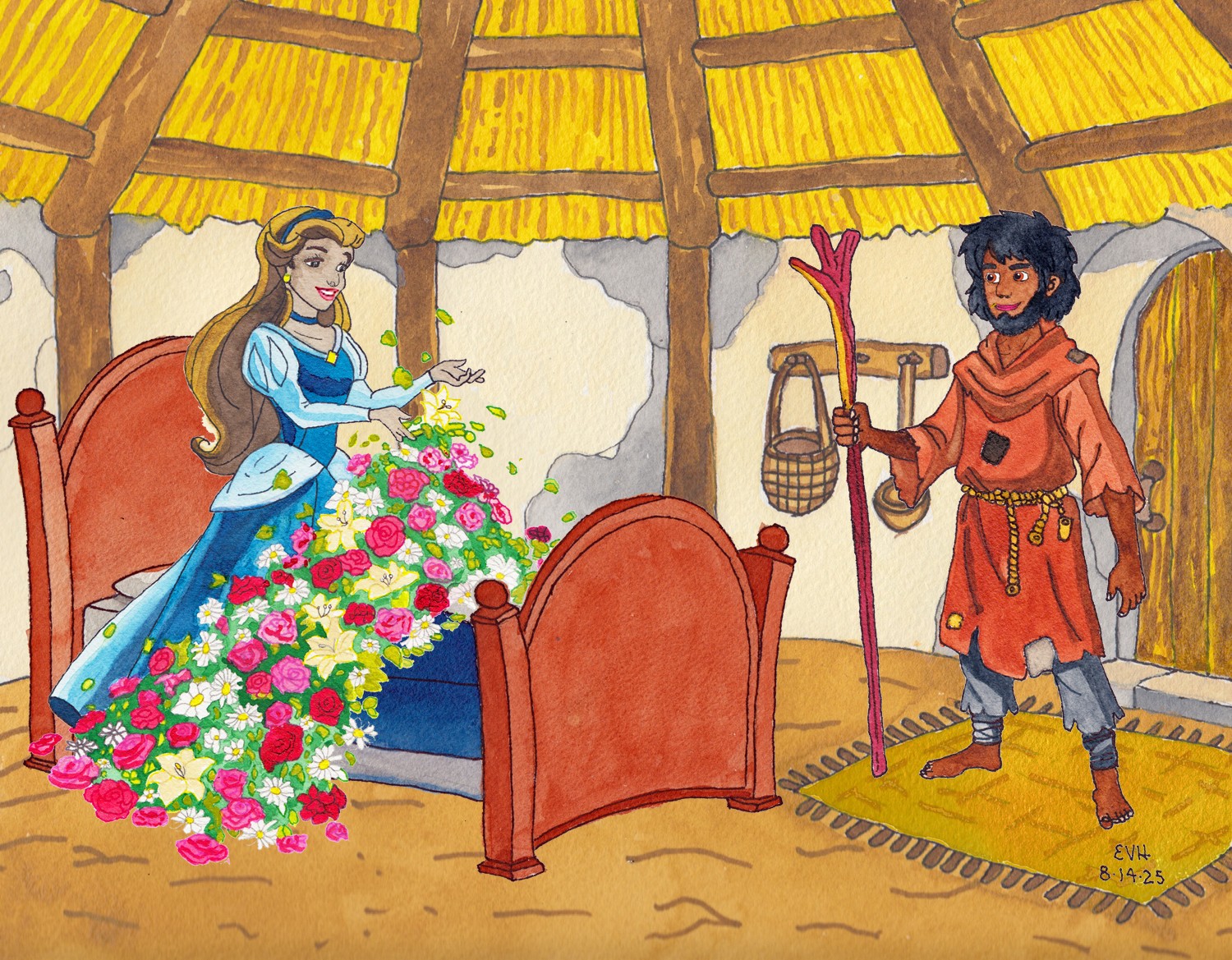
Figure: “The prince saw the Nāga in all her great beauty.”
He asked her who she was. “My lord, I am a Nāga woman.” Then he asked, “Do you have a husband?” She replied, “I am a widow without a husband. And where do you live?” “I am Brahmadattakumāra, the son of the king of Benares. But why do you wander about, leaving the abode of the Nāgas?” “My lord, as I saw the happiness of the other Nāga women who had husbands, I became discontented because of sensual passion. I left and went wandering about, looking for a husband.” He replied, “I also am not an ascetic from faith, but I have come to live here because my father drove me away. Do not be distressed. I will be your husband, and we will live here in harmony.” She at once consented.
From that time on, they lived in harmony together there. Using her magic power, she made an expensive house and brought a costly couch and spread a bed. From then on, he ate no roots or fruits but feasted on divine meat and drink.
After a while she conceived and gave birth to a son who they called Sāgara-Brahmadatta. When the child was able to walk, she gave birth to a daughter, and because she was born on the seashore, they called her Samuddajā (literally “sea-born”).
Now a forester who lived in Benares went to that place, and when he greeted him, he recognized the prince. After he had stayed there a few days, he said, “My lord, I will tell the king’s family that you are living here.” Accordingly, he left and returned to the city.
Just then the king died. After the ministers had buried him, they met together on the seventh day where they deliberated together. “A kingdom without a king cannot stand. We do not know where the prince lives nor whether he is alive or dead. We will send forth the festal car (something like a royal chariot) and go find the king.”
At that time the forester entered the city. He heard the news and went to the ministers. He told them that before he arrived there, he had been staying for three or four days near the prince. The ministers paid him respect and went there under his guidance. After a friendly greeting, they told the prince that the king was dead and asked him to assume the kingdom. He thought to himself, “I will learn what the Nāga woman thinks.” So he went to her and said, “Lady, my father is dead. His ministers have come to raise the royal umbrella (the symbol of royal authority) over me. Let us go and we will both reign in Benares, and you will be the chief among the 16,000 queens.”
“My lord, I cannot go.” “Why?” “We possess deadly poison, and we are easily enraged for a trifling matter. The anger of a co-wife is a serious thing. If I see or hear anything and cast an angry glance, poison will be instantly scattered like a handful of chaff. Therefore, I cannot go.”
The prince asked her again on the next day. She said to him, “On no account can I go. But these my children are not young Nāgas. Because they are your children, they are of the race of men. If you love me, watch over them. But because they are of watery nature and delicate, they will die if they go by the road and bear the burden of the wind and sunshine. So I will hollow out a boat and fill it with water. Then you will let them play in the water. And once you have brought them to the city, you will have a lake prepared in the vicinity of the palace. In this way they will not suffer.”
With these words, she saluted the prince and walked around him respectfully. She embraced her sons and folded them between her breasts and kissed their heads. Then she entrusted them to him, and with many tears and sobs, she vanished and departed to the Nāga-world.
The prince was also overcome with sorrow. His eyes filled with tears. He went out of the house, and, after wiping his eyes, proceeded to the ministers. They sprinkled him (making him king) and said, “Sire, let us go to the city.”
He commanded them to hollow out a ship, put it on a cart, and fill it with water. “Strew all sorts of flowers of various colors and scents on the surface of the water, for my sons have a watery nature, and they will go along joyfully playing there.” The ministers did so.
When the king arrived at Benares, he entered the city. It was richly decorated. He seated himself on the terrace surrounded by 16,000 dancing girls, his ministers, and other officers. They held a great drinking feast for seven days. Then he had a lake built for his sons where they played continually.
But one day when the water was let into the lake, a tortoise entered. He did not see an exit, so he floated on the surface of the water. While the lads were playing, it rose out of the water, poked out its head, looked at them, and then sank back into the water.
When they saw it, they were frightened. They ran to their father and said to him, “O father, a yakkha (supernatural spirit) has frightened us in the lake.” The king ordered some men to go and seize it. They threw a net and caught the tortoise. Then they showed it to the king.
When the princes saw it, they cried out, “O father, it is a demon.” Because he loved his sons, the king was angry. He ordered the attendants to punish it. Some said, “It is an enemy to the king. It should be pounded to powder with a pestle and mortar.” Others said, “Let us cook it three times over and eat it.” Others said, “Bake it on hot coals.” Still others said, “It must be baked in a jar.”
But one minister—who was afraid of the water—said, “It should be thrown into the whirlpool of the Yamunā. It will be utterly destroyed there. There is no punishment for it like that.” The tortoise heard his words. He thrust out his head and said, “Friend, what misdeed have I committed that you are discussing such a punishment for me? The other punishments I can bear, but this last is excessively cruel. Do not even mention it.”
When the king heard him, he said, “This is the punishment to put into action.” So he ordered him to be thrown into the whirlpool of the Yamunā. There he found a current that led to the dwelling of the Nāgas, and he went to their realm.
Now at that time some young sons of the Nāga king Dhataraṭṭha were sporting in that stream. When they saw him they cried, “Seize that slave.” The tortoise thought, “I have escaped from the hand of the king of Benares to fall into the hands of these fierce Nāgas. How will I get away?” Then he thought of a plan, and making up a false story, he said to them, “Why do you speak in this way to one who belongs to the court of King Dhataraṭṭha? I am a tortoise named Cittacūḷa. I have come to Dhataraṭṭha as a messenger from the king of Benares. Our king has sent me because he wishes to give his daughter to King Dhataraṭṭha. Show me to him.” They were pleased to hear this.
They went to the king and told him the whole matter. The king ordered them to bring the tortoise. But the king was displeased when he saw him. He said, “Those who have such mean bodies cannot act as messengers.” When he heard this the tortoise replied by telling of his own good qualities, “Why should the king need messengers as tall as a palm tree? A small body or a big body is of no matter. The real matter is the power to carry out the errand where you are sent. Now our king, O monarch, has many messengers. Men do his business on the dry land, birds in the air, and I in the water, for I am a favorite of the king’s named Cittacūḷa. I have a particular post. Do not scoff at me.”
Then King Dhataraṭṭha asked him why he was sent by the king. He answered, “The king said to me that he was friends with all the kings of Jambudīpa (one of the continents in Buddhist mythology), and that he now wished to give his daughter Samuddajā in order to make friendship with the Nāga king Dhataraṭṭha. He sent me with these words. Do not delay. Send a company at once with me, name the day, and receive the maiden.”
Greatly pleased, the king paid him great honor. He sent four Nāga youths with him. He instructed them to go and arrange a day after hearing the king’s words and then return. And they, having taken the tortoise with them, left the realm of the Nāgas.
The tortoise saw a lotus pond between the Yamunā and Benares. And trying to find some way to escape, he said, “O Nāga youths, our king and his queen and son saw me coming out of the water as I went to the king’s palace. They asked me to give them some lotuses and lotus roots. I will gather some for them. Let me go here, and, if you do not see me, go forward to the king. I will meet you there.” They believed him and let him go.
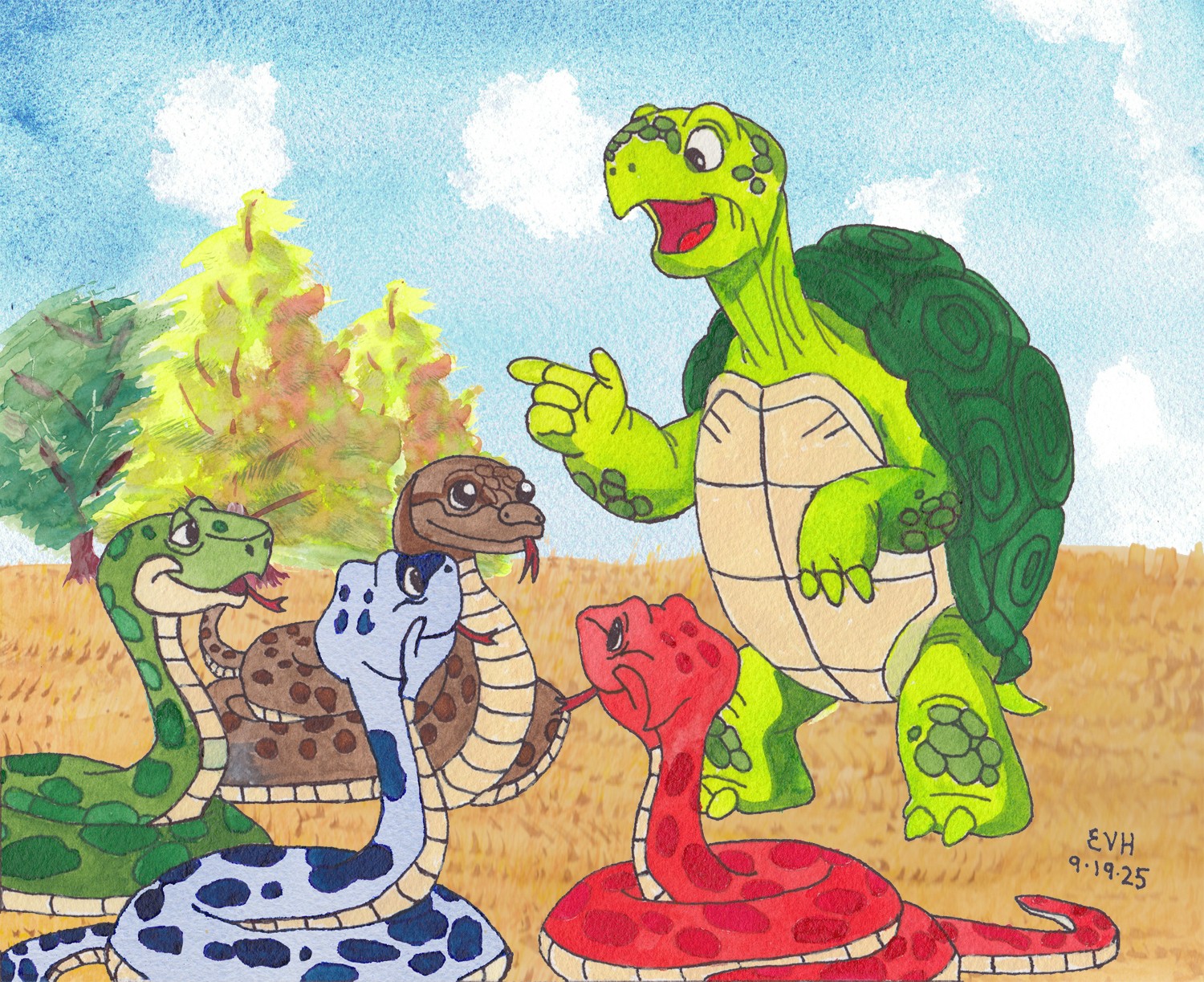
Figure: The tortoise deceives the Nāgas.
He hid himself. The others, as they could not see him, thought that he must have gone on to the king. So they proceeded to the palace in the shape of young men. The king received them with honor and asked them from where they had come. “From Dhataraṭṭha, your majesty.” “For what purpose?” “O king, we are his messengers. Dhataraṭṭha asks after your health, and he will give you whatever you desire. Then he asks you to give us your daughter Samuddajā as his queen.” To explain this they repeated the first stanza:
“Whatever jewels there may be in Dhataraṭṭha’s palace stored,
They all are yours, his royal boon. Give us your daughter for our lord.”
When the king heard this, he replied in the second stanza:
“Ne’er has a man been known to wed his daughter to a Nāga king,
This match is utterly unfit. How could we think of such a thing?”
The youths answered, “If an alliance with Dhataraṭṭha seems so improper to you, then why did you send your attendant, the tortoise Cittacūḷa, to our king, offering to give your daughter Samuddajā? After sending such a message you now show scorn to our king. We will deal with you as you deserve.” So saying they uttered two stanzas by way of threat:
“You sacrifice your life, O king, your throne and kingdom what are they?
Before a Nāga in his wrath all mortal glory fades away.
“You a poor mortal standing there, who, by your vanity undone,
Would look with scorn on Yamuna, king Varuṇa’s imperial son.”
Then the king repeated two stanzas:
“I do not scorn that king of yours, Dhataraṭṭha of wide renown,
Of many Nāgas he is king, he wears by right a royal crown.
“But great and noble though he be, sprung from Videha’s khattiya line,
My daughter is of purer blood, let him not dream of child of mine.”
Although the Nāga youths wished to kill him on the spot using the blast of their breath, they reflected that since they had been sent to fix the marriage day, it would not be right to go away and leave the man dead. So they immediately vanished out of sight, saying, “we will depart and tell the king.”
Their king asked them whether they had brought the princess. They replied angrily, “O king, why did you send us about here and there without cause? If you want to kill us, then kill us here at once. He reviled and defamed you. He put his daughter on a pinnacle touting the superiority of her birth.” In this way they aroused the king’s wrath.
He ordered them to assemble his army, saying:
“Assataras and Kambalas, summon the Nāgas one and all,
Towards Benares let them flock but do no harm to great or small.”
(Assataras and Kambalas are Nāga tribes.)
Then the Nāgas answered, “If no man is to be harmed, then what are we to do if we go there?” He uttered two stanzas to tell them what they were to do and what he himself would do:
“Over the tanks and palaces, the public roads and tops of trees,
Over the gateways twilled in wreaths let them hang dangling in the breeze.
“While with white body and white hoods I will the city all invest,
And drawing close my lines of siege with terror fill each Kāsi breast.”
The Nāgas did so.

The Teacher thus described what happened:
“Seeing the snakes on every side, the women throng, a trembling crowd,
And as the monsters swell their hoods in fear they shriek and wail aloud.
Benares city prostrate lay before these wild invading bands,
Raising their arms all begged and prayed, “Give him the daughter he demands.”
While the king lay in bed he heard the wailing of his own wives and those of the citizens. And fearing death from the threats of the four youths, three times he exclaimed, “I will give my daughter Samuddajā to Dhataraṭṭha.” When they heard this, all the Nāga kings retreated to a distance of a league (three miles or 4.63 km). They established their camp there, built a veritable city of the gods, and sent a complimentary present, saying, “Let him send his daughter as he says.”
The king received the present, then he dismissed those who brought it, saying, “You can now leave. I will send my daughter accompanied by my ministers.” He sent for his daughter and, taking her on the terrace, he opened a window and said to her, “Daughter, behold this adorned city. They say that you will be the chief queen of a king there. The city is not far off. You can come back when you feel a longing for home. But now you must go there.”
He had the attendants wash her head and adorn her with all kinds of ornaments. Then he put her in a covered carriage and sent her off in the care of his ministers.
The Nāga kings came to meet her and paid her great honor. The ministers entered the city and handed her over, then they returned with much wealth. The princess was taken into the palace and made to lie on a divinely decked bed. Young Nāga women, assuming humpbacked and other deformed appearances, waited on her as if they were human attendants. As soon as she lay down on the heavenly bed, she felt a divinely soft touch and fell asleep. Dhataraṭṭha, having received her, vanished instantly with all his host and appeared in the world of the Nāgas. When the princess awoke, she saw the adorned heavenly bed and the golden and jeweled palaces and the gardens and tanks and the Nāga-world adorned like a city of the gods. She asked the humpbacked and other female attendants, “This city is magnificently adorned. It is not like our city. Whose is it?” “O lady, it belongs to your lord. It is not those of scanty merits who win such glory as this. You have obtained it by reason of your great merits.”
Then Dhataraṭṭha ordered the drums to be carried about the Nāga city, which was 500 yojanas (it was big!) in extent, with a proclamation that whoever betrayed any signs of his snake-nature to Samuddajā would be punished. Therefore no one dared to appear as a snake before her.
So she lived affectionately and harmoniously thinking that it was a world of men.
II.
In the course of time Dhataraṭṭha’s queen conceived and gave birth to a son. Because of his fair appearance they him Sudassana (literally “having a good appearance”). Then she gave birth to a second son who they called Datta. He was a Bodhisatta. Then she gave birth to another who they named Subhaga and a fourth who they named Ariṭṭha. Yet even though she had given birth to these four sons, she did not know that it was the world of the Nāgas.
One day they said to Ariṭṭha, “Your mother is a woman, not a Nāga.” Ariṭṭha said to himself, “I will test her.” So one day, while drinking his mother’s breast, he assumed a serpent’s form and struck the back of her foot with his tail. When she saw his serpent-form, she uttered a great cry in her terror and threw him on the ground. He struck his eye with her nail so that the blood poured forth. The king, hearing her cry, asked why she screamed. When he learned what Ariṭṭha had done, he came up with threats. “Seize the slave and put him to death.” The princess, knowing his passionate nature, declared her love for her son. “My lord, I struck my son’s eye, forgive him.” The king, when she said this, replied, “What can I do?” and he forgave him.
That was the day she learned that it was the realm of the Nāgas, and from then on, Ariṭṭha was always called Kāṇāriṭṭha (or one-eyed Ariṭṭha).
The four princes grew up to the years of discretion. Their father gave them each a kingdom a hundred yojanas square. They had great glory, and each was attended by 16,000 Nāga maidens.
Now their father’s kingdom was only a hundred yojanas square. The three sons went to visit their parents every month. But the Bodhisatta went every two weeks. He used to pose some question that had arisen in the Nāga-world. Then he would go with his father to visit the great King Virūpakkha where he would discuss the question with him.
Now one day Virūpakkha went with the Nāga assembly to the world of the gods. They were sitting there waiting upon Sakka. A question arose among the gods, and none could answer it. But the Great Being was seated on a noble throne, and he was able to answer it. Then the king of the gods honored him with divine flowers and fruits and addressed him, “O Datta, you are endowed with a wisdom as broad as the earth. From here forward you will be called Bhūridatta,” and he gave the Bodhisatta this name.
From that time on he would go to pay homage to Sakka, and when he saw the exceedingly delightful splendor of his court with its heavenly nymphs, he longed for the heavenly world. “What do I want to do with this frog-eating snake-nature? I will return to the snake-world and keep the fast and follow the observances by which one may be born among the gods.”
With these thoughts he asked his parents on his return to the abode of the snakes, “O my father and mother, I will keep the fast.” “By all means, O son, keep it. But when you keep it, do not go outside. Keep it within this one empty palace in the Nāga-world, for there is great fear of the Nāgas outside.” He agreed.
So he kept the fast only in the parks and gardens of the empty palace. But the snake maidens kept waiting on him with their musical instruments, and he thought to himself, “If I live here, my observance of the fast will never come to its completion. I will go to the haunts of men and keep the fast there.” So because of his fear of being hindered, without telling it to his parents, he said to his wife, “Lady, if I go to the haunts of men there is a banyan tree on the bank of the Yamunā. I will fold up my body in the top of an anthill nearby and undertake the fast with its four divisions (free from jealousy, drunkenness, desire, and wrath). There I will lie down and observe the fast. And when I have lain there all night and kept the fast, let ten of your women come at dawn with musical instruments in their hands. And after decking me with perfumes and flowers, let them conduct me back with song and dance to the realm of the Nāgas.”
With these words he went and folded his body on the top of an anthill. He said aloud, “Let whoever take my skin or muscles or bones or blood.” Then he undertook the fast with its four divisions, and he lay down. He assumed a body which only consisted of a head and a tail, and he kept the fast.
At daybreak the Nāga girls came. And having done as they were ordered, they conducted him to the Nāga-world. And while he observed the fast in this fashion, a long period of time elapsed.
III.
Now at that time there was a brahmin who lived in a village near the gate of Benares. He used to go into the forest with his son Somadatta and set snares and nets and stakes and kill wild animals. Then he carried the flesh on a pole and sold it. In this way he made a livelihood.
One day he failed to catch even a young lizard. He said to his son, “If we go home empty-handed your mother will be angry. Let us catch something at any rate.” So he went towards the anthill where the Bodhisatta was lying. He saw the footsteps of a deer who had gone down to the Yamunā to drink. He said, “My son, this is a haunt of deer. Return and wait while I shoot some deer that has come to drink.” Then he stood watching for deer at the foot of a tree.
Now in the evening a deer came to drink. He wounded it. However, it did not fall at once. Spurred on by the force of the arrow, it fled with its blood flowing. The father and son chased it to the spot where it fell. Then they took its flesh and left the wood, reaching that banyan tree as the sun set.
“It is a bad time. We cannot go on. We will stay here.” So saying they laid the flesh on one side. They climbed the tree and lay on the branches.
The brahmin woke at dawn. He was listening to hear the sound of the deer when the Nāga maidens arrived and prepared the flowery couch for the Bodhisatta. He laid aside his snake’s body and assumed a divine body adorned with all kinds of ornaments. He sat on his flowerbed with all the glory of a Sakka. The Nāga maidens honored him with perfumes and garlands and played their heavenly instruments and performed their dance and song.
When the brahmin heard the sound he said, “Who is this? I will find out.” He called to his son, but even though he called, he could not wake him. “Let him sleep on,” he said. “He is tired. I will go alone.” So he climbed down from the tree and approached. But when the Nāga maidens saw him, they sank into the earth with their instruments and departed to the realm of the Nāgas. This left the Bodhisatta alone. The brahmin—standing nearby—questioned him in these two stanzas:
“What youth is this, red-eyed, who here is seen,
His shoulders broad with ample space between,
And what ten maidens these who guard him round
Clad in fair robes, with golden bracelets bound!
“Who are you ‘midst this forest greenery,
Bright like a fire just newly dressed with ghee?
Are you a Sakka or a yakkha, say,
Or some famed Nāga prince of potent sway?”
When the Great Being heard him, he thought, “If I say that I am one of the Sakkas he will believe me, for he is a brahmin. But I must speak only the truth today.” So he declared his Nāga birth:
“I am a Nāga great in power, invincible with poisonous breath,
A prosperous land with all its sons my angry bite could smite with death.
“My mother is Samuddajā, Dhataraṭṭha as sire I claim,
Sudassan’s youngest brother I, and Bhūridatta is my name.”
But when the Great Being said this, he reflected, “This brahmin is fierce and cruel. He may betray me to a snake charmer and hinder my performance of the fast. What if I were to take him to the Nāga kingdom and give him great honor there. This will enable me to carry on my fast without a break.”
So he said to him, “O brahmin, I will give you great honor. Come to the pleasant home of the Nāgas. Let us go there at once.”
“My lord, I have a son. I will go if he comes too.”
The Bodhisatta replied, “Go, brahmin, and fetch him.” And he described to him his own realm:
“Awful and dark is yonder lake, incessant storms its waters toss,
That is my home. My subjects there all hear and none my bidding cross.
“Plunge you beneath the dark blue waves, the peacocks and the herons call,
Plunge and enjoy the bliss there stored for those who keep the precepts all.”
The brahmin went and told this to his son. He brought him, and the Great Being took them both. They went to the bank of the Yamunā, and, standing there, said:
“Fear not, O brahmin with your son, follow my words and you will live
Honored and happy in my home with all the pleasures I can give.”
So using his power, the Great Being brought the father and son to the realm of the Nāgas. There they obtained a divine condition. He bestowed on them divine prosperity and gave each of them 400 Nāga maidens, and they enjoyed great prosperity.
The Bodhisatta continued to practice his fast diligently. Every two weeks he went to pay honor to his parents and taught them the Dharma. Then he would go to the brahmin, ask him about his health, and say to him, “Tell me anything that you want. Enjoy yourself without discontent.” And, after giving a kindly greeting to Somadatta, he proceeded to his own home.
After living in the Nāga-world for a year, because of his lack of merit, the brahmin began to grow discontented. He longed to return to the world of men. The realm of the Nāgas seemed like a hell to him, the adorned palace like a prison, and the Nāga maidens with their ornaments like female yakkhas. He thought to himself, “I am discontented. I will learn what Somadatta thinks.” So he went to him and said, “Aren’t you discontented, my son?” “Why should I be discontented? We should not feel that way. Are you discontented, father?” “Yes, my son?” “Why so?” “Because I do not see your mother and your brothers and sisters. Come, my son, let us go.”
Somadatta answered that he would not go. But after being repeatedly entreated by his father, he at last consented. The brahmin reflected, “I have won my son’s consent, but if I tell Bhūridatta that I am discontented, he will heap even more honor on me, and I will not be able to go. My objective can only be attained in one way. I will describe his prosperity and then ask him, ‘why do you leave all this glory and go to the world of men to practice the observance of the fast?’ When he answers, ‘for the sake of obtaining heaven,’ I will tell him, ‘far more then we should do so, we who have made our livelihood by slaughtering living creatures. I, too, will go to the world of men. There I will see my family. Then I will leave the world and follow the law of the ascetics.’ Then he will let me depart.”
One day when Bhūridatta came up to him and asked him whether he was discontented, he assured him that nothing was wanting that he could supply. And without making any mention of his intended departure, at first he described the other’s prosperity in the following stanzas:
“Level the ground on every side, with flowering blossoms whitened o’er,
Red with the cochineal insect-swarms, the brightest verdure for its floor,
“With sacred shrines in every wood, and swan-filled lakes which charm the eye,
While strewn the fallen lotus leaves as carpets on the surface lie,
“The thousand-columned palaces with halls where heavenly maidens dance,
Their columns all of jewels wrought, whose angles in the sunshine glance.
“You have, indeed, a glorious home, won by your merits as your own,
When all desires are gratified as soon as each new wish is known.
“You envy not great the Sakka’s halls, your courts even greater and so fine?
Your palaces more glorious are and with more dazzling splendors shine.”
The Great Being replied, “Say not so, brahmin. Our glory compared to Sakka’s is only like a mustard seed beside Mount Meru. We are not even equal to his attendants.” And he repeated a stanza:
“Our highest thoughts cannot conceive the imperial pomp round Sakka’s throne,
Or the four Regents in his court, each in his own appointed zone.”
(The four Regents are the guardians of the four directions.)
When he heard him repeat his words “this palace of yours is Sakka’s palace,” he said, “I have had this in my mind. It is because of my desire to obtain Vejayanta (Sakka’s heaven) that I practice the observance of the fast.” Then he repeated a stanza, describing his own earnest wish:
“I long intensely for the home of the immortal saints on high,
Therefore upon that anthill top I keep the fast unceasingly.”
When the brahmin heard this, he thought to himself, “Now I have my opportunity.” And filled with joy, he repeated two stanzas begging leave to depart:
“I, too, sought deer when with my son into that forest glade I sped,
The friends I left at home know not whether I am alive or dead.
“O Bhūridatta, let us go, you glorious lord of Kāsi race,
Let us depart and see once more our kindred in their native place.”
The Bodhisatta answered:
“‘Tis my desire that you should live with us and here pass happy hours,
Where in the upper world of men will you find haunts of peace like ours?
“But would you live awhile elsewhere and yet enjoy our pleasures still,
Then take my leave, go, see your friends, and be as happy as you will.”
And thinking to himself “if he obtains this happiness through me, he will not tell anyone else. I will give him my jewel that grants all desires.”
So he gave him the jewel and said:
“The bearer of this heavenly gem beholds his children and his farm,
Take it, O brahmin, and be gone, its bearer never comes to harm.”
The brahmin replied:
“I understand your words too well, I have grown old as you can see,
I will adopt the ascetic life, what are life’s pleasures now to me?”
The Bodhisatta said:
“If you should fail and break your vow then seek life’s common joys once more,
And come and find me out again and I will give you ample store.”
The brahmin answered:
“O Bhūridatta, I accept with thanks the offer you have made,
Should the occasion come to me I will return to claim your aid.”
The Great Being saw that he had no desire to live there, so he commanded some young Nāgas to take him to the world of men.
The Master then described what happened:
“Then Bhūridatta gave commands to four of his young Nāgas, ‘Go,
Take you this brahmin in your charge and lead him where he wants to go.’
“The four attendants heard the words, at once their lord’s command was done,
They brought the brahmin to the place and leaving him returned alone.”
Then the brahmin, as he went along, said to his son, “Somadatta, we wounded a deer in this place and a boar in that,” and seeing a lake on the way he exclaimed, “Somadatta, let us bathe.” So they took off their divine ornaments and clothes, and wrapping them up in a bundle, they laid them on the bank and bathed.
At that very moment the ornaments vanished and returned to the Nāga-world, and their former poor yellow clothes were wrapped around their bodies. Their bows, arrows, and spears came back as they were before. “We are undone, father,” bewailed Somadatta. But his father comforted him: “Fear not. As long as there are deer, we will make a livelihood by killing them in the forest.”
Somadatta’s mother heard of their arrival, and having gone to meet them, she brought them home. She satisfied them with food and drink. When the brahmin had eaten and fallen asleep she asked her son, “Where have you been all this time?” “O mother, we were carried by the Nāga king Bhūridatta to the great Nāga-world, and we have just now come back because we were discontented.” “Have you brought any jewels? “None, mother.” “Why did he not give any to you?” “Mother, Bhūridatta gave a jewel to my father that grants all desires, but he would not accept it.” “Why?” “He is going, they say, to become an ascetic.” “What? After leaving me so long with the burden of the children and living in the Nāga-world, he is now going to become an ascetic?”
She flew into a rage. She struck his back with the spoon that she used for frying the rice. She chastised him, saying, “You wicked brahmin, why did you say that you were going to become an ascetic and refuse the precious jewel? And why did you come here and not take the ascetic’s vow? Leave my house immediately!”
But he said to her, “Good lady, do be not angry. As long as there are deer in the forest, I will support you and your children.” So on the next day, he went into the forest with his son. There he followed there the same livelihood as he had before.
IV.
Now at that time a garuḷa bird (a “garuda” bird is a mythical golden winged bird) lived in a silk-cotton tree in Himavat (Himalayas) in a region of the great southern ocean. He swept up the water with the wind of its wings, and swooping down on the Nāga region. he seized a Nāga king by the head. But this was the period when the garuḷas did not know how to properly seize the Nāgas. They learned how in the Paṇḍara Jātaka (Jātaka 518). So although he seized it by the head without scattering the water, he carried it dangling to the summit of Himavat.
A brahmin who was an old inhabitant of Kāsi, was following the life of a recluse in the region of Himavat. He was living in a hut of leaves that he had built. There was a great banyan tree at the end of his covered walk. He spent his days at its root.
The garuḷa carried the Nāga to the top of the banyan, and as he hung down, in his effort to escape, he twisted its tail around a branch. The garuḷa—unaware of this—flew up to heaven by using his great strength and carried the banyan tree up without its roots. The bird then took the Nāga to the silk-cotton tree and struck it with his beak. This split open its belly. And having eaten the fat, he dropped the body into the middle of the sea.
As it fell, the banyan tree made a great noise. The bird wondered what the noise was. He looked down, and seeing the tree he thought to himself, “Where did that come from?” Then he recognized that it was the banyan at the end of the recluse’s covered walk. He thought, “This tree was of great service to him. Will some evil consequence come to me? I will ask him and learn.” So he went to him in the guise of a young pupil.
Now at that moment the recluse was smoothing down the earth. So the king of the garuḷas, having saluted him, sat down on one side. He asked him—as if he were himself ignorant of the fact—what had once grown in that spot. He replied, “A garuḷa was carrying off a Nāga for his food. The Nāga wrapped its tail around a branch of a banyan tree in order to escape. But using its great strength, the bird sprang upwards and flew off. And so the tree was torn up. This is the place from which it was torn.” “What negative consequences accrued to the bird?” “If he did it not knowing what he did, it was only ignorance, not a wicked act.” “What was the case with the Nāga?” “He did not seize the tree with an intent to hurt it. Therefore he, also, has no negative consequences.”
The garuḷa was pleased with the recluse. He said, “My friend, I am that king of the garuḷas, and I am pleased with your explanation of my question. Now you live here in the forest, and I know the Ālambāyana spell of priceless value. I will give it to you as my fee for your lesson. Please accept it.” “I know enough spells. You can go.”
But he continued to press him, and at last he persuaded him to accept the spell. So he gave him the spell, and showed him the necessary herbs, and departed.
Now at that time a poor brahmin in Benares had gotten deeply into debt. He was being pressured by his creditors. He said to himself, “Why should I go on living here? I am sure it would be better to go into the forest and die.” So he left his home and traveled until he came to that hermitage. He entered it and pleased the ascetic by his diligent service. The recluse said to himself, “This brahmin is very helpful to me, I will give him the divine spell which the king of garuḷas gave to me.” So he said to him, “O brahmin, I know the Ālambāyana spell. I will give it to you. Please take it.” The brahmin replied, “Peace, good friend. I do not want any spell.” But the recluse pressed him again and again, and at last he persuaded him. So he gave him the spell, showed him the herbs necessary for it, and described the entire method of using it.
The brahmin said to himself, “I have gained a means of livelihood.” So after staying there a few days, he complained that he had an attack of rheumatism. And after begging the ascetic’s forgiveness, he took his respectful leave of him and departed from the forest. And after traveling by successive stages, he reached the bank of the Yamunā. From there he traveled along the high road, repeating the spell.
Now at that very time a thousand Nāga youths who attended Bhūridatta were carrying the jewel that grants all desires. They had come out of the Nāga-world and had stopped and placed it on a hill of sand. And after playing all night in the radiant water, they had put on all their ornaments at daybreak. Then they made the jewel display its splendor and sat down, guarding it.
The brahmin reached the spot while he was repeating his charm. When they heard the charm, they were filled with terror that it might be the garuḷa king. So, they plunged into the earth without taking the jewel, and they fled to the Nāga-world.
When he saw the jewel, the brahmin exclaimed, “My spell has succeeded!” He joyfully seized the jewel and went on his way. Now at that very time the outcast brahmin was entering the forest with his son Somadatta to kill deer. When he saw the jewel in the other’s hand he said to his son, “Isn’t that the jewel that Bhūridatta gave to us ?” “Yes,” his son said, “it is the very one.” “Well, I will tell him that it is evil and trick him into giving us the jewel.” “O father, you did not keep the jewel when Bhūridatta gave it to you. This brahmin will surely cheat you. Be silent about it.” “Let it be, my son. You will see who can cheat the best, him or me.” So he went to Ālambāyana and said to him:
“Where did you get that gem of yours, bringing good luck and fair to th’ eye,
But having certain signs and marks, which I can recognize it by?”
Ālambāyana answered in the following stanza:
“This morning as I walked along, I saw the jewel where it lay,
Its thousand red-eyed guards all fled and left it there to be my prey.”
The outcast’s son, wishing to cheat him, proceeded to tell him the jewel’s evil qualities in three stanzas:
“Carefully tended, honored well, and worn or stowed away with care,
It brings its owner all good things, however large his wishes are.
But if he shows it disrespect and wears or stows it heedlessly,
Sore will he rue the finding it, ’twill only bring him misery.
Do you have nought to do therewith, you have no skill such ware to hold,
Give it to me and take instead a hundred pounds of yellow gold.”
Then Ālambāyana spoke a stanza in reply:
“I will not sell this gem of mine, though cows or jewels offered be,
Its signs and marks I know full well, and it shall ne’er be bought from me.”
The brahmin said:
“If cows or jewels will not buy from you that jewel which you wear,
What is the price you’ll sell it for? Come, a true answer let me hear.”
Ālambāyana answered:
“He who can tell me where to find the mighty Nāga in his pride,
To him this jewel will I give, flashing its rays on every side.”
The brahmin said:
“Is this perchance the Garuḷ King, come in a brahmin’s guise today,
Seeking, while on the track for food, to seize the Nāga as his prey?”
Ālambāyana answered:
“No bird-king I, a garuḷ bird ne’er came across these eyes of mine,
I am a brahmin doctor, friend, and snakes and snake-bites are my line.”
The brahmin said:
“What special power do you possess, or have you learned some subtle skill
Which gives you this immunity to handle snakes whose fangs can kill?”
He replied, thus describing his power:
“The hermit Kosiya in the wood kept a long painful penance well,
And at the end a Garuḷa revealed to him the serpent spell.
“That holiest sage, who lived retired upon a lonely mountain height,
I waited on with earnest zeal and served unwearied day and night.
“And at the last to recompense my years of faithful ministry
My blessed teacher did reveal the heavenly secret unto me.
“Trusting in this all-powerful spell, the fiercest snakes I do not fear,
I counteract their deadliest bites, I Alambāyana the seer.”
As he heard him, the outcast brahmin thought to himself, “This Ālambāyana is ready to give the pearl of gems to anyone who shows him the Nāga. I will show him Bhūridatta and so secure the gem.” So he uttered this stanza as he consulted with his son:
“Let us secure this gem, my son, come, Somadatta, let’s be quick,
Nor lose our luck as did the fool who smashed his meal dish with his stick.”
Somadatta replied:
“All honor due he showed to you, when you came in that stranger’s way,
And would you turn and rob him now, his kindly welcome to repay?
“If you want wealth, go look for it from Bhūridatta as before,
Ask him and he will gladly give all that your heart desires, and more.”
The brahmin said:
“That which, by lucky fortune brought, in bowl or hand all ready lies,
Eat it at once no questions ask, lest you should lose the offered prize.”
Somadatta replied:
“Earth yawns for him, hell’s fiercest fires await the traitor at the end,
Or, with fell hunger gnawed, he pines a living death, who cheats his friend.
“Ask Bhūridatta, he will give, if you want wealth, the wished-for boon;
But if you err, I fear the deed will find you out and that right soon.”
The brahmin said:
“But, through a costly sacrifice brahmins may err and yet be clean,
Great sacrifices we will bring and, so made pure, escape the mean.”
Somadatta said:
“Cease your vile talk, I will not stay, this very moment I depart,
I will not go one step with you, this baseness rankling in your heart.”
So saying, the wise youth—rejecting his father’s counsel—exclaimed with a loud voice that startled the deities in the neighborhood. “I will not go with such an evil-doer!” He fled as his father stood looking on. Plunging into the recesses of Himavat, he became an ascetic. And having practiced the Faculties (1) faith/confidence, 2) energy, 3) mindfulness, 4) concentration/samadhi and 5) wisdom/insight) and the Attainments (jhānas), and having perfected mystic meditation, he was born in the Brahma world.
The Teacher explained this in the following stanza:
“The noble Somadatta thus rebuked his father where he stood,
Startling the spirits of the place and turned and hurried from the wood.”
The outcast brahmin thought to himself, “Where will Somadatta go except to his own home?” When he saw that Ālambāyana was a little vexed, he said to him, “Do not mind, Ālambāyana. I will introduce you to Bhūridatta.” So he took him and went to the place where the snake king kept the fast day. And when he saw him lying on the top of the anthill with his hoods contracted, he stood a little way off, and holding out his hand uttered two stanzas:
“Seize this King serpent where he lies and snatch forthwith that priceless gem,
Which bright red like a lady-bird glows on his head a diadem.
“On yonder ant heap see! He lies, stretched out without a thought of fear,
Spread like a heap of cotton there, seize him before he knows you’re near.”
The Great Being opened his eyes, and—seeing the outcast—he pondered, “I took this fellow to my Nāga home and settled him in great prosperity. But he would not accept the jewel that I gave him, and now he comes here with a snake charmer. But if I were angry with him for his treachery, my moral character would be injured. Now my first duty is to keep the fast day in its four periods (i.e., the four Uposatha days). That must remain inviolate. So whether Ālambāyana cuts me into pieces or cooks me or fixes me on a spit, I must not be angry with him.” So he closed his eyes, and with the greatest resolution, he placed his head between his hoods and lay perfectly motionless.
V.
Then the outcast brahmin exclaimed, “O Ālambāyana, seize this Nāga and give me the gem.” Ālambāyana, delighted at seeing the Nāga and not caring the least for the gem, threw it into his hand, saying, “Take it, brahmin.” But the jewel slipped out of his hand, and as soon as it fell, it went into the ground and was lost in the Nāga-world.
The brahmin found himself bereft of the three things: the priceless gem, Bhūridatta’s friendship, and his son. He went off to his home, loudly lamenting, “I have lost everything. I would not follow my son’s words.” But Ālambāyana anointed his body with divine herbs. And eating a little, he fortified himself within. He uttered the divine spell, and—going up to the Bodhisatta—seized him by the tail. He held him fast, opened his mouth, and, having himself eaten a drug, spat into it.
The pure-natured Nāga king did not allow himself to feel any anger for fear of violating the moral precepts. And even though he opened his eyes, did not open them completely. After Ālambāyana had filled the snake with the magic drug, He held him by the tail with his head downwards. He shook him and made him vomit the food he had swallowed. He stretched him out at full length on the ground. Then he pressed him like a pillow with his hands. He crushed his bones to pieces. Then he seized his tail and pounded him as if he were beating cloth. The Great Being felt no anger even though he suffered such pain.
The Teacher described this in the following stanza:
“By using drugs of magic power and muttering spells with evil skill,
He seized and held him without fear and made him subject to his will.”
Having made the Great Being helpless, he prepared a basket of vines and threw him into it. At first his huge body would not go into it, but after kicking him with his heels he forced him to enter. Then he went to a certain village. He set the basket down in the middle of it and shouted aloud, “Let all come here who wish to see a snake dance.”
All the villagers crowded round. Then he called to the Nāga king to come out. The Great Being reflected, “It will be best for me to please the crowd and dance today. Perhaps he will get some money, and in his content, he will let me go. Whatever he wants me to do, I will do it.”
So when Ālambāyana took him out of the basket and told him to swell out, he assumed his full size. And when he told him to become small or round or heaped up like a bank or to assume one hood or two hoods or three or four or five or ten or twenty or any number up to a hundred, or to become high or low, or to make his body visible or invisible, or to become blue or yellow or red or white or pink, or to emit water, or to emit water and smoke, he made himself assume all these various appearances as he was commanded. He showed his dancing powers. No one who witnessed it could keep back his tears, and the people brought gold coin, gold, garments, ornaments, and the like so that he received a 100,000 gold coins in that village alone.
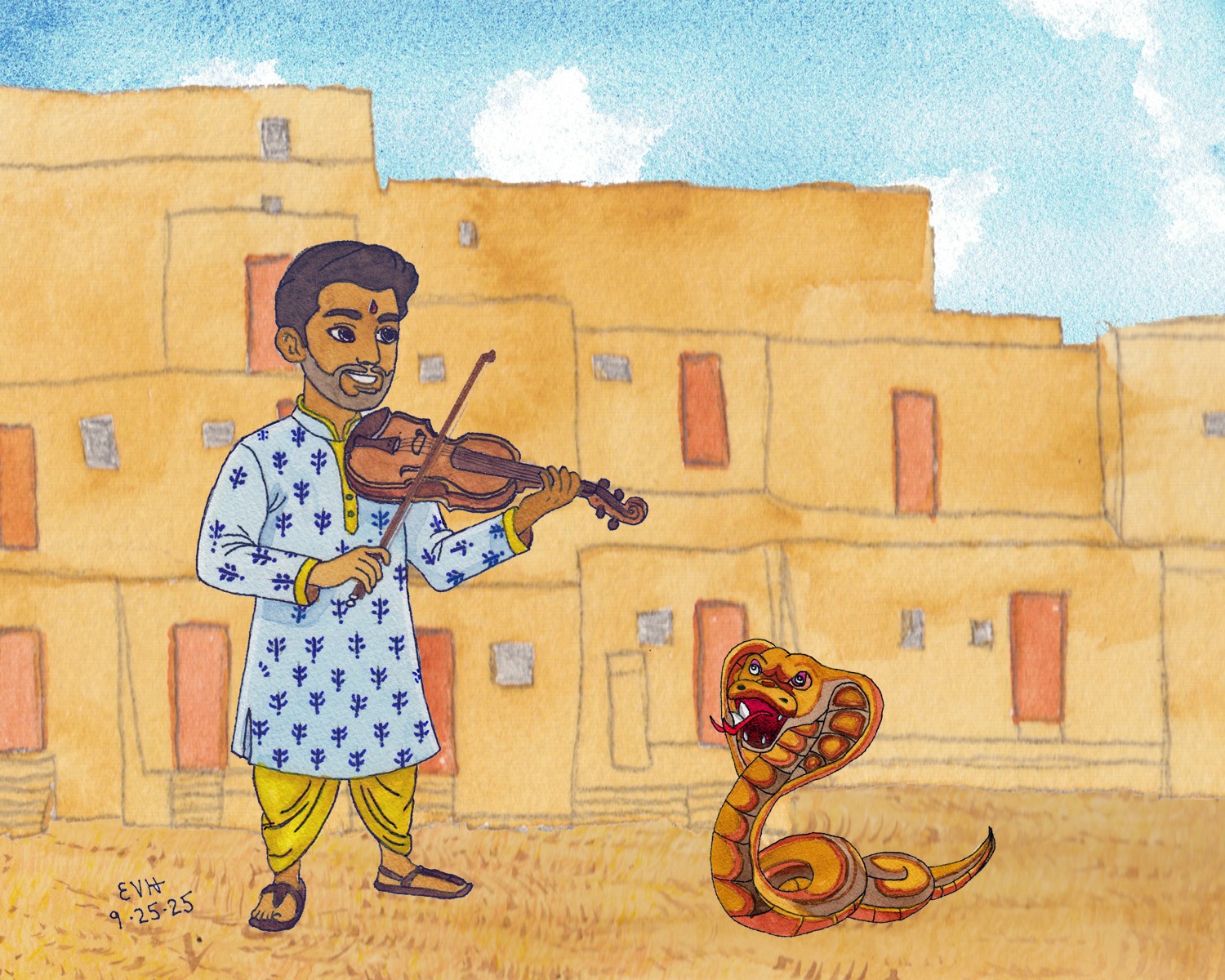
Figure: The Great Being performs for the crowd.
Now at first, after he had captured the Great Being, he had intended to let him go when he had gained 100,000 gold coins. But when he made such a harvest, he said, “I have gained all this money in one little village. What a fortune I will get in a city!” So, after settling his family there, he made a basket all covered with jewels. He threw the Great Being into it, mounted a luxurious carriage, and went off with a great train of attendants.
He made him dance in every village and town which they passed, and at last they reached Benares. He gave the snake king honey and fried grain. He killed frogs for him to eat. But he would not take the food. He was afraid that he would not be released from his captivity. But even though he did not eat, the brahmin made him perform.
Beginning with the four villages at the gates of the city, there he spent a month. Then on the fast day of the fifteenth, he announced to the king that he would exhibit the snake’s dancing powers before him. As a result, the king made a proclamation by beat of drum. A large crowd collected. Tiers of scaffolding were erected in the courtyard of the palace
VI.
But on the day when the Bodhisatta was seized by Ālambāna, the Great Being’s mother saw in a dream that a black man with red eyes had cut off her arm with a sword and was carrying it away streaming with blood. She sprang up in terror. But on feeling her right arm, she saw that it was only a dream. Then she reflected, “I have seen an evil frightful dream. It foreshadows some misfortune either to my four sons or to King Dhataraṭṭha or to myself.” But then she fixed her thoughts on the Bodhisatta: “Now all the others are livin in the Nāga-world. But he has gone into the world of men resolved to keep the precepts with a vow to observe the fast day. I wonder if some snake charmer or garuḷa has seized him.
So she thought of him more and more, and at the end of a fortnight, she became quite dejected. She said, “My son could not live a whole two weeks without me. Surely some evil has come to him.”
After a month had passed, there was no limit to the tears that flowed from her eyes in her distress. She sat watching the road by which he would return, continually saying, “Surely he will now be coming home. Surely be will now be coming home.”
At the end of a month’s absence, her eldest son Sudassana came with a great retinue to pay a visit to his parents. And having left his attendants outside, he ascended the palace. After saluting his mother, he stood on one side. But she said nothing to him from the despair for Bhūridatta. He thought to himself, “Whenever I have returned before, my mother has always been pleased and given me a kind welcome. But today she is in deep distress. What can be the reason?” So he asked her, saying:
“You see me come with all success, my every wish has hit the mark,
And yet you show no signs of joy, and your whole countenance is dark.
“Dark as a lotus rudely plucked which droops and withers in the hand,
Is this the welcome that you give when I come back from foreign land?”
Even with these words of his, she said nothing. Then Sudassana thought, “Can she have been abused or slandered by someone?” So he uttered another stanza, questioning her:
“Has anyone upbraided you or are you racked with secret pain,
That so your countenance is dark, e’en when you see me back again?”
She replied as follows:
“I saw an evil dream, my son, a month ago this very day,
There came a man who lopped my arm as on my bed I sleeping lay,
And carried off the bleeding limb, no tears of mine his hand could stay.
“Blank terror overpowers my heart, and since I saw that cruel sight
A moment’s peace or happiness I have not known by day or night.”
After she said this, she burst out lamenting, “I cannot see my darling son anywhere, youngest brother. Some evil must have happened to him.” And she exclaimed:
“He whom fair maidens in their bloom used to be proud to wait upon,
Their hair adorned with golden nets, Bhūridatta, alas! is gone.
He whom stout soldiers used to guard, with their drawn swords, a gallant train,
Flashing like some blossoming flowers, alas! I look for him in vain!
I must pursue your brother’s track and find where he has fixed to dwell,
Fulfilling his ascetic vow and learn myself if all be well.”
Having uttered these words, she set out with his retinue as well as her own.
Now Bhūridatta’s wives were not anxious when they did not find him on the top of the anthill. They said that he had undoubtedly gone to his mother’s home. But when they heard that she was weeping because she could not find her son, they went to meet her. They fell at her feet, loudly lamenting, “O lady, today it has been a month since we last saw your son.”
The Teacher described this as follows:
“The wives of Bhūridatta there beheld his mother drawing nigh,
And putting out their arms they wept with an exceeding bitter cry.
“Bhūridatta, your son, went off a month ago, we know not where,
Whether he be alive or dead we cannot tell in our despair.”
The mother joined with her daughters-in-law in their lamentations in the middle of the road, and she then went up with them into the palace. There her grief burst forth as she looked on her son’s bed:
“Like a lone bird whose brood is slain, when it beholds its empty nest,
So sorrow, when I look in vain for Bhūridatta, fills my breast.
“Deep in my heart my grief for him burns with a fierce and steady glow
Just like the furnace which a smith carries where’er he is called to go.”
As she wept, Bhūridatta’s house seemed to be filled with one continuous sound like the hollow roar of the ocean. No one was unmoved, and the whole dwelling was like a sāl-forest smitten by the storm of doomsday.
The Teacher thus described it:
“Like sāl-trees prostrate in a storm, their branches broken, roots uptorn,
So mother, wives, and children, lay in that lone dwelling-place forlorn.”
The brothers Ariṭṭha and Subhagawho had come to visit their parents also heard the noise. They entered Bhūridatta’s dwelling and tried to comfort their mother.
The Teacher thus described it:
“Ariṭṭha then and Subhaga, eager to help and comfort, come,
Hearing the sounds of wild lament which rose in Bhūridatta’s home.
“Mother, be calm, your wailings end, this is the lot of all who live.
They all must pass from birth to birth. Change rules in all things, do not grieve.’’
Samuddajā replied:
“My son, I know it but too well, this is the lot of all who live,
But now no common loss is mine, left thus forlorn I can but grieve.
“Verily if I see him not, my jewel and my soul’s delight,
My Bhūridatta, I will end my wretched life this very night.”
Her sons answered:
“Mourn not, dear mother, still your grief, we’ll bring our brother back;
Through the wide earth on every side, we will pursue his track.
“O’er hill and dale, through village, town and city, till he’s found,
Within ten days we promise you to bring him safe and sound.”
Then Sudassana thought, “If all three of us go in one direction it will take too much time. We must go to three different places: one to the world of the gods, one to Himavat, and one to the world of men. But if Kāṇāriṭṭha goes to the land of men he will set that village or town on fire where he finds Bhūridatta, for he has a cruel nature. It will not do to send him.” So he said to him, “Go to the world of the gods. If the gods have carried him to their world to learn the Dharma from him, then bring him here.” Then he said to Subhaga, “Go to Himavat and search for Bhūridatta in the five rivers and then return.” But as he was considering going to the world of men, he reflected, “If I go as a young man, people will revile me. I must go as an ascetic. Ascetics are dear and welcome to men.” So he put on the robes of an ascetic and, after bidding his mother farewell, he set out.
Now the Bodhisatta had a sister born of another mother. Her name was Accimukhī. She had a great love for the Bodhisatta. When she saw Subhaga setting out, she said to him, “Brother, I am greatly troubled. I will go with you.” “Sister,” he replied, “you cannot go with me for I have assumed an ascetic’s attire.” “I will become a little frog, and I will go inside your matted hair.” He agreed to this. She became a young frog and lay down in his matted hair.
Subhaga resolved that he would search for the Bodhisatta his last known location. So he asked his wife where he spent the fast day and went there first of all. When he saw the blood on the spot where the Great Being had been seized by Ālambāna and the place where he had made the basket of creeping plants, he felt sure that the Bodhisatta had been seized by a snake-charmer. Overcome with grief, and having his eyes filled with tears, he followed Ālambāna’s track.
When he came to the village where he had first displayed the dancing, he asked the people whether a snake charmer had shown his tricks there with a snake. “Yes, Ālambāna showed these tricks a month ago.” “Did he gain anything from it?” “Yes, he gained 100,000 gold coins in this one place.” “Where has he gone now?” “To such and such a village.” He went off asking his way as he went. At last he arrived at the palace gate.
At that very moment Ālambāna had arrived. He had just bathed and been anointed, He was wearing a tunic of fine cloth. His attendant was carring his jeweled basket. A great crowd collected. A seat was placed for the king. While he was still in the palace, he sent a message, “I am coming, let him make the king of snakes play.” Then Ālambāna placed the jeweled basket on a brightly colored rug. He gave a sign, saying, “Come here, O snake king.”
Sudassana was standing at the edge of the crowd. The Great Being poked out his head and looked around surveying the people. Now Nāgas look at a crowd for two reasons. One is to see there are any garuḷa near or any actors. If they see garuḷas, they do not dance out of fear. If they see any actors, they do not dance from shame.
As he looked around, the Great Being saw his brother in the crowd. Repressing the tears that filled his eyes, he came out of the basket and went up to his brother. The crowd, seeing him approach, retreated in fear and Sudassana was left alone. So he went up to him, laid his head on his foot, and wept. Sudassana wept as well. Finally, the Great Being stopped weeping and went into the basket. Ālambāna said to himself, “This Nāga must have bitten that ascetic, I must comfort him.” So he went up to him and said:
“It slipped out of my hand and seized your foot with all its might,
Did it chance bite you? never fear, there’s no harm in its bite.”
Sudassana wished speak to him, so he answered:
“This snake of yours can harm me not,
I am a match and like his lot.
“Search where you will, you will not see
One who can charm a snake like me.”
Ālambāna did not know who it was, so he answered angrily:
“This lout dressed out in brahmin guise challenges me today,
Let all the assembly hear my words and give us both fair play.”
Then Sudassana uttered a stanza in answer:
“A frog shall be my champion, and let a snake be yours,
Five thousand pieces be the stake and let us show our powers.”
Ālambāna rejoined:
“I am a man well-backed with means, and you a bankrupt clown,
Who will stand surety on your side, and where’s the money down?
There is my surety, there’s the stake in case I lose the bet,
Five thousand coins will show my powers, your challenge, see, is met.”
Sadassana heard him and said, “Well, let us show our powers for 5,000 gold coins.” And so—undismayed—he went up into the royal palace. He went up to the king—his father-in-law—and said this stanza:
“O noble monarch, hear my words, ne’er may good luck your steps forsake,
Wilt you be surety in my name? Five thousand pieces is the stake.”
The king thought to himself, “This ascetic asks for a very large sum. What can it mean?” so he replied:
“Is it some debt your father left or is it all your own,
That you should come and ask from me such an unheard-of loan?”
Sudassana repeated two stanzas:
“Ālambāna would beat me with his snake,
I with my frog his brahmin pride will break.
“Come forth, O king, with all your train appear,
And see the beating which awaits him here.”
The king consented and went out with the ascetic.
When Ālambāna saw him, he thought, “This ascetic has gone and got the king on his side. He must be some friend of the royal family.” So he grew frightened and began to follow him, saying:
“I do not want to humble you, I will not boast at all,
But you despise this snake too much, and pride may have a fall.”
Sudassana uttered two stanzas:
“I do not seek to humble you, a brahmin, or despise your skill,
But wherefore thus cajole the crowd with harmless snakes that cannot kill?
“If people knew your real worth as well as I can see it plain,
Why talk of gold? a little meal would be the limit of your gain.”
Ālambāna grew angry and said:
“You mendicant in ass’s skin, uncombed and squalid to the sight,
You dare to scorn this snake of mine, and say forsooth it cannot bite.
“Come near and test what it can do, learn by experience if you must,
I warrant you its harmless bite will make of you a heap of dust.”
Then Sudassana uttered a stanza, mocking him:
“A rat or water-snake perchance may bite
And leave its poison if you anger it.
But your red-headed snake is harmless quite,
It will not bite, however much it spit.”
Ālambāna replied in two stanzas:
“I have been told by holy saints who practiced penance ceaselessly,
Those who in this life give their alms will go to heaven when they die.
“I counsel you to give at once if you have anything to give,
This snake will turn you into dust, you have but little time to live.”
Sudassana said:
“I too have heard from holy saints, those who give alms will go to heaven,
Give you your alms while yet you may, if you have all that can be given.
“This is no common snake of mine, she’ll make you lower your boastful tone,
A daughter of the Nāga king, and a half-sister of my own,
Accimukhī, her mouth shoots flames; her poison ‘s of the deadliest known.”
Then he called to her in the middle of the crowd, “O Accimukhī, come out of my matted locks and stand on my hand.” He put out his hand, and when she heard his voice, she uttered a cry like a frog three times while she was lying in his hair. Then she came out and sat on his shoulder. And springing up, she dropped three drops of poison on the palm of his hand and then went back into his matted locks.
Sudassana stood holding the poison. He exclaimed three times, “This country will be destroyed, this country will be wholly destroyed.” The sound filled all Benares with for an extent of twelve leagues. The king asked what should destroy it. “O king, I see no place where I can drop this poison.” “This earth is big enough, drop it there.” “That is not possible,” he answered, and he repeated a stanza:
“If I should drop it on the ground, listen, O king, to me,
The grass and creeping plants and herbs would parched and blasted be.”
“Well then, throw it into the sky.” “That also is not possible,” he said, and he repeated a stanza:
“If I should do what you suggest, and throw it in the sky,
No rain nor snow will fall from heaven till seven long years roll by.”
“Then throw it into the water.” “That is not possible,” he said, and he repeated a stanza:
“If in the water it were dropped, listen, O king, to me,
Fishes and tortoises would die and all that lives i’ the sea.”
Then the king exclaimed, “I am utterly at a loss. Tell us some way to prevent the land from being destroyed.” “O king, cause three holes to be dug here in succession.” The king did so. Sudassana filled the middle hole with drugs, the second with cow dung, and the third with heavenly medicines. Then he let the drops of poison fall into the middle hole.
A flame erupted. It filled the hole with smoke. This spread and caught fire in the hole with the cow dung. Then once again burst into flame in the hole filled with the heavenly plants. The fire consumed them all, and then itself became extinguished.
Ālambāyana was standing near that hole. The heat of the poison struck him. The color of his skin vanished, and he became a white leper. Filled with terror, he exclaimed three times, “I will set the snake king free.” On hearing him, the Bodhisatta came out of the jeweled basket. He assumed a form radiant with all kinds of ornaments. He stood with all the glory of Indra. Sudassana and Accimukhī stood by.
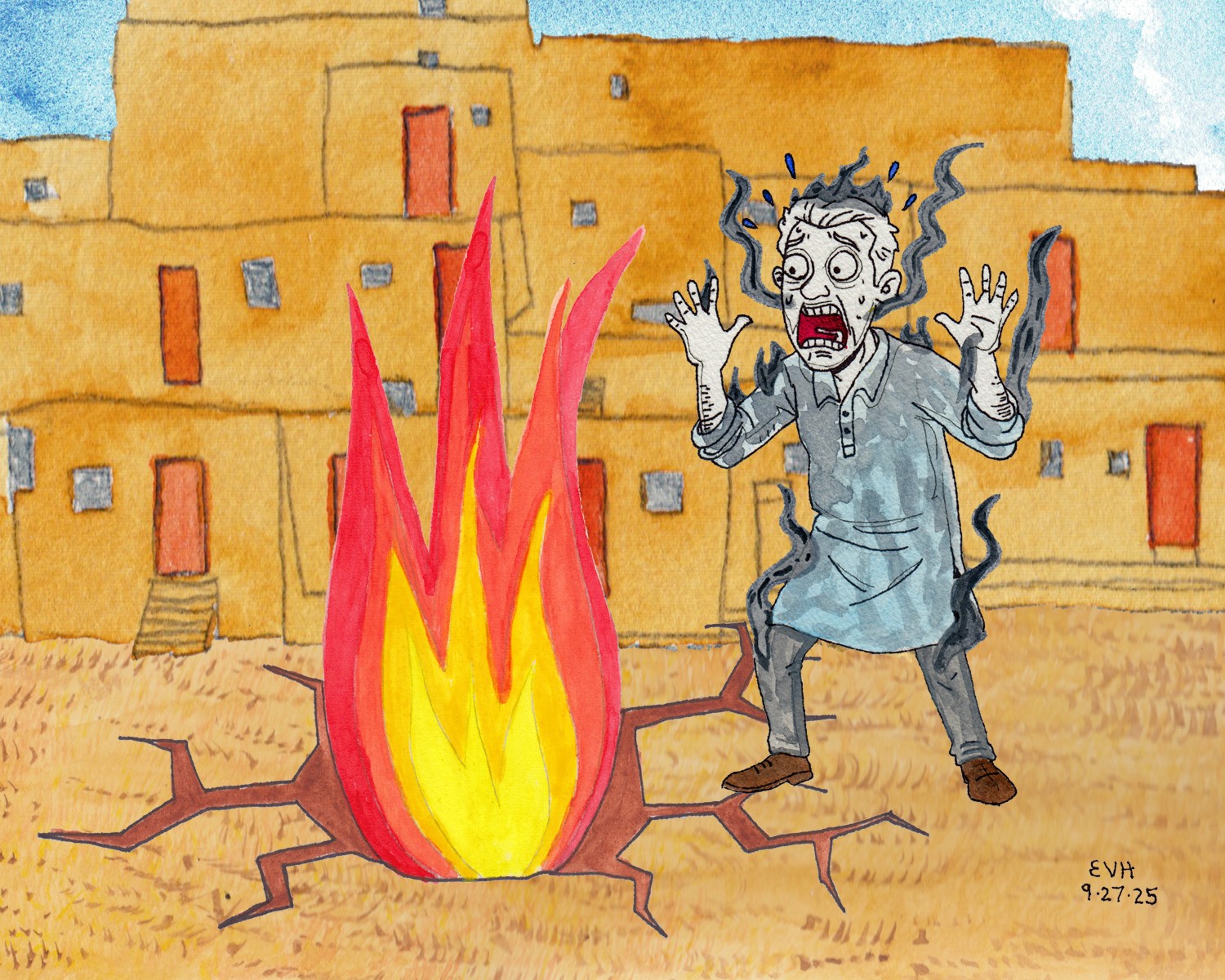
Figure: Sudassana’s scorched Earth policy.
Then Sudassana said to the king, “Do you not know whose children these are?” “I do not.” “You do not know us, but you know that the king of Kāsi gave his daughter Samuddajā to Dhataraṭṭha.” “I know it well, for she was my youngest sister.” “We are her sons, and you are our uncle.” Then the king embraced them and kissed their heads and wept. He took them up into the palace and paid them great honor.
While he was showing all kindness to Bhūridatta, he asked him how Ālambāna had caught him when he possessed such a terrible poison. Sudassana related the whole story and then said, “O great monarch, a king ought to rule his kingdom in this way,” and he taught his uncle the Dharma.
Then he said, “O uncle, our mother is pining because she is afraid of what might have happened to Bhūridatta. We cannot stay away from her any longer.” “It is right. You shall go. But I too want to see my sister. How can I do that?” “O uncle, where is our grandfather, the king of Kāsi?” “He could not bear to live without my sister, so he left his kingdom and became an ascetic. He is now living in the forest.” “Uncle, my mother is longing to see you and my grandfather. We will take her and go to our grandfather’s hermitage. Then you, too, will see him.” So they arranged a day on which to meet and left the palace. And the king, after parting with his sister’s sons, returned weeping, and they sank into the earth and went to the Nāga-world.
VII.
When the Great Being came among them, the city became filled with one universal lamentation. He was tired from his month’s residence in the basket and took to a sick-bed. There was no limit to the number of Nāgas who came to visit him, and he tired himself out talking to them. In the meantime Kāṇāriṭṭha, who had gone to the world of the gods and did not find the Great Being there, was the first to come back. So they made him the doorkeeper of the Great Being’s sick residence, for they said that he was passionate and could keep away the crowd of Nāgas.
Subhaga, also, after searching all Himavat and after that the great ocean and the other rivers, came in the course of his wanderings to search the Yamunā. But when the outcast brahmin saw that Ālambāna had become a leper, he thought to himself, “He has become a leper because he worried Bhūridatta. Now I, too, through lust of the jewel, betrayed him, although he had been my benefactor. This crime will come to haunt me. Before it comes, I will go to the Yamunā, and I will wash away the guilt in the sacred bathing place.” So he went down into the water, saying that he would wash away the consequences of his treachery.
At that moment Subhaga arrived at that spot, and, hearing his words, he said to himself, “This evil wretch betrayed my brother for the sake of a gem charm. My brother had given Ālambāna a means of enriching himself. I will not spare his life.” So, twisting his tail around his feet and dragging him into the water, he held him down. Then when he was breathless, he let him remain quiet a while. And when he lifted his head up, he dragged him down again and held him there. He repeated this several times, until at last the outcast brahmin lifted his head and said:
“I’m bathing at this sacred spot here in Payāga’s holy flood,
My limbs are wet with sacred drops, what cruel demon seeks my blood?”
Subhaga answered him in the following stanza:
“He who, men say, in ancient days to this proud Kāsi wrathful came,
And wrapped it round with his strong coils, that serpent king of glorious fame,
His son am I, who hold you now. Subhaga, brahmin, is my name.”
The brahmin thought, “Bhūridatta’s brother will not spare my life. But what if I were to move him to tender-heartedness by reciting the praises of his father and mother and then beg my life?” So he recited this stanza:
“Scion of Kāsi’s royal race divine,
Your mother born from that illustrious line,
You would not leave the meanest brahmin’s slave
To perish drowned beneath the ruthless wave.”
Subhaga thought, “This wicked brahmin is trying to deceive me and persuade me to let him go. But I will not give him his life.” So he answered, reminding him of his misdeeds:
“A thirsty deer approached to drink, from your tree porch your shaft flew down,
In fear and pain your victim fled, spurred by an impulse not its own.
“Deep in the wood you saw it fall and bore it on your carrying pole
To where a banyan’s shoots grew thick, clustering around the parent bole.
(“Bole” is the trunk of a tree.)
The parrots sported in the boughs, the kokil’s song melodious rose,
Green spread the grassy sward below, evening invited to repose.
But there your cruel eye perceived my brother, who the boughs among
In summer pomp of color dressed sported with his attendant throng.
He in his joyance harmed you not, but you in malice did him slay,
An innocent victim, lo, that crime comes back on your own head to-day,
I will not spare your life an hour, my utmost vengeance you shall pay.”
Then the brahmin thought, “He will not give me my life. I must try my best to escape.” So he uttered the following stanza:
“Study, the offering of prayers, libations in the sacred fire,
These three things make a brahmin’s life inviolate to mortal’s ire.”
Subhaga, when he heard this, began to hesitate and he thought to himself, “I will carry him to the Nāga-world and ask my brothers about this.” So he repeated two stanzas:
“Beneath the Yamunā’s sacred stream, stretching to far Himālaya’s feet,
Lies deep the Nāga capital where Dhataraṭṭha holds his seat.
“There all my hero brethren dwell, to them will I refer your plea,
And as their judgment shall decide, so shall your final sentence be.”
He then seized him by the neck, and, shaking him with loud abuse and revilings, carried him to the gate of the Great Being’s palace.
VIII.
Kāṇāriṭṭha, who had become the doorkeeper, was sitting there. And when he saw that the brahmin was being dragged along so roughly, he went to meet them. He said, “Subhaga, do not hurt him. All brahmins are the sons of the great spirit brahman. If he learned that we were hurting his son, he would be angry and would destroy the Nāga-world. In the world brahmins rank as the highest and possess great dignity. You do not know what their dignity is, but I do.” For they say that Kāṇāriṭṭha in the birth immediately preceding this one had been born as a sacrificing brahmin, and therefore he spoke so positively. Moreover, being skilled in sacrificial lore from his former experiences, he said to Subhaga and the Nāga assembly, “Come, I will describe the character of sacrificial brahmins to you.” And he went on as follows:
“The Veda and the sacrifice, things of high worth and dignity,
Belong to brahmins as their right, however worthless they may be.
“Great honor is their privilege and he who flouts them in his scorn,
Loses his wealth and breaks the law, and lives guilt-burdened and forlorn.”
Then Kāṇāriṭṭha asked Subhaga if he knew who had made the world. When he confessed his ignorance, he told this stanza to show that it was created by Brahma the grandfather of the brahmins:
“Brahmins he made for study, for command
He made the khattiyas, vessas plough the land.
He made Suddas he made servants to obey the rest,
Thus from the first went forth the Lord’s behest.”
Then he said, “These brahmins have great powers, and he who pleases them and gives them gifts is not fated to enter any new birth but goes at once to the world of the gods.“ And he repeated these stanzas:
“Kuvera, Soma, Varuṇa, of old,
Dhātā, Vidhātā, and the Sun and Moon,
Offered their sacrifices manifold,
And to their brahmin priests gave every boon.
The giant Ajjun, too, who wrought such woe,
Round whose huge bulk a thousand arms once grew,
Each several pair with its own threatening bow,
Heaped on the sacred flame the offerings due.”
Then he went on describing the glory of the brahmins and how the best gifts are to be given to them.
“That ancient king who feasted them so well
Became at last a god, old stories tell.
King Mujalinda long the fire adored,
Glutting its thirst with all the ghee he poured.
And at the last the earned reward it brought,
He found the pathway to the heaven he sought.”
He also repeated these stanzas to illustrate this lesson:
“Dujīpa lived a thousand years in all,
Chariots and hosts unnumbered at his call.
“But an ascetic’s life was his at last,
And from his hermitage to heaven he passed.
Sāgara all the earth in triumph crossed,
And raised a golden sacrificial post.
None worshipped fire more zealously than he,
And he, too rose, to be a deity.
The milk and curds which Aṅga, Kāsi’s lord,
In his long offerings so profusely poured,
Swelled Gaṅgā to an ocean by their flood,
Until at last in Sakka’s courts he stood.
Great Sakka’s general on the heavenly plain,
By soma-offerings did the honor gain.
(“Soma” is a traditional religious drink.)
He who now marshals the immortal powers
Rose from mortal wicked stained lot like ours.
Brahma the great Creator, he who made
The mountains landmarks in his altar yard,
Whose hest the Ganges in its path obeyed,
By sacrifice attained his great reward.”
Then he said to him, “Brother, do you know how this sea became salt and undrinkable?” “I know not, Ariṭṭha.” “You only know how to injure brahmins. Listen to me.” Then he repeated a stanza:
“A hermit student, versed in prayer and spell,
Once stood upon the shore, as I’ve heard tell.
He touched the sea, it forthwith swallowed him,
And since that day has been undrinkable.”
“These brahmins are all like this.” And he uttered another stanza:
“When Sakka first attained his royal throne,
His special favor upon brahmins shone.
East, west, north, south, they made their ritual known,
And found at last a Veda of their own.”
In this way Ariṭṭha described the brahmins and their sacrifices and Vedas.
When they heard his words, many Nāgas came to visit the Bodhisatta’s sick bed. They said to one another, “He is telling a legend of the past,” and they seemed to be in danger of accepting false doctrine. Now the Bodhisatta heard it all as he lay in his bed, and the Nāgas told him about it. The Bodhisatta reflected, “Ariṭṭha is telling a false legend. I will interrupt his discourse and put true views into the assembly.” So he rose and bathed and put on all of his ornaments. He sat down in the pulpit and gathered the Nāga multitude together. Then he sent for Ariṭṭha and said to him, “Ariṭṭha, you have spoken falsely when you described the brahmins and the Vedas. The sacrifice of victims by all of these ceremonies of the Vedas is not desirable and it does not lead to heaven. See what unreality there is in your words.” So he repeated these verses describing the various kinds of sacrifice:
(What follows is a condemnation of Brahminism, their practice of animal sacrifice, and theism in general.)
“These Veda studies are the wise man’s toils,
The lure which tempts the victims whom he spoils.
“A mirage formed to catch the careless eye,
But which the prudent passes safely by.
“The Vedas have no hidden power to save
The traitor or the coward or the knave.
“The fire, though tended well for long years past,
Leaves his base master without hope at last.
“Though all earth’s trees in one vast heap were piled
To satisfy the fire’s insatiate child,
“Still would it crave for more, insatiate still,
How could a Nāga hope that maw to fill?
Milk ever changes, thus where milk has been
Butter and curds in natural course are seen.
And the same thirst for change pervades the fire,
Once stirred to life it mounts still higher and higher.
“Fire bursts not forth in wood that‘s dry or new,
Fire needs an effort ere it leaps to view.
“If dry fresh timber of itself could burn,
Spontaneous would each forest blaze in turn.
“If he wins merit who to feed the flame
Piles wood and straw, the merit is the same.
“When cooks light fires or blacksmiths at their trade
Or those who burn the corpses of the dead.
“But none, however zealously he prays
Or heaps the fuel round to feed the blaze,
“Gains any merit by his mummeries,—
The fire for all its crest of smoke soon dies.
“Were Fire the honored being that you think,
Would it thus dwell with refuse and with stink,
“Feeding on carrion with a foul delight,
Where men in horror hasten from the sight?
“Some worship as a god the crested flame,
Barbarians give to water that high name.
“But both alike have wandered from their road,
Neither is worthy to be called a god.
“To worship fire, the common drudge of all,
Senseless and blind and deaf to every call,
“And then one’s self to live a wicked life,
How could one dream to win heaven with such strife?
“These brahmins all a livelihood require,
And so they tell us Brahma worships fire.
“Why should the increate who all things planned
Worship himself the creature of his hand?
“Doctrines and rules of their own, absurd and vain,
Our sires imagined wealth and power to gain.
“’Brahmins he made for study, for command
He made the khattiyas; vessas plough the land.
“’Suddas he servants made to obey the rest,
Thus from the first went forth his high behest.’
“We see these rules enforced before our eyes,
None but the brahmins offer sacrifice.
“None but the khattiya exercises sway,
The vessas plough, the Suddas must obey.
“These greedy liars propagate deceit,
And fools believe the fictions they repeat.
“He who has eyes can see the sickening sight,
Why does not Brahma set his creatures right?
“If his wide power no limits can restrain,
Why is his hand so rarely spread to bless?
“Why are his creatures all condemned to pain?
Why does he not to all give happiness?
“Why do fraud, lies, and ignorance prevail?
Why triumphs falsehood, truth and justice fail?
“I count your Brahma one th’ injust among,
Who made a world in which to shelter wrong.
“Those men are counted pure who only kill
Frogs, worms, bees, snakes or insects as they will.
“These are your savage customs which I hate,
Such as Kamboja 2 hordes might emulate.
(The “Kambojas” were a northwestern tribe that was supposed to have lost their original Aryan customs and became barbarians.)
“If he who kills is counted innocent
And if the victim safe to heaven is sent,
“Let brahmins brahmins kill—so all were well—
And those who listen to the words they tell.
“We see no cattle asking to be slain
That they a new and better life may gain.
“Rather they go unwilling to their death
And in vain struggles yield their latest breath.
“To veil the post, the victim and the blow
The brahmins let their choicest rhetoric flow.
“The post shall as a cow of plenty be
Securing all your heart’s desires to thee.
“But if the wood thus round the victim spread
Had been as full of treasure as they said,
“As full of silver, gold and gems for us,
With heaven’s unknown delights as overplus,
“They would have offered for themselves alone
And kept the rich reversion as their own.
“These cruel cheats, as ignorant as vile,
Weave their long frauds the simple to beguile,
“Offer your wealth, cut nails and beard and hair,
And thou shalt have thy bosom’s fondest prayer.
“The offerer, simple to their hearts’ content,
Comes with his purse, they gather round him fast,
“Like crows around an owl, on mischief bent,
And leave him bankrupt and stripped bare at last.
“The solid coin which he erewhile possessed,
Exchanged for promises that none can test.
“Like grasping strangers sent by those who reign
The cultivators’ earnings to distrain,
“These rob where’er they prowl with evil eye,
No law condemns them, yet they ought to die.
“The priests a shoot of Butea must hold
As part o’ the rite sacred from days of old.
(“Butea” is black ginger.)
“Indra’s right arm ‘tis called, but were it so,
Would Indra triumph o’er his demon foe?
“Indra’s own arm can give him better aid,
‘Twas no vain sham which made hell’s hosts afraid.
“Each mountain range which now some kingdom guards
Was once a heap in ancient altar yards,
“And pious worshippers with patient hands
Piled up the mound at some great lord’s commands.
“So brahmins say, fie on the idle boast,
Mountains are heaved aloft at other cost.
“And the brick mound, search as you may, contains
No veins of iron for tile miner’s pains.
“A holy seer well known in ancient days,
On the seashore was praying, legend says.
“There was he drowned and since this fate befell
The ocean’s waves have been undrinkable.
“Rivers have drowned their learned men at will
By hundreds and have kept their waters still.
“Their streams flow on and never taste the worse,
Why should the sea alone incur the curse?
“And the salt streams that run upon the land
Spring from no curse but own the digger’s hand.
“At first there were no women and no men,
‘Twas mind first brought mankind to light, and then,
“Though they all started equal in the race,
Their various failures made them soon change place.
“It was no lack of merit in the past,
But present faults which made them first or last.
“A clever low caste lad would use his wit,
And read the hymns nor find his head piece split.
“The brahmins made the Vedas to their cost
When others gained the knowledge which they lost.
“Thus sentences are made and learned by rote
In metric forms not easily forgot,
“The obscurity but tempts the foolish mind,
They swallow all they’re told with impulse blind.
“Brahmins are not like violent beasts of prey,
No tigers, lions of the woods are they.
“They are to cows and oxen near akin,
Differing outside they are as dull within.
“If the victorious king would cease to fight
And live in peace with his friends and follow right,
“Conquering those passions which his bosom rend,
What happy lives would all his subjects spend!
“The brahmin’s Veda, khattiya’s policy,
Both arbitrary and delusive be,
“They blindly grope their way along a road
By some huge inundation overflowed.
“In brahmin’s Veda, khattiya’s policy,
One secret meaning we alike can see.
“For after all, loss, gain and glory, and shame
Touch the four castes alike, to all the same.
“As householders to gain a livelihood
Count all pursuits legitimate and good,
“So brahmins now in our degenerate day
Will gain a livelihood in any way.
“The householder is led by love of gain,
Blindly he follows, dragged in pleasure’s train,
“Trying all trades, deceitful and a fool,
Fallen alas! how far from wisdom’s rule.”
The Great Being, having refuted their arguments, established his own Dharma. And when they heard his exposition, the assembly of Nāgas was filled with joy. The Great Being delivered the outcast brahmin from the Nāga-world and did not wound him with a single contemptuous speech.
Sāgara-brahmadatta also did not let the appointed day pass. He went with his entire army to his father’s dwelling place. The Great Being also, having proclaimed by beat of drum that he would visit his maternal uncle and grandfather, crossed over from the Yamunā. He first went to that hermitage with great pomp and magnificence. His remaining brothers and his father and mother came afterwards.
At that moment Sāgara-brahmadatta, not recognizing the Great Being as he approached with his great retinue, asked his father:
“Whose drums are these? Whose tabours, conchs, and what those instruments, whose voice
Swells with deep concert through the air and makes the monarch’s heart rejoice?
“Who is this youth who marches there, with quiver and with bow arrayed,
Wearing a golden coronet that shines like lightning round his head?
“Who is it that approaches there, whose youthful countenance shines bright,
Like an acacia brand which glows in a smith’s forge with steady light?
“Whose bright umbrella, golden-hued, o’erpowers the sun in noonday’s pride,
While deftly hangs a fly flapper ready for action by his side?
“See peacocks’ tails on golden sticks wave by his face with colors blend,
While his bright earrings deck his brow as lightning wreaths the firmament.
“What hero owns that long large eye, that tuft of wool between the brows,
Those teeth as white as buds or shells, their line so faultless and so even,
Those lac-dyed hands, those bimba lips,—he shines forth like the sun in heaven;
(“Bimba” is a child.)
“Like some tall sāl-tree full of bloom, upon a mountain peak alone,
Indra in his triumphant dress with every demon foe o’erthrown.
“Who is it bursts upon our view, drawing from out its sheath his brand,
Its jeweled handle and rich work radiant with splendor in his hand,
“Who now takes off his golden shoes, richly inwrought with varied thread,
And, bending with obeisance low, pours honor on the Sage’s head?”
Having been asked by his son Sāgara-brahmadatta, the ascetic, possessed of transcendent knowledge and supernatural power, replied, “O my son, these are the sons of King Dhataraṭṭha, the Nāga sons of thy sister.” And he repeated this verse:
“These are all Dhataraṭṭha’s sons glorious in power and great in fame,
They all revere Samuddajā and her as common mother claim.”
While they were talking, the host of Nāgas came up, saluted the ascetic’s feet, and then sat down on one side. Samuddajā also saluted her father. And then, after weeping, they returned with the Nāgas to the Nāga-world. Sāgara-brahmadatta stayed there for a few days, and then he went to Benares.
Samuddajā died in the Nāga-world. The Bodhisatta, having kept the precepts all his life and performed all the duties of the fast day, went with the host of Nāgas to fill the seats of heaven at the end of his life.
After the lesson the Teacher exclaimed, “In this way pious disciples, wise men of former times before the Buddha was born, gave up the glory of the Nāga state and rigorously fulfilled the duties of the fast day.” Then he identified the birth: “At that time the family of the great King were my father and mother, Devadatta was the outcast brahmin, Ānanda was Somadatta, Uppalavaṇṇā was Accimukhī, Sāripputta was Sudassana, Moggallāna was Subhaga, Sunakkhatta was Kāṇāriṭṭha, and I was Bhūridatta.”
(Ānanda was the Buddha’s cousin and his personal attendant, Uppalavaṇṇā was one of the Buddha’s foremost nuns, Sāriputta and Moggallāna were the Buddha’s two chief disciples, and Sunakkhatta was a Licchavi prince from Vesāli.)
