
Jataka 542
Khaṇḍahāla Jātaka
The Priest Khaṇḍahāla
as told by Eric Van Horn
originally translated by H.T. Francis and R.A. Neil, Cambridge University
originally edited by Professor Edward Byles Cowell, Cambridge University
This is another but somewhat more intricate story about Devadatta. In this story, an extremely foolish king falls under the influence of a wicked priest. This is, of course, Devadatta in a previous life. Not surprisingly the wicked priest, after a lengthy back and forth with the king, loses out. But the Bodhisatta saves the king from retribution from the city’s people. Nonetheless, the ungrateful kind, who is banished from the city and his status, is ungrateful toward the compassionate Bodhisatta.
“In Pupphavatī once there reigned.” The Teacher was living on the Gijjhakūṭa mountain (This is where Vulture Peak is. It was the Buddha’s favorite place to meditate.). There he related this story concerning Devadatta. Its substance is contained in the section relating to the offense of causing schisms in the community. (Presumably this means in the monastic code, the Vinaya.) It is to be fully known by studying the Tathāgata’s conduct from his first becoming an ascetic down to the murder of King Bimbisāra. (Devadatta conspired with King Bimbisāra’s son Ajatasattu to kill both Bimbisāra and the Buddha.)
As soon as he had killed his father, Devadatta went to Ajātasattu and said to him, “O king, your desire has attained its end, but mine has not yet been attained.” Ajātasattu replied, “What is your desire?” “I wish to have Dasabala (the Buddha) killed and then become Buddha myself.” “Well, what must we do?” “We must collect some archers together.”
The king assented and collected 500 archers. They were all able to shoot as quick as lightning. From these he chose 31 of them and sent them to wait on Devadatta, telling them to carry out his commands. He called the chief one among them and said, “My friend, the ascetic Gotama lives on the Gijjhakūṭa mountain. At a certain time, he walks up and down in his place of retirement during the day. You go there and shoot him with a poisoned arrow, and when you have killed him, return here by a certain road.”
Then he sent two archers by that road and said to them, “You will meet a man coming by your road. Kill him and return by a certain road.”
Then he sent four archers by that road with the same instructions. And after that, similarly he sent eight and then sixteen. If you ask why he did this, he did it to conceal his own wickedness.
So this chief man among the archers bound his sword on his left side, and put his quiver on his back. He took his bow made of a ram’s horn, and he went to the Tathāgata. He strung his bow and fixed the arrow to shoot him. But when he pulled the string, he could not shoot it. His whole body became stiff as if it were crushed, and he stood terrified with the fear of death.
When the Teacher saw him, he spoke in a gentle voice: “Fear not. Come here.” The archer threw down his weapons at once and fell with his head on the Blessed One’s feet. He said, “My lord, wickedness overpowered me like a child or a fool or a criminal. I did not know your virtue. I came here at the command of that blind fool Devadatta to take your life. I beg you to forgive me.”
He gained the Blessed One’s pardon and sat down on one side. Then the Teacher taught the Dharma to him. This caused him to attain stream-entry. Then the Buddha told him to return by a different road than that ordered by Devadatta. Then he went from his covered walk and sat at the foot of a tree.
Because the first archer did not return, the next two archers went along the road to find him. They wondered why he had been delayed for so long. At last they saw the Buddha. They went up to him, and after saluting him, they sat down on one side of him. Then he taught the Dharma to them as well, and this made them also attain stream-entry. He told them to return by a different road than that ordered by Devadatta.
In the same way, as the other archers arrived and successively sat down, he established them all in stream-entry, and then he sent them away by another road.
The first archer to return went to Devadatta and said to him, “Master, I was not able to kill the Allwise One. He is the Mighty One, the Blessed One of supernatural powers.” They all stated they had saved their lives only through the Allwise One. They embraced the ascetic life under him and became arahants.
This incident became known in the Saṇgha, and one day they began to talk about it in the Dharma Hall. “Brothers, have you heard how Devadatta, in his hatred against one person—the Blessed One—tried to deprive many people of their lives, and they were saved through the Teacher?”
The Master came in and asked, “Brothers, what are you discussing as you sit here?” When they told him, he said, “This is not the first time he tried to deprive many people of their lives in his hatred against me.” And he told them this story from the past.
In a past time, Benares was called “Pupphavatī.” The son of King Vasavatti reigned there. Hs name was Ekarājā, and his son, Candakumāra, was viceroy. A brahmin named Khaṇḍahāla was the family priest. He gave the king counsel in temporal and spiritual matters. The king had a high opinion of his wisdom and made him a judge. But he was fond of bribes. He used to take bribes and deprive the real owners of their property and put the wrong owners in possession of it.
One day a man who had lost his lawsuit left the judgment hall loudly complaining. He saw Candakumāra on his way to visit the king. He threw himself at his feet. The prince asked him what was the matter. “My lord, Khaṇḍahāla robs the suitors when he judges. I have lost my cause, even though I gave him a bribe.” The prince told him not to worry. He took him back to court and ordered that the disputed property be returned to him.
The people loudly shouted their applause. When the king heard the clamor and asked the reason for it, they replied, “Candakumāra has rightly decided a lawsuit that was judged wrongly by Khaṇḍahāla. This is why there was such a commotion.”
When the prince went and paid his homage, the king said to him, “My son, they say you have just judged a case.” “Yes, sire.” The king gave the office of judge to the prince and told him to judge all lawsuits.
As a result, Khaṇḍahāla’s income began to decline, and from then on he held a grudge against the prince. He watched for some way to bring about his downfall.
Now the king had little religious insight. One day at dawn, at the end of his sleep, he saw the heaven of the Thirty-three gods with its ornamented portico and its walls made of the seven precious things (gold, silver, pearl, coral, cat’s-eye, ruby, and diamond). It was 60 yojanas in extent, with golden streets. It was a thousand yojanas in height. It was adorned with the Vejayanta (a palace belonging to Sakka) and other palaces. (A “yojana” is not a fixed distance. It is believed to be the distance that an ox can travel in one day.) It had all the glories of the Nandana (a divine forest) and other forests and the Nandā (a sacred lake) and other lakes. It was filled everywhere with heavenly beings.
The king longed to enter it. He thought, “when the teacher Khaṇḍahāla comes, I will ask him the way to the world of the gods. Then I will enter it by the road that he points out.”
Khaṇḍahāla went to the palace in the early morning. He asked whether the king had passed a happy night. Then the king commanded that a seat be given to him, and he asked his question.

To explain this, the Master said:
“In Pupphavatī once there reigned a wicked king who in his need
Asked Khaṇḍahāla, his base priest, brahmin in name but not in deed.
“You are a seer to whom, they say, all sacred learning has been given,
Tell me the road whose travelers rise by their good merits up to heaven.”
Now this was a question which, in the absence of an all-knowing Buddha or his disciples, one must ask a Bodhisatta. But the king asked Khaṇḍahāla. It was just like a man who had lost his way for one week might ask guidance of another who had lost his way for a two weeks. He thought to himself, “Now is the time to see my enemy’s back. I will kill Candakumāra and fulfil my desire.” So he addressed the king:
“Exceeding many gifts bestow, those who deserve not death destroy,
Thus men surpassing merit win and reach at last to heaven’s joy.”
The king asked:
“What are the exceeding many gifts? And who deserves not to be slain?
I’ll give the gifts, the victims slay, if you but make your meaning plain.”
Then he explained his meaning:
“Your sons, your queens must offered be, your merchant princes too must fall,
Thy choicest bulls, your noblest steeds, yes the four kinds of victims all.”
So when he was asked the road to heaven, he declared the road to hell.
The priest said to himself, “If I take Candakumāra alone, they will think that I have done it through my hatred of him.” So he put him with some other people. When the matter became known, the ladies of the royal palace, hearing the rumor, were filled with alarm. They raised a loud cry at once.
Explaining this, the Master recited a stanza:
“The royal ladies heard the news: ‘Princes and queens are doomed,’ they cried,
And a wild cry of sudden fear rose up to heaven on every side.”
The entire royal family was agitated like a grove of sāl trees shaken by the wind at the world’s end. Even the brahmin asked the king whether it was possible for him to offer the sacrifice. “What do you mean, O teacher? If I offer it, I will go to the world of the gods.” “O king, those who are timid and weak cannot offer this sacrifice. Assemble them all here, and I will make the offering in the sacrificial pit.”
So he took sufficient forces and went out of the city. He ordered a sacrificial pit to be dug with a level floor, and he surrounded it with a fence. He did this because ancient brahmins had instructed that this surrounding fence should be made to prevent some righteous ascetic or brahmin from stopping the rite.
The king also made a proclamation. “By sacrificing my sons and daughters and my wives, I will go to the world of the gods. Go and announce this to them and bring them all here.” He immediately ordered them to bring his sons:
“Warn Canda, Suriya of my will, then Bhaddasena in his turn,
Sūra and Vāmagotta next. They must all die, my will is stern.”
So they first went to Candakumāra and said, “O prince, your father wants to kill you and go to heaven. He sent us to seize you.” “By whose instructions has he ordered me to be seized?” “By those of Khaṇḍahāla.” “Does he wish to have me alone seized or others also with me?” “Others also with you, for he wants to offer a sacrifice of the four kinds of victims.”
He thought to himself, “He has no hatred against others. But he intends to put many to death in his hatred against me alone. It is because I prevent him from committing robbery by his unjust judgment. It is my duty to obtain an interview with my father and gain the release of all the rest from him.”
So he said to them, “Carry out my father’s commands.” They took him to the palace yard and placed him by himself. Then they brought the others, and when they had set them near, they informed the king. Then he ordered them to bring his daughters and place them near the others:
“Upaseṇī and Kokilā, Muditā, Nandā, each in turn,
Tell the princesses of their doom, they must all die. My will is stern.”
So they went and brought them, weeping and wailing, and placed them near their brothers. Then the king uttered a stanza to order that his wives should be seized:
“Tell Vijayā, first of all my queens, Sunandā, Kesinī, each in turn,
With all their beauty and their charms, they must all die. My will is stern.”
Then they brought them, as well, loudly wailing. He placed them near the princes. Then the king uttered a stanza ordering them to seize his four merchants:
“Punṇamukha and Bhaddiya, Siṅgāla, Vaddha, each in turn,
Bear to my merchants my command. They all must die. My will is stern.”
The king’s officers went and brought them. When the king’s sons and wives were brought, the citizens uttered not a word. But the merchants had large families. The whole city was troubled when they were seized. They loudly protested their being sacrificed. They went with their relatives into the king’s presence. Then the merchants, surrounded by their families, begged the king to spare their lives.
Explaining this, the Master said:
“The merchants raised a bitter cry, surrounded by their sons and wives,
“Leave but the topknot, shave our heads, make us your slaves, but spare our lives.”
But no matter how much they begged, they could not find mercy.
The king’s officers forced them to retire, then they dragged the merchants to stand near the princes.
Then the king ordered the elephants and the other animals to be brought:
“Bring them here, all my elephants, of matchless might, and costly price,
My best of horses and of mules, let them all be the sacrifice.
My bulls the leaders of the herd, a noble offering they shall be,
And all the officiating priests shall have their gifts accordingly.
Make ready for the sacrifice against tomorrow’s dawning light,
And bid the princes feast their fill, enjoying now their life’s last night.”
The king’s father and mother were still living, so some men went and told them of their son’s proposed offering. In consternation they took their hearts in their hands and went weeping before him. “Is it true, O son, that you intend such a sacrifice?”
The Teacher described it:
“The mother left her royal home, ‘My son, what means this monstrous thing?
Must your four sons be put to death to swell your cruel offering?”
The king answered:
“When I lose Canda I lose all. But him and them will I resign,
For by this costly sacrifice a heavenly dwelling will be mine.”
His mother said:
“To sacrifice your sons, my child, can never lead to heaven’s bliss,
Give ear to no such lying words; the road to hell and night is this.”
You take the well-proved royal road, let all your wealth in alms be given,
And hurt no living thing on earth. This is the certain path to heaven.”
The king replied:
“I must obey my teacher’s words, my sons alas! must all be slain,
‘Tis hard indeed to part with them, but heaven’s the prize that I shall gain.”
Unable to convince him, the mother left.
Then the father heard the tidings and came to remonstrate.
The Teacher describes what happened:
“The father Vasavatti came, ‘Strange tidings fill my soul with fright!
Must your four sons be put to death to crown to the full your monstrous rite?’”
The same dialogue was repeated, and the old king, unable to disuade his son, went away repeating as his parting words:
“Give all you can and never harm a living thing of your own will,
And with your sons as bodyguard shield all your land from every ill.”
Then Candakumāra thought to himself, “This sorrow has befallen so many people on my account. I will implore my father and deliver them from the pain of death.” So he said to his father:
“Let us be Khaṇḍahāla’s slaves, but spare our lives and do not kill,
His horses and his elephants we’ll watch in chains, if such his will.
Let us be Khaṇḍahāla’s slaves, but spare our lives and do not kill,
We’ll sweep his stables and his yards, and work in chains, if such his will.
Give us as slaves to whom you will, we are as bondsmen in your hands.
Or banish us from your domains to beg our bread in foreign lands.”
The king listened to his lamentations. He felt his heart broken. His eyes filled with tears, and he ordered them all to be set free: “No one,” he said, “will kill my sons. I have no need of the world of the gods.”
“These piteous pleadings for their lives do break my heart, go set them free,
Release the princes, let them go, no more of sacrifice for me.”
On hearing the king’s words, they set the whole multitude free. They began with the princes and ended with the birds.
Meanwhile Khaṇḍahāla was busily engaged in the sacrificial pit. A man said to him, “You villain Khaṇḍahāla. The king has released the princes. Go and kill your own sons and offer a sacrifice with their throats’ blood.” “What has the king been doing?” he cried. He rushed to the king and said:
“I warned you that this sacrifice would prove a hard and troubling one,
Why interfere to stop the rite when it is all so well begun?
“They who give offerings such as these go by a certain road to heaven,
Or those who heartily approve, seeing the same by others given.”
The foolish king, hearing the words of the incensed brahmin, and having his thoughts fixed on religion, ordered his sons to be recaptured. Then Candakumāra reasoned with his father:
“Why did the brahmin at our birth utter vain blessings on our path,
When ‘twas our fate that we should die innocent victims of your wrath?
Why did you spare us while still babes, too young as yet to feel the blow?
We are to die today instead, now that the joys of youth we know.
Think of us riding dressed in mail on horse or elephant to the fight,
And then as victims butchered here in sacrifice, can this be right?
In battle ‘gainst a rebel chief or in a forest such as I
Are wont to serve, whom now you kill without a cause or reason why.
See the wild birds who build their nests and sing amidst the trees all day,
They love their young and tend them well, and you, would now your children slay?
Nor think your treacherous brahmin friend will spare your life when I am gone,
Your turn, O king, will follow next, I will not perish all alone.
Kings give these brahmins villages, choice cities are their appanage,
On every family they feed and gain a goodly heritage.
(“Appanage” is a gift of land.)
And ‘tis these benefactors, sire, whom they most readily betray,
The brahmin’s order, take my word, is faithless and evil always.”
On hearing his son’s reproach, the king exclaimed:
“These piteous pleadings for their lives do break my heart, go set them free,
Release the princes and the rest, no more of sacrifice for me.”
Khaṇḍahāla again rushed up as before and repeated his former objections. The prince again reasoned with his father:
“If they who sacrifice their sons are, when they die, all glorified,
Then let the brahmin offer his, the king shall follow him as guide.
“If they who sacrifice their sons go straight to heaven when they die,
Why does the brahmin not offer himself and all his family?
No rather, they who offer up such victims all shall go to hell,
And those who dare to approve the deed shall perish at the last as well.”
When the prince, as he uttered these words, found that he could not convince his father, he turned to the multitude who surrounded the king and said to them:
“How can the fathers, mothers, here stand silent, looking on, and none,
Loving their children as they do, forbids the king to slay his son?
“I love the welfare of the king, I love to see your hearts rejoice,
And is there none among you found to utter one protesting voice?”
But no one spoke a word. Then the prince begged his wives to go and implore the king to show pity:
“Go, noble ladies, with your prayers, implore the king, implore his priest,
To spare these guiltless sons of his, well-proved in battle’s sternest test.
“Implore the king, implore the priest, to spare these sons unstained by crime,
Whose names are blazoned through the world, the glory of their land and time.”
They went and implored him to show mercy. But the king paid no regard. Then the prince, feeling himself helpless, began to lament:
“O had I but been born from courts aloof,
Under some cobbler’s, sweeper’s, outcast’s roof,
“I should have lived my days to the end in peace,
Not died a victim to a king’s caprice.”
Then he exclaimed:
“Go, all you women in a band, low before Khaṇḍahāla fall,
And tell him you have wronged him not, that you are guiltless one and all.”
These are the Teacher’s words:
“Loudly wails Sela when she sees her brothers sentenced by the king,
“My father longs for heaven, they say, and this forsooth his offering.”
But the king paid no regard to her either.
Then the prince’s son Vāsula, seeing his father’s grief, said, “I will beg my grandfather. I will make him grant me my father’s life.” He fell at the king’s feet and lamented.
The Teacher thus described it:
“Then Vāsula with uncertain steps went this way, that way to the throne,
O spare our father, children we, leave us not helpless and alone.”
The king heard his lament, and his heart was broken. He embraced the boy with tears in his eyes and said to him, “Be comforted, my child. I will give your father to you.” And he gave his orders:
“Here is your father, Vāsula, your words o’erpower me, he is free,
Release the princes, let them go, no more of sacrifice for me.”
Then again Khaṇḍahāla rushed up with his old objections, and again the king foolishly yielded to his words. Once again, he ordered his sons to be recaptured.
Then Khaṇḍahāla thought to himself, “This tender-hearted king now seizes his sons and then releases them. He will yet again release them through the words of his children. I will take him into the sacrificial pit.” So he repeated a verse to urge him to go there:
“The sacrifice has been prepared, the costliest treasures have been given,
Go forth, O king, to offer it, and claim the choicest joys of heaven.”
When they took the Bodhisatta into the sacrificial pit. The royal ladies went out in a body.
The Teacher has described it:
“Prince Chanda’s seven hundred queens, radiant in all their youthful bloom,
With hair disheveled, weeping eyes, followed the hero to his doom.
“And other ladies joined the train like beings from heaven’s firmament,
With hair disheveled, weeping eyes, following the hero as he went.”
Then they all raised their lamentations:
“With earrings, aloes, sandalwood, in Kāsī silk of costly price,
See Canda, Suriya yonder led as victims to the sacrifice.
Piercing their mother’s heart with woe, filling the citizens with gloom,
See Canda, Suriya yonder led as victims to their cruel doom.
Bathed and perfumed with richest scents and with white robes of Kāsī dressed,
See Canda, Suriya yonder led as victims at the king’s behest.
They who once rode on elephants, a gallant sight for every eye,
Our Canda, Suriya yonder see, toiling along on foot to die.
They who in chariots once did ride, or mules, or horses golden bright,
Our Canda, Suriya yonder see, toiling on foot to die ere night.”
While the queens were lamenting, the officers carried the Bodhisatta out of the city. In great agitation the whole city went out with him. But as the vast multitude went out, the gates were not wide enough to give them room. The brahmin was apprehensive about what might happen, so he ordered the gates to be closed. As a result, the multitude were unable to find a way out. But there was a garden near the inner gate. They gathered there and lamented the prince’s fate with a loud cry. With that uproar, a great crowd of birds gathered in the sky. The citizens raised a general wailing and addressed the birds:
“Birds, would you feast on flesh? Then fly to Pupphavatī’s eastern gate,
There the mad king is offering up his four brave sons in blinded hate.
Birds, would you feast on flesh? Then fly to Pupphavatī’s eastern gate,
There the mad king is offering up four daughters in his blinded hate.”
Birds, would you feast on flesh? Then fly to Pupphavatī’s eastern gate,
There the mad king is offering up his four queens in his blinded hate.”
Birds, would you feast on flesh? Then fly to Pupphavatī’s eastern gate,
There the mad king is offering up householders in his blinded hate.”
Birds, would you feast on flesh? Then fly to Pupphavatī’s eastern gate,
There the mad king is offering up elephants in his blinded hate.”
Birds, would you feast on flesh? Then fly to Pupphavatī’s eastern gate,
There the mad king is offering up great horses in his blinded hate.”
Birds, would you feast on flesh? Then fly to Pupphavatī’s eastern gate,
There the mad king is offering up mighty bulls in his blinded hate.”
Birds, would you feast on flesh? Then fly to Pupphavatī’s eastern gate,
There the mad king offers four kinds of victims in his blinded hate.”
In this way the multitude lamented in the garden.
Then they went to the Bodhisatta’s house. They went around it in solemn procession uttering their lamentations as they gazed on the queens’ apartments, the towers and gardens, the groves and lakes, and the elephants’ stables:
“Villages uninhabited turn to a forest solitude,
So will our capital lie waste, if once our princes shed their blood.”
Unable to find a way out of the city, they wandered about lamenting within its walls.
In the meantime, the Bodhisatta was led to the sacrificial pit. His mother, Queen Gotamī, threw herself prostrate at the king’s feet. She begged with tears and cries for him tod spare her son’s life:
“I shall go crazy in my grief, covered with dust, undone, forlorn,
If my son Canda has to die, my breath will choke me as I mourn.”
When she got no answer from the king, she embraced the prince’s four wives. She said to them, “My son must have gone away from you in displeasure. Why do you not persuade him to turn back?”
“Why do you not talk lovingly each to the other as you stand,
And dance around him cheerfully, clasping each other hand in hand.
Until his melancholy flies and leaves him cured at your command,
For who can dance, indeed, like you, although they search through all the land?”
Seeing that nothing else could be done, she ceased to lament with the royal ladies and began to curse Khaṇḍahāla:
“Now may your mother, cruel priest, feel all the bitter agony
Which tears my heart when I behold my precious Canda led to die.
“Now may your wife, O cruel priest, feel all the bitter agony
Which tears my soul when I behold my precious Suriya led to die.
“May she see sons and husband slain, for you, O cruel priest, today
The pride and glory of the world, those guiltless lion-hearts would slay.”
Then the Bodhisatta entreated his father in the sacrificial pit.
“Some women long and beg for sons and offer prayers and gifts to heaven,
They long for sons and grandsons too, but none to cheer their homes are given.
O slay us not so recklessly, though given in answer unto prayer,
Nor offer us a sacrifice in spite of all our mother’s care.”
When he received no reply from his father, he fell lamenting at his mother’s feet:
“Tenderly have you nursed your son, hard is the lot which falls to thee,
I bow before your sacred feet, all blessings on my father be.
Give me your feet to kiss once more, embrace me, mother, as we part,
‘Tis a long journey which I go, a bitter sorrow to your heart.”
Then his mother uttered her stanzas of wailing:
“Bind on your head, my darling son, a coronet of lotus leaves,
With Campāk flowers, such princely crown your manly beauty well receives.
“For the last time anoint yourself with all those unguents rich and rare
Which in old days before the king in court festivities you did wear.
For the last time put on, my boy, bright Kāsi silk in fine array,
And wear the jewels and the pearls which you should wear on gala day.”
Then his chief queen Candā fell at his feet and bitterly lamented:
“This lord of lands, this sovereign king, whose will in all his realm is done,
Sole heir of all his country’s wealth, has no affection for his son.”
When the king heard her, he replied:
“My sons are dear, myself is dear, and yes, my queens, are dear as well,
I sacrifice my son, because I wish to go to heaven, not hell.”
Candā exclaimed:
“O king, in mercy slay me first, don’t let the anguish rend my heart,
Your boy is garlanded for both, he is complete in every part.
Slay us together on the pile, and let me go where Canda goes,
Infinite merit will be your, two souls will rise to heaven’s repose.”
The king answered:
“Wish not for death before its time, gallant brothers-in-law have you,
They will console you, large-eyed one, for the dear prince you now eschew.”
Then she beat her breast with her hands and threatened to drink poison. Then she burst into loud lamentations:
“No friends or counsellors surround this king,
Who dare to warn him not to do this thing.
He has no faithful ministers, not one,
Who dares persuade him not to kill his son.
His other sons wear all their bravery,
Let them be offered and set Canda free.
Cut me in pieces, offer me, but spare my eldest son, my knight,
Him whom the world does reverence, the lion-hearted in the fight.”
In this way she mourned. But she found no comfort. The queen went up to the Bodhisatta and stood weeping by his side. He said to her, “O Candā, during my lifetime many pearls and gems have been given by me to you. Now today I give you this last ornament from my body. Please accept it.”
Candā burst into tears. She uttering the following stanzas:
“His shoulders once were bright with flowers, which hung down as his diadem,
Today the cruel sharp bright sword spreads its dark shadow over them.
Soon will the sword come sweeping down upon that guiltless royal neck,
Ah! iron bands must bind my heart, or else what could it do but break?
With aloes and with sandal decked, wearing rich silks and many a ring,
Go, Canda-Suriya, to the pile, befitting offering for the king.
With aloes and with sandalwood, with silken robes and gems of price,
Go, Canda-Suriya, to the pile, the great king’s worthy sacrifice.
Bathed for the offering, waiting there in silk and gems the impending blow,
Go, Canda-Suriya, to the pile, filling the people’s hearts with woe.”
While she lamented, all the preparations were completed in the sacrificial pit. They brought the prince and placed him in his proper position with his neck bent forward. Khaṇḍahāla held the golden bowl close and took the sword and stood up, saying, “I will cut his neck.” When the queen Cana saw this, she said to herself; “I have no other refuge. I will bless my lord with the power of truth.” She clasped her hands, and—walking amidst the assembly—performed a solemn asseveration of truth.
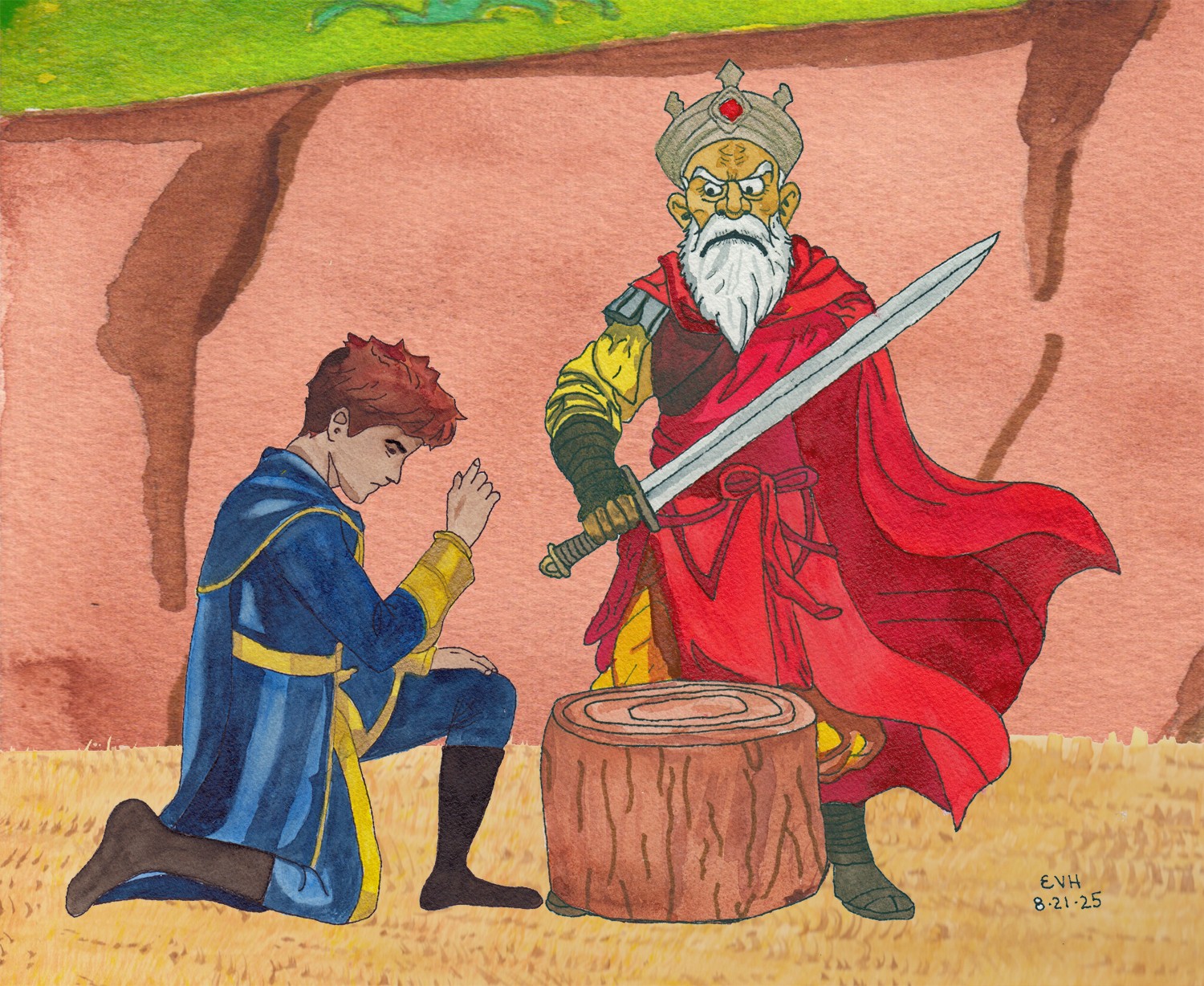
Figure: The evil priest prepares to kill the prince.
The Teacher described it in this way:
“When all is ready for the rite and Canda sits and waits the blow,
The daughter of the Pañcāl king went through the assembly, high and low:
“As truly as the brahmin here works a vile purpose by his guile,
So may I gain my dear-loved lord restored me in a little while.
“May all the spirits in this place—ghosts, goblins, fairies—hear my word,
Do my commission loyally and reunite me to my lord.
“Oh all you gods who fill this place, lo! Prostrate at your feet I fall,
Protect me in my helplessness, hear me in mercy as I call.”
Sakka, the king of the gods, heard her cry. And seeing what had happened, he took a blazing mass of iron. This frightened the king and dispersed the assembly.
The Teacher has described the scene:
“A heavenly being heard the cry and came to earth to help the right,
Whirling a blazing iron mass, filling the tyrant’s heart with fright,
“Know me, O tyrant, who I am, mark well the weapon which I wield,
Harm not your guiltless eldest son, the lion of the battlefield.
“Where has earth seen a crime like this, your sons, their wives, to slaughter given,
With all your noblest citizens, worthy to fill my highest heaven?”
“The tyrant and his minister then set the guiltless victims free,
And all the crowd seized sticks and stones, and in a fit of frenzied glee
Made Khaṇḍahāla there and then pay forfeit for his cruelty.”
When they had killed the minister, the great crowd sought to put the king himself to death. But Sakka embraced him and would not allow them to kill him. The multitude decided that they would spare his life. “But we will not give him rule or dwelling in this city. We will make him an outcast and make him live outside the city.” So they stripped him of his royal garments and made him wear a yellow dress. They put a yellow cloth on his head, and having made him an outcast, they sent him away to an outcast settlement. And all who had helped in any way in the sacrifice or approved of it went to hell as their punishment.
The Teacher uttered this stanza:
“All who had done so vile a deed passed straight to hell, none could attain
An afterbirth in any heaven, who bore the trace of such a stain.”
The great multitude, having caused the two monsters of wickedness to be removed out of sight, brought the materials for the coronation, and they anointed Prince Canda as king.
“When all the captives were released, a vast assembly gathering
With solemn pomp and festival anointed Canda to be king.
A vast assembly, gods and men, waved cloths and flags and sang his praise,
Starting a new and happy reign of plenty, peace and halcyon days.
Men, women, gods and goddesses joined in one great festivity,
Comfort and peace filled every home, and every captive was set free.”
The Bodhisatta caused all his father’s wants to be attended to, but he was not allowed to enter the city. And once his allowance was gone, he would go up to the Bodhisatta when he went to join in the amusements of the public gardens or other public spectacles. At these times he did not join his hands to salute his son, for he said to himself, “I am the true king.” But he addressed him, “Live long, O Master.” And when he asked for something, the Bodhisatta ordered that it be given to him.
When the Master ended his discourse, he added, “Brothers, this is not the first time that Devadatta has sought to kill many people on my account. He did the same before.” Then he identified the birth: “At that time Devadatta was Khaṇḍahāla, Mahāmāyā was Queen Gotamā, Rāhula’s mother was Candā, Rāhula was Vāsula, Uppalavaṇṇā was Selā, Kassapa of the Vāma family was Sūra, Moggallāna was Candasena, Sāriputta was Prince Suriya and I was Candarāja.”
((Mahāmāyā was the Buddha’s birth mother. Rāhula was the Buddha’s son, and Yasodhara was his mother. Uppalavaṇṇā was one of the Buddha’s foremost bhikkhunis. Kassapa was one of the Buddha’s foremost monks, and Moggallāna and Sāriputta were the Buddha’s two chief disciples.))
