
Jataka 541
Nimi Jātaka
King Nimi
as told by Eric Van Horn
originally translated by H.T. Francis and R.A. Neil, Cambridge University
originally edited by Professor Edward Byles Cowell, Cambridge University
One of the most interesting parts of this story is the exhaustive descriptions of the hell realms and the heavenly realms. It drives home the point of why you want to end up in a heavenly realm, and that you want to avoid the hell realms at all costs. The contrast is about as wide as you can imagine.
“Lo these grey hairs.” The Master told this when he was living in Makhādeva’s mango park near Mithilā. It is about a smile. One evening, the Master was walking up and down in this mango park with a large company of monks when he saw a pleasant spot. Wanting to tell a story from former times, he allowed a smile to be seen on his face. When asked by the Venerable Ānanda why he smiled, he answered, “In that spot, Ānanda, I once lived, deep in ecstatic meditation. It was during the time of King Makhādeva.” Then at his request, he sat down upon an offered seat and told this story from the past.
Once upon a time in the kingdom of Videha and in the city of Mithilā, a Makhādeva was king. For 84,000 years he took his pleasure as a young man. For 84,000 years he was viceroy, and for 84,000 years he was king.
Now he told his barber to be sure to inform him as soon as he saw grey hairs on his head. When by and by the barber saw grey hairs, he told him. The King made the man pull them out with a pair of tongs, and had him lay them in his hand, He saw death as if it were clinging to his forehead. “Now,” he thought, “it is the time for me to leave the world.”
So he gave the barber his choice of a village, and sending for his eldest son, he told him to assume control of the government since he was about to renounce the world. The son asked, “Why, my lord?” The King replied:
“Lo these grey hairs that on my head appear
Take of my life in passing year by year.
They are true messengers, which bring to mind
The time I must renounce the world is near.”
With these words he made his son king with the ceremonial sprinkling. And leaving him instructions on how to act, he left the city and embraced the life of a monk. Through 84,000 years he fostered the Four Excellencies (the brahma viharas), and he was then reborn in Brahma’s heaven.
His son also, in the same way, renounced the world and became destined to Brahma’s heaven. As did his son, and so did one royal prince after another, to the number of 84,000 less two. Each did so when he saw a white hair in his head, becoming an ascetic in this mango park. They all fostered the Four Excellencies and were born in Brahma’s heaven. The first of this line to be there born, King Makhādeva, stood in Brahma’s heaven looking down on the fortunes of his family. He was glad at heart to see that 84,000 princes less two had renounced the world.
He pondered: “Will there be nirvana now, or not?” Seeing that there would not, he resolved that he and no other must round off his family. (While the Brahma realms are the highest heavens, traditionally it is understood that one cannot become enlightened there.) Accordingly, he left there and was conceived in the womb of the king’s consort in Mithilā. On his name-day, the soothsayers looked at his marks and said, “Great King, this prince is born to round off your family. Your tradition of recluses will go no further.” Hearing this, the king said, “The boy is born to round off my family like the hoop of a chariot-wheel!” So he gave him the name of “Nemi-Kumāra,” or “Prince Hoop.”
From his childhood upwards, the boy was devoted to giving, to virtue, and to keeping the sabbath vow (the Uposatha Precepts). Then his father, as usual, saw a white hair. He gave a village to his barber and made his son king. He became a hermit in the mango park, destined for Brahma’s heaven.
King Nimi, in his devotion to almsgiving, built five alms halls, one at each of the four gates of the city and one in the midst of it. He distributed great gifts. In each of the alms halls he distributed 100,000 gold coins, that is 500,000 each day. He kept the Five Precepts. On the moon-days (Uposatha), he observed the sabbath. He encouraged the multitude in almsgiving and good works. He pointed out the road to heaven. He admonished them with the fear of death, and he preached the Dharma. They abided by his admonitions, giving gifts and doing good.
They passed away one after another and were born in the world of gods. That world became full, and hell was as empty. Then in the Heaven of the Thirty-three, the company of gods assembled in Sudhammā—the divine hall of assembly—crying aloud, “Hail to our teacher, King Nimi! By his doing, by the knowledge of a Buddha, we have attained to this infinite, divine enjoyment!” In this way they sang the virtues of the Great Being. Even in the world of men that sound of praise was spread as oil spreads over the surface of the great deep.

The Master explained this to the assembled monks in the following lines:
It was a marvel in the world how good men did arise
In the days of good King Nimi, the worthy and the wise.
Alms gave Videha’s monarch, the conqueror of his foes,
And as he gave in charity, this thought in him arose,
“Which is more fruitful—holy life or giving alms? Who knows?”
At that moment Sakka’s throne became hot. Sakka, pondering the reason, saw him reflecting there. “I will solve the question,” he said. And going about swiftly, he made the palace one blaze of light. He entered the chamber and stood there glowing. At the king’s request, he made all clear.
To explain this, the Master said:
“The mighty monarch of the gods, he of the thousand eyes,
Perceives his thought, before his light away the darkness flies.
“Great Nimi spoke to Vāsava, and all his flesh did creep.
“‘Who are you? A demigod or Sakka’s own self must be.
For I have never seen or heard such glory as I see.’
“Then Vāsava to Nimi spoke, knowing his flesh did creep.
“’Sakka, the king of gods, I am, to visit you I’m here.
Ask what you will, O king, and let your flesh not creep for fear.’
“Then Nimi spoke to Vāsava, this invitation made.
“’Most powerful lord of all that breathe, this question solve for me,
Holy to live, or alms to give, which should more fruitful be?’
“Then Vāsava to Nimi spoke, solving his question so,
And told the fruit of holy life to him who did not know.
“’He’s born a Khattiya, who lives holy in the third degree,
A god, the middle, and the first brings perfect purity.’
“Not easy are these states to win by any charity,
Which hermits who have left the world win by austerity.”
By these verses he illustrated the great fruitfulness of a holy life, and then recited others, naming the kings who in times past had been unable to get beyond the sensory realm by giving great gifts:
“Dudīpa, Sāgara, Sela, Mucalinda, Bhagīrasa,
Usīnara and Aṭṭhaka, Assaka, and Puthujjana,
“Yea, kings and brahmins, Khattiya chiefs, many and many a one,
For all their sacrifice, beyond the Peta world came none.”
(The “Peta” world is the realm of hungry ghosts.)
Having thus explained how much greater was the fruitfulness of holy life than that of almsgiving, he described those ascetics who by the holy life had passed the Peta world to be born in Brahma’s heaven, and said:
“These holy hermits who had left the world,
Seven sages, passed beyond: Yāmahanu,
Somayāga, Manojava, Samudda,
Māgha, and Bharata, and Kālikara:
Four others: Kassapa, Aṅgīrasa,
Akitti, Kisavaccha, these besides.”
So far, he described by tradition the great fruit of a holy life. But now he went on, declaring what he had himself seen:
“Sīdā’s a river in the north, unnavigable, deep,
About it, like a fire of reeds, blaze golden mountains steep,
“With creepers filled and fragrant plants river and hills as well.
Thereby ten thousand recluses once on a time did dwell.
“Noble am I, who kept the vow of temperance, self-control,
Almsgiving, solitary then tended each steadfast soul.
“Caste or no caste, the upright man I would attend at need,
For every mortal man is bound by his own act and deed.
“Apart from righteousness, all castes are sure to sink to hell,
All castes are purified if they are righteous and act well.”
(Note that at the time of the Buddha there was no caste system as we know it. They had a pre-caste system called the “Varna” system. In it there were no untouchables.)
After this, he said, “But, great King, although holy living is more fruitful by far than almsgiving, yet both these are the thoughts of great men. Be watchful in both. Give alms and follow virtue.” With this advice, he went to his own realm.
Then the company of gods said, “Sire, we have not seen you lately. Where have you been?” “Sirs, a doubt arose in the mind of King Nimi at Mithilā, and I went to resolve his question and to place him beyond doubt.” And then he described the occurrence in verse:
“Listen to me, sirs, one and all that here assembled be,
Men who are righteous differ much in caste and quality.
“There is King Nimi, wise and good, the better part who chose—
King of Videha, gave great gifts, that conqueror of his foes.
“And as these bounteous gifts he gave, behold this doubt arose,
Which is more fruitful—holy life or giving alms? Who knows?”
So he spoke, without omission, telling the King’s quality. This made the deities long to see that King. They said, “Sire, King Nimi is our teacher. By following his admonitions, by his means, we have attained to the joy of godhood. We wish to see him. Send for him, Sire, and show him to us!”
(Note that here a human is teacher to the devas/gods. This is consistent with one of the Buddha’s titles, “teacher of gods and humans. Reportedly Ajahn Munn, founder of the Thai Forest tradition in the 20th century, also taught devas.)
Sakka consented and sent Mātali. “Friend Mātali, yoke my royal car. Go to Mithilā. Place King Nimi in the divine chariot and bring him here.” Mātali obeyed and departed.
While Sakka was talking with the gods, giving his orders to Mātali, and sending his chariot, one month passed. So it was the holy day of the full moon. King Nimi opened the eastern window and was sitting on the upper floor surrounded by his courtiers. He was contemplating virtue. And just as the moon’s disk rose in the east, this chariot appeared.
The people had eaten their evening meal and sat at their doors talking comfortably together. “Why, there are two moons today!” they cried. As they gossiped, the chariot became plain to their view. “No, it is no moon,” they said, “but a chariot!” In due course, Mātali’s team appeared with a thousand thoroughbreds. It was the car of Sakka. They wondered for whom that could be? Ah, their king was righteous. It must be for him that Sakka’s divine car was sent. Sakka must wish to see their king. So in delight they cried out:
“A marvel in the world, to make one shiver with delight,
For glorious Videha comes the car divine in sight!”
As the people talked and talked, Mātali came as swift as the wind. He turned the chariot and brought it to rest out of the way by the sill of the window. Then he called on the King to enter.
Explaining this, the Master said:
“The mighty Mātali, the charioteer
Of heaven, summoned now Videha’s king
Who lived in Mithilā: “Come, noble king,
Lord of the world, upon this chariot mount.
Indra and all the gods, the Thirty-three,
Would see you, waiting in Sudhammā Hall.”
The King thought, “I shall see the gods’ dwelling-place which I never have seen. And I shall be showing kindness to Mātali.” So he addressed his women and all the people, “In a short time I shall return. You must be watchful. Do good and give alms.” Then he got into the car.
The Master said, to explain this:
Then with all speed, Videha’s king arose,
And went towards the chariot, and got in.
When he was in it, Mātali thus spoke,
“By which road shall I take you, noble king?
Where dwell the wicked, or where dwell the good?”
At this the king thought, “I have never seen either of these places before, and I should like to see both.” He answered:
“Mātali, charioteer divine, both places I would see,
Both where the righteous men abide, and where the wicked be.”
Mātali thinking, “One cannot see both at once. I will question him.” He recited a stanza:
“Which first, great monarch, noble king—which place first would you see,
That where the righteous men abide, or where the wicked be?”
Then the king, thinking that he would go to heaven in any case, thought that he might as well choose to see hell. He recited the next stanza:
“I’d see the place of wicked men, please let me go to hell,
Where they who once did cruel deeds and where the wicked dwell.”
Then he showed him Vetaraṇī, the river of hell.
To explain this, the Master said,
“Mātali showed the king Vetaraṇī,
A river stinking, full of corrosive brine,
Hot, covered all with burning flames of fire.”
The king was terrified when he saw creatures sorely tormented in Vetaraṇī. He asked Mātali what wicked deeds they had done. Mātali told him.
This the Master explained:
“Then Nimi, when he saw the people fall
In this deep river-flood, asked Mātali
‘Fear comes on me to see it, charioteer.
Tell me, what wicked deed these mortals did
Who are cast in the river?’ He replied,
Describing how ill ripens and bears fruit,
‘Who in the world of life are strong themselves,
Yet hurt the weak, oppress them, doing ill,
These cruel creatures begat ill, and they
Are cast into the stream Vetaraṇī.’”
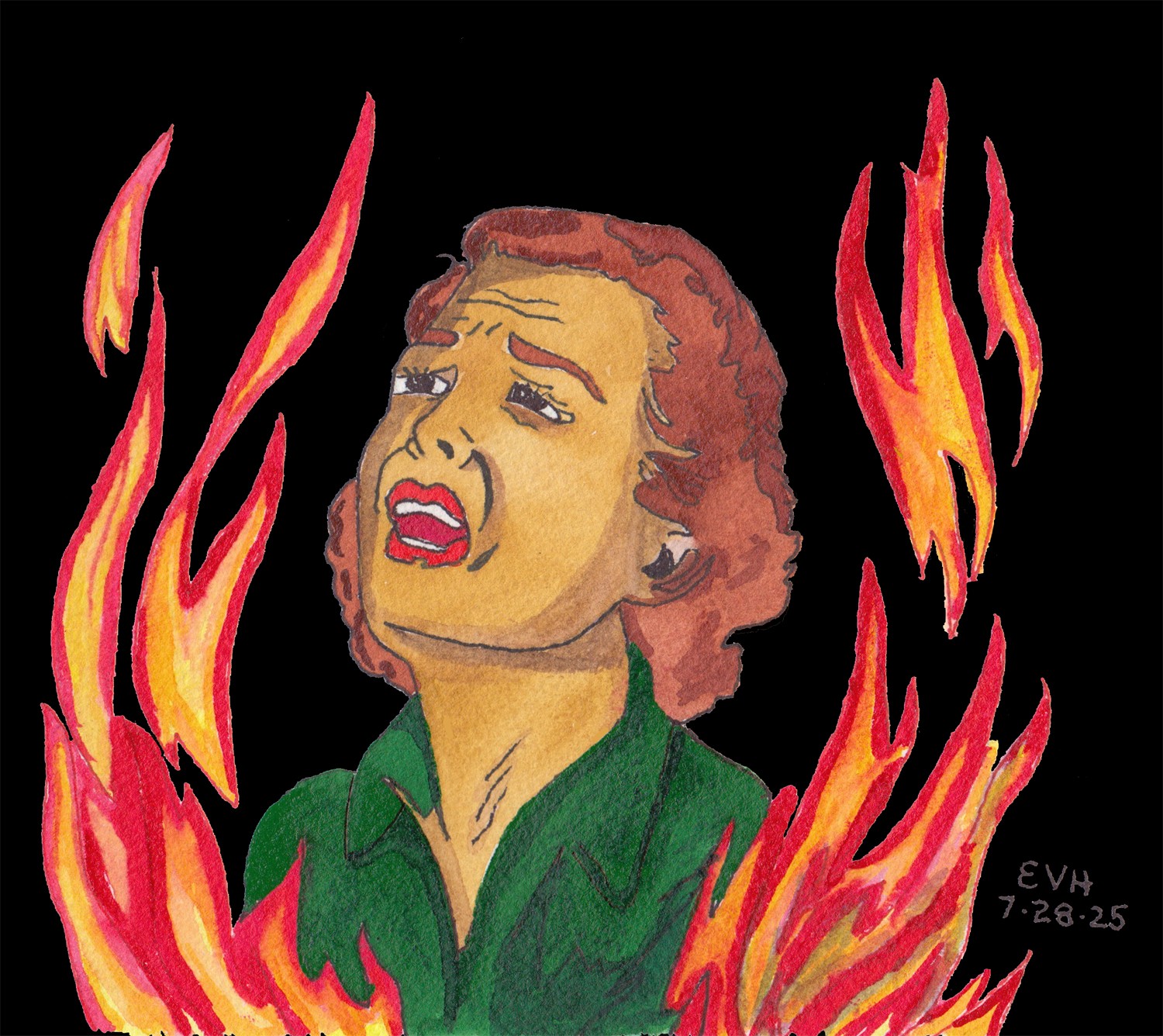
Figure: You don't want to go there.
In this way Mātali answered his question.
Once the king had seen the hell Vetaraṇī, he caused this place to disappear. And driving the chariot onwards, he showed him the place where they are torn by dogs and other beasts. He answered the king’s question as follows.
This the Master explained:
“’Black dogs and speckled vultures, flocks of crows
Most horrid, prey upon them. When I look,
Fear seizes on me. Tell me, Mātali,
What ill have these committed, charioteer,
Whom ravens prey on?’ Mātali replied,
Describing how ill ripens and bears fruit.
‘These are the churls, the misers, foul of tongue
To brahmins and ascetics, that do hurt.
These cruel creatures begat ill, and they
Are those you see of ravens here the prey.’”
His other questions were answered in the same way.
“Their bodies all ablaze they lie prostrate,
Pounded with red-hot lumps. When I behold,
Fear seizes on me. Tell me, Mātali,
What ill have these committed, charioteer,
Who lie there beaten with the red-hot lumps?”
Then Mātali the charioteer replied,
Describing how ill ripens and bears fruit.
“These in the world of life were wicked men,
Who hurt and did torment those without ill,
Both men and women, wicked as they were.
These cruel creatures begat ill, and they
Now lie there beaten with the red-hot lumps.”
“Others lie struggling in a pit of coals,
Roaring, their bodies charred. When I behold,
Fear seizes on me. Tell me, Mātali,
What ill have these committed, charioteer,
Who lie there struggling in the fiery pit?”
Then Mātali the charioteer replied,
Describing how ill ripens and bears fruit.
“These are they who before a crowd of men
Suborned a witness and defaulted debt.
And thus destroying people, mighty king,
These cruel creatures begat ill, and they
Lie there now struggling in the pit of coals.”
“Blazing and flaming, all one mass of fire,
I see an iron cauldron, huge and great.
Fear comes upon me, as I look upon it.
Mātali, tell me, charioteer divine—
What ill these mortals did, that here headfirst
They’re cast into the iron cauldron huge?”
Then answered Mātali the charioteer,
Describing how ill ripens and bears fruit.
“Whoe’re has hurt a brahmin or ascetic,
Foul men of ill, and he a virtuous man,
Those cruel creatures begat ill, and they
Now headlong fall into the iron bowl.”
“They wring them by the neck and cast them in,
Filling the cauldron full of boiling water!
Fear seizes on me. Tell me, Mātali,
What ill has been committed by those mortals
That with their heads all battered, there they lie?”
Then answered Mātali the charioteer,
Describing how ill ripens and bears fruit.
“These are the wicked men who in the world
Caught birds, and did destroy them, mighty king.
And thus, destroying other creatures, they
By these their cruel acts gave rise to ill,
And they lie yonder, with their own necks wrung.”
“There flows a river, deep, with shallow banks,
Easy of access. Over there go the men,
Scorched with the heat and drink. But as they drink,
The water turns to chaff which when I see,
Fear seizes on me. Tell me, Mātali,
What ill has been committed by those mortals,
That as they drink, the water turns to chaff?”
Then answered Mātali the charioteer,
Describing how ill ripens and bears fruit.
“These men are they who mixed good grain with chaff,
And sold it to a buyer, doing ill.
Therefore, now scorched with heat and parched with thirst,
Even as they drink, the water turns to chaff.”
“With spikes and spears and arrowheads they pierce
Those loudly wailing folk on either side.
Fear seizes on me. Tell me, Mātali,
What ill has been committed by those mortals,
That they lie yonder riddled with the spears?”
Then answered Mātali the charioteer,
Describing how ill ripens and bears fruit.
“These in the world of life were wicked men
Who took what was not theirs, and lived upon it—
Goats, sheep, cows, bulls, corn, treasure, silver, gold.
These cruel creatures begat ill, and they
Now lie yonder all riddled with the spears.”
“Who are these fastened by the neck I see,
Some cut to pieces, others all so torn
Fear seizes on me. Tell me, Mātali,
What ill has been committed by those mortals,
That they lie yonder torn in little bits?”
Then answered Mātali the charioteer,
Describing how ill ripens and bears fruit.
“Fishers and butchers, hunters of the boar,
Slayers of cattle, bulls, and goats, who slew
And laid the corpses in the slaughterhouse,
These cruel creatures begat ill, and they
Are lying yonder torn in little bits.”
“That lake of filth and manure, stinking foul,
With evil scent unclean, where starving men
Eat of the contents! This when I behold,
Fear seizes on me. Tell me, Mātali,
What ill has been committed by those mortals,
Whom there I see devouring dirt and filth?”
Then answered Mātali the charioteer,
Describing how ill ripens and bears fruit.
“These are malicious persons, who, for hurt
Of others, lived with them, and harmed their friends.
These cruel creatures begat ill, and now,
Poor fools, they have manure and filth to eat.”
“That lake is full of blood, and stinking foul,
With evil scent unclean, where scorched with heat
Men drink the contents! Which when I behold,
Fear seizes on me. Tell me, Mātali,
What ill has been committed by those mortals,
That they must now drink of the draught of blood?”
Then answered Mātali the charioteer,
Describing how ill ripens and bears fruit.
“They who have slain a mother or a father,
Whom they should give respect. Excommunicate
These cruel creatures begat ill, and they
Are those who yonder drink the draught of blood.”
“That tongue see, pierced with a hook, like as a shield
Stuck with a hundred barbs, and who are those
Who struggle leaping like a fish on land,
And roaring, drabble spittle? When I see it,
Fear seizes on me. Tell me, Mātali,
What ill has been committed by those mortals,
Whom I see yonder swallowing the hook?”
Then answered Mātali the charioteer,
Describing how ill ripens and bears fruit.
“These men are they who in the marketplace
Haggling and cheapening from their greed of gain
Have practiced trickery and thought it hidden,
Like one that hooks a fish. But for the knave
There is no safety, dogged by all his deeds.
These cruel creatures begat ill, and they
Are lying yonder swallowing the hook.”
“Those women, bent and broken, stretching their arms
And wailing, wretched, smeared with stains of blood,
Like cattle in the shambles, stand waist-deep
Buried in earth, the upper trunk ablaze!
Fear seizes on me. Tell me, Mātali,
What ill has been committed by those women,
That now they stand all buried in the earth
Waist-deep, the upper trunk a mass of flame?”
Then answered Mātali the charioteer,
Describing how ill ripens and bears fruit.
“They were of noble birth when in the world,
Lived lives unclean, did deeds of wickedness,
Were traitors, left their husbands, and besides
Did other things to satisfy their lust.
They spent their lives in faithlessness. Therefore now
Stand blazing, waist-deep buried in the earth.”
“Why do they seize those persons by the legs
And cast them headlong into Naraka?
Fear seizes on me. Tell me, Mātali,
What ill has been committed by those men,
That they are so hurled headlong into Naraka?”
Then answered Mātali the charioteer,
Describing how ill ripens and bears fruit.
“These in the world did evil, did seduce
Another’s wife, stole his most precious thing,
So now are headlong cast in Naraka.
They suffer misery for countless years
In hell. There is no safety for the wicked,
But he is ever dogged by his own deeds.
These cruel creatures begat ill, and they
Are now cast headlong into Naraka.”
With these words, Mātali the charioteer made this hell disappear also. And driving the chariot onwards, showed him the hell of torment for heretics. On request he explained it to him.
“Many and various causes I have seen
Most terrible, among these hells. To see them
Fear seizes on me. Tell me, Mātali,
What ill has been committed by those mortals,
Why they must suffer this excessive pain,
So sharp, so cruel, so intolerable?”
Then answered Mātali the charioteer,
Describing how ill ripens and bears fruit.
“Who in the world were wicked heretics,
Who put their faith in false delusion,
Made converters of others to their heresy,
They by their heresy begetting ill
Must therefore suffer this excessive pain,
So sharp, so cruel, so intolerable.”
(The word translated here as “heretics” means anyone who disputes the Dharma, and this case, even worse, convinces others to follow them.)
Now in heaven the gods were sitting in Sudhammā Hall, looking for the king’s arrival. “Mātali is a long time away,” thought Sakka, and he saw the reason. So he said, “Mātali is going round as guide, showing all the different hells to the king and telling him what misdeed led to each hell.” So calling to a young god, very swift, he said to him, “Go tell Mātali to bring the king here quickly. He is using up King Nimi’s life. He must not go around to all the hells.” With speed the young god went and gave his message. When Mātali heard it, he said, “We must not delay.” Then showing all the great hells in the four quarters in one flash to the king, he recited a stanza:
“Now, mighty monarch, you have seen the place
Of villains, and where cruel men are sent,
And where the wicked go. Now, royal sage,
Come let us hasten to the king of heaven.”
With this speech he turned the chariot towards heaven.
As the king went towards heaven. He saw the mansion of the goddess Bīraṇī in the air. It had pinnacles of jewels and gold. It was ornamented in great magnificence. It had a park and a lake covered with lilies. It was surrounded with trees worthy of the place. There was the goddess seated upon a divan in a gabled chamber towards the front. She was attended by a thousand nymphs and was looking out through an open window. He asked Mātali who she was, and Mātali explained it to him.
“Behold that mansion with five pinnacles,
There, decked with garlands, lies upon a couch
A most powerful woman, who assumes
All kinds of majesty and wondrous power.”
“Joy comes on me to see it, charioteer.
But tell me, Mātali, what her good deeds,
That she is happy in this heavenly mansion.”
Then answered Mātali the charioteer,
Describing how good ripens and bears fruit.
“Heard you ever of the world of Bīraṇī?
A brahmin’s home-born slave, who once received
A guest at the right moment, welcomed him
As mother might her son. And therefore now,
Generous and chaste, lives happy in this mansion.”
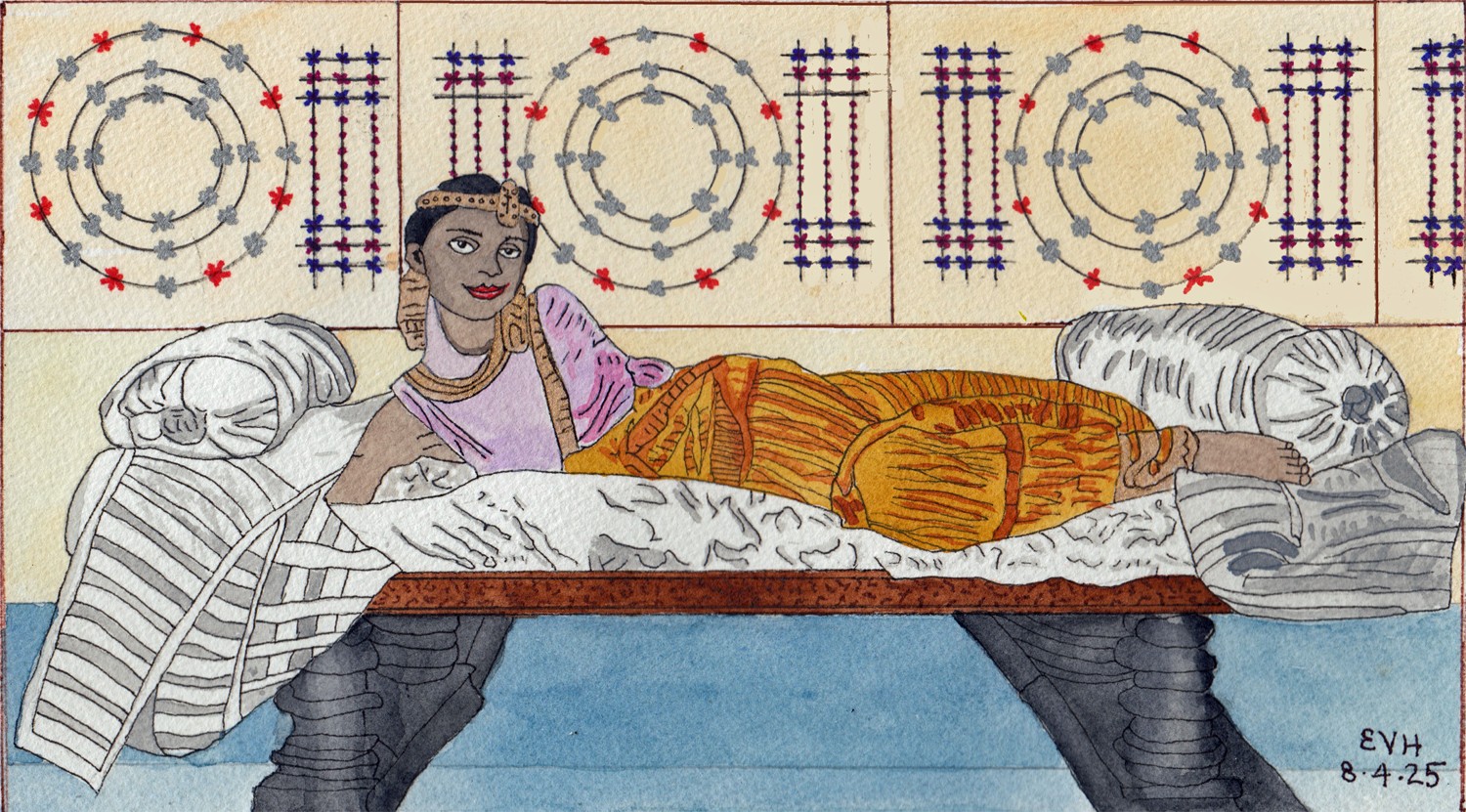
Figure: 🎵 Heaven. I'm in heaven. 🎵
With these words, Mātali drove the chariot onwards and showed him the seven golden mansions of the god Soṇadinna. When he saw these and the glory of the god, he asked an explanation, which Mātali gave.
“There are seven mansions, shining clear and bright,
Where dwells a mighty being, richly clad,
Who with his wives inhabits them”. “Delight
Moves me to see it. Tell me, Mātali,
What is the good this mortal did, that he
Dwells happy in this mansion heavenly?”
Then answered Mātali the charioteer,
Declaring how good ripens and bears fruit.
“This once was Soṇadinna, one who gave
With royal bounty, and for hermits wrought
Seven hermitages. All their needs did crave
He faithfully provided. Food he brought,
Bedding to lie on, clothes to wear, and light,
Contented with those men of life upright,
He kept the sabbath day, and each fortnight
The eighth, the fourteenth and the fifteenth days,
Generous, controlled, he walked in holy ways,
So now dwells in this mansion of delight.”
In this way he described the deeds of Soṇadinna.
Then driving his chariot onwards, he showed a mansion of crystal. It was 25 leagues tall. (A league is about three miles or 4.828 kilometers.) It had hundreds of columns made of the seven precious things (gold, silver, pearl, coral, cat’s-eye, ruby, and diamond) and hundreds of pinnacles. It was set about with lattices and little bells. A banner of gold and silver flew. Beside it was a park and grove full of many bright flowers. It had a lovely lake of lilies. There were many nymphs cunning to sing and to make music. Seeing this the king asked what were the deeds of these nymphs, and Mātali told him.
“That mansion built of crystal, shining bright,
With pinnacles uplifted in the height,
With food and drink in plenty, and a throng
Of goodly women skilled in dance and song!
Joy seizes on me. Tell me, Mātali,
What good these women did, that now in heaven
They dwell within this palace of delight?”
Then answered Mātali the charioteer,
Describing how good ripens and bears fruit.
“These women ever walked in holy ways,
Faithful lay sisters, kept the holy days,
Generous, controlled, and watchful, heart-serene,
Now happy in the mansion you have seen.”
He drove the chariot on and showed the king a mansion of gems. It stood on a level spot, lofty, shining brightly. It was full of gods that played and sang divine music. Seeing this, the king asked what were the deeds of these gods. Mātali replied:
“That mansion built of jewels, shining bright,
Symmetrical, proportioned, a fair sight,
Where in most divine melody around,
Songs, dances, and percussion do resound.
I never have beheld a sight so fair,
Nor sounds so sweet have ever heard, I swear!
Joy seizes on me. Tell me, Mātali,
What good these mortals did, that now I see
Happy in this heavenly mansion of delight?”
Then answered Mātali the charioteer,
Describing how good ripens and bears fruit.
“These were lay monks in the world of men,
Provided parks and wells, or water drew
In the well-shed, and tranquil saints did feed,
Found clothes, food, drink and bedding, every need,
Contented with these men of life upright,
Who kept the sabbath day, and each fortnight
The eighth, the fourteenth and the fifteenth days.
Generous, controlled, they walked in holy ways,
And now dwell in this mansion of delight.”
Thus having described the deeds of these persons, he drove on and showed him another crystal mansion. It had many pinnacles. There were all manner of flowers around it. There were fine trees echoing with the songs of birds of all kinds. A river of pure water flowed. It was surrounded by a company of nymphs. It was the dwelling-place of a virtuous person. Seeing this the king asked what his deeds were. Mātali told him.
“That mansion built of crystal, shining bright,
Its pinnacles uplifted in the height,
With food and drink in plenty, and a throng
Of goodly women skilled in dance and song,
And rivers, fringed with many a flower and tree—
Joy seizes on me. Tell me, Mātali,
What good this mortal did in life, that he
Rejoices in this mansion heavenly?”
Then answered Mātali the charioteer,
Describing how good ripens and bears fruit.
“At Kimbilā a householder was he,
Bounteous, gave parks and wells, and faithfully
Drew water, and the tranquil saints did feed,
Found clothes, food, drink and bedding, every need,
Contented with these men of life upright,
He kept the sabbath day, and each fortnight
The eighth, the fourteenth and the fifteenth days.
Generous, controlled, he walked in holy ways,
And now dwells in this mansion of delight.”
In this way he described the deeds of this man, and then he drove on.
Then he showed another crystal mansion. This even more than the last mansion was grown about with all manner of fruit and flowers and clumps of trees. Seeing this, the king asked what were the deeds of this man who was so fortunate. Mātali told him.
“That mansion, built of jewels, shining bright,
Its pinnacles uplifted in the height,
With food and drink in plenty, and a throng
Of goodly women skilled in dance and song,
And rivers, fringed with many a tree and flower,
Royal and elephant trees, and mango, sāl,
Rose apple sweet, and tindook, piyal bower,
And orchard-trees fruit-bearing one and all—
Joy seizes on me. Tell me, Mātali,
What good this mortal did in life, that he
Rejoices in this mansion heavenly?”
Then answered Mātali the charioteer,
Describing how good ripens and bears fruit.
“At Mithilā a householder was he,
Bounteous, gave parks and wells, and faithfully
Drew water, and the tranquil saints did feed,
Found clothes, food, drink and bedding, all their need,
Contented with these men of life upright,
He kept the sabbath day, and each fortnight
The eighth, the fourteenth and the fifteenth days.
Generous, controlled, he walked in holy ways,
And now dwells in this mansion of delight.”
In this way he described the deeds of this man also, and then he drove on.
Then he showed another mansion of jewels, like the first, and at the king’s request, he told him the deeds of a god who was happy there:
“That mansion built of jewels, shining bright,
Symmetrical, proportioned, a fair sight,
Where in most divine melody around,
Songs, dances, drums, and tabours do resound.
I never have beheld a sight so fair,
Nor sounds so sweet have ever heard, I swear!
Joy seizes on me. Tell me, Mātali,
What good these mortals did, whom now I see
Happy in this heavenly mansion of delight?”
Then answered Mātali the charioteer,
Describing how good ripens and bears fruit.
“Once a Benares householder was he,
Bounteous, gave parks and wells, and faithfully
Drew water, and the tranquil saints did feed,
Found clothes, food, drink and bedding, all their need,
Contented with these men of life upright,
He kept the sabbath day, and each fortnight
The eighth, the fourteenth and the fifteenth days.
Generous, controlled, he walked in holy ways,
And now dwells in this mansion of delight.”
Again driving on, he showed a mansion of gold. It was like the sun in its strength. And at the king’s request, he told him the deeds of the god who lived there.
“Behold that mansion made of flaming fire,
Red like the sun whereas he rises higher!
Joy seizes on me. Tell me, Mātali,
What good this mortal did in life, that he
Rejoices in this mansion heavenly?”
Then answered Mātali the charioteer,
Describing how good ripens and bears fruit.
“Once a Sāvatthi householder was he,
Bounteous, gave parks and wells, and faithfully
Drew water, and the tranquil saints did feed,
Found clothes, food, drink, and bedding, all their need,
Contented with these men of life upright,
He kept the sabbath day, and each fortnight
The eighth, the fourteenth and the fifteenth days.
Generous, controlled, he walked in holy ways,
And now dwells in this mansion of delight.”
In this way he described these eight mansions. Sakka, king of the gods, thinking that Mātali was a long time in coming, sent another swift god with a message. Mātali, on hearing the message, saw that there must be no more delay. So in a flash he showed many mansions, and he described to the king what were the deeds of those who lived in then.
“See many fiery mansions in the air,
As in a bank of cloud the lightning’s flare!
Joy seizes on me. Tell me, Mātali,
What good these mortals did, whom now I see
Rejoicing in the heavenly mansion there?”
Then answered Mātali the charioteer,
Describing how good ripens and bears fruit.
“Good-living, well-instructed, resolve within,
They acted as the Master’s teaching kin.
By living as the All-wise Buddha told
They came to these abodes you now behold.”
Having thus shown him these mansions in the sky, he set out to go before Sakka with these words:
“You’ve seen the places of the good and wicked in the air.
Unto the monarch of the gods come let us now repair.”
With these words he drove on. He showed him the seven hills that make a ring about Sineru.
To explain how the king questioned Mātali on seeing these, the Master said:
“As the king journeyed on his way in the celestial car
Drawn by a thousand steeds, he saw the mountain peaks afar
In Sīdā ocean, and he asked, ‘Tell me what hills these are.’”
At this question of Nimi the god, Mātali replied:
“The mighty hills Sudassara, Karavīka, Īsadhara,
Yugandhara, Nemindhara, Vinataka, Assakaṇṇa.
These hills are in Sīdantara, in order there they be,
Which high-upstanding in the air you, mighty king, do see.”
In this way he showed the Heaven of the Four Great Kings.
He drove on until he could show the statues of Indra which stood around the great Cittakūṭa gateway of the Heaven of the Thirty-three. At this sight the king asked, and Mātali answered.
“This place so fine, elaborate, adorned,
Set round with Indra’s statues, as it were
By tigers guarded— as I see this sight,
Joy comes upon me. Tell me, Mātali,
What is the name of this that I behold?”
Then answered Mātali, the charioteer,
Describing how good ripens and bears fruit.
“This place is Cittakūṭa which you see,
The entrance to the place of heaven’s king,
The doorway of the Mountain Beautiful,
Elaborate, adorned, and set about
With Indra’s statues, as by tigers guarded.
Enter, wise king! Enter this spotless place.”
With these words, Mātali led the king in.
So it is said—
“Journeying in the car celestial,
Drawn by a thousand steeds, the mighty king
Beheld the place where all the gods assemble.”
And as he passed along standing still in the car, he saw the place of the gods’ assembly in Sudhammā. The king questioned Mātali, who replied.
“As in the autumn is the sky all blue,
So is that jeweled mansion to the view.
Joy comes upon me. Tell me, Mātali,
What is this mansion which I now behold?”
Then answered Mātali the charioteer,
Describing how good ripens and bears fruit.
“This is Sudhammā, where the gods assemble,
Supported by fair columns, finely wrought,
Eight-sided, made of gems and jewels rare,
Where dwell the Three-and-thirty, with their chief,
Lord Indra, thinking of the happiness
Of gods and men. Enter this lovely place,
O mighty monarch, where the gods abide!”
The gods on their part sat watching for his arrival. When they heard that the king had come, they went out to meet him as far as the great Cittakūṭa gateway. They carried with them divine flowers and perfumes. They presented him with their flowers and perfumes, then they brought him to Sudhammā Hall. The king dismounted from the car and entered the hall of the gods. The gods offered him a seat.
Explaining this, the Master said:
“The gods beheld the king arrive, and then, their guest to greet,
Cried, ‘Welcome, mighty monarch, whom we are so glad to meet!
O king! beside the king of gods we pray you take a seat.’
“And Sakka welcomed Vedeha, the king of Mithilā town,
Ay, Vāsava offered him all joys and prayed him to sit down.
“’Amid the rulers of the world O welcome to our land.
Dwell with the gods, O king! who have all wishes at command.
Enjoy immortal pleasures, where the Three-and-thirty stand.’”
In this way Sakka offered him celestial pleasures.
The king declined, saying:
“As when a chariot, or when goods are given on demand,
So is it to enjoy a bliss given by another’s hand.
“I care not blessings to receive given by another’s hand,
My goods are mine and mine alone when on my deeds I stand.
“I’ll go and do much good to men, give alms throughout the land,
Will follow virtue, exercise control and self-command.
He that so acts is happy and fears no remorse at hand.”
(The king declining such riches is the act of a renunciate.)
In this way the Great Being gave a discourse to the gods with honeyed sound. He taught for seven days by men’s reckoning, and he gave delight to the company of the gods. And standing in the midst of the gods, he described the virtue of Mātali:
“A most obliging personage is Mātali the charioteer,
The places where the good abide and where the bad, he showed me clear.”
Then the king took leave of Sakka, saying that he wished to go to the world of men. Then Sakka said, “Friend Mātali, take King Nimi at once to Mithilā.” He prepared the chariot. The king exchanged friendly greetings with the company of gods, left them, and entered the car.
Mātali drove the car eastwards to Mithilā. There the crowd, seeing the chariot, were delighted to know that their king was returning. Mātali passed around the city of Mithilā right wise and put the Great Being down at the same window. Then he took his leave and returned to his own realm.
A great number of people surrounded the king and asked him what the gods’ world was like. The king, described the happiness of the gods and of Sakka their king. He exhorted them to give alms and do good, so that they, too, should be born in that divine place.
Afterwards, when his barber found a white hair and told him, he made the barber put aside that white hair. Then he gave a village to the barber. And wishing to renounce the world, he made his son king in his place. When asked why he wished to renounce the world, he recited the stanza, “Lo, these grey hairs.” And like the former kings, he renounced the world and lived in the same mango grove. He developed the Four Excellencies and became destined to Brahma’s heaven.
It is his renouncing of the world that is described by the Master in the last stanza:
“Thus spoke King Nimi, lord of Mithilā,
And having made a mighty sacrifice,
Entered upon the path of self-control.”
And his son, Kaḷāra Janaka, also renounced the world, and this brought his line to an end.
When the Master had finished this discourse, he said, “So, monks, this is not the first time the Tathāgata left the world. He did the same before.” Then he identified the birth: “At that time, Anuruddha was Sakka, Ānanda was Mātali, the 84 kings were the Buddha’s followers, and I was King Nimi.”
(Anuruddha was one of the Buddha’s chief disciples and the Buddha’s cousin by birth. Ānanda was the Buddha’s faithful attendant for the last 25 years of the Buddha’s life and was also his first cousin.)
