Jataka 540
Sāma Jātaka
The Story of Sāma
as told by Eric Van Horn
originally translated by H.T. Francis and R.A. Neil, Cambridge University
originally edited by Professor Edward Byles Cowell, Cambridge University
This is another wonderful story about self-sacrifice and caring for one’s parents. In Buddhism, possibly because of Indian culture, caring for one’s parents brings great merit. This is a passage from the Aṇguttara Nikāya:
"I tell you, monks, there are two people who are not easy to repay. Which two? Your mother and father. Even if you were to carry your mother on one shoulder and your father on the other shoulder for 100 years, and were to look after them by anointing, massaging, bathing, and rubbing their limbs, and they were to defecate and urinate right there [on your shoulders], you would not in that way pay or repay your parents. If you were to establish your mother and father in absolute sovereignty over this great earth, abounding in the seven treasures, you would not in that way pay or repay your parents. Why is that? Mother and father do much for their children. They care for them, they nourish them, they introduce them to this world. But anyone who rouses his unbelieving mother and father, settles and establishes them in conviction; rouses his unvirtuous mother and father, settles and establishes them in virtue; rouses his stingy mother and father, settles and establishes them in generosity; rouses his foolish mother and father, settles and establishes them in discernment: To this extent one pays and repays one's mother and father." – [AN 2.32]
This passage is interesting for two reasons. First, the Buddha emphasizes the importance and the merit that comes from caring for your parents. But the last passage also says that the best thing that you can do for them is to establish them in the Dharma. Admittedly not all parents are great, and sometimes the circumstances are not great. Still, it is worth considering that if you are caring for your parents, this is a gift and an opportunity.
“Who, as I filled.” The Master told this story at Jetavana. It is about a monk who supported his mother. They say that there was a wealthy merchant at Sāvatthi who was worth 18 crores. (One crore is 10 million rupees.) He had a son who was very dear and winning to his father and mother. One day the youth went on the terrace of the house. He opened a window and looked down on the street. He saw a great crowd going to Jetavana with perfumes and garlands in their hands to hear the Dharma preached. He exclaimed that he would go, too. So, having ordered perfumes and garlands to be brought, he went to the monastery, and having distributed clothing, medicines, drinks, etc. to the assembly and honored the Blessed One with perfumes and garlands, he sat down on one side.
After hearing the Dharma and understanding the evil consequences of desire and the blessings arising from adopting the holy life, he asked the Blessed One for ordination. But he was told that the Tathāgatas do not ordain anyone who has not obtained the permission of his parents. So, he went away. He lived for a week without food. And having at last obtained his parents’ consent, he returned and begged for ordination.
The Master sent a monk who ordained him. After he was ordained, he earned great honor and gain. He won the favor of his teachers and preceptors, and having received full orders, he mastered the Dharma in five years.
Then he thought to himself, “I live here distracted. It is not suitable for me.” He became anxious to attain the goal of mystic insight. So having obtained instruction in meditation from his teacher, he departed to a frontier village and lived in the forest. And there, having entered a practice of spiritual insight, he failed. No matter how much he labored and strove for twelve years, he was unable to attain awakening.
As time went on, his parents became poor. Those who hired their land or merchandising for them, when they found out that there was no son or brother in the family to enforce payment, they seized what they could lay their hands on and ran away. The servants and laborers in the house seized the gold and coins and made off with those, so that at the end the two were reduced to an evil plight. They did not even have a jug for pouring water. Finally, they sold their house, and finding themselves homeless and in extreme misery, they wandered begging for alms. They were clothed in rags and carried broken pottery in their hands.
Now at that time the monk went from Jetavana to his parents’ home. He performed the duties of hospitality and, as he sat quietly, the owner asked from where he had come. When they learned that he had come from Jetavana. he asked after the health of the teacher and the principal disciples. Then the monk asked for news of his parents. “Tell me, sir, about the welfare of the merchant’s family in Sāvatthi.” “O friend, don’t ask for news of that family.” “Why not, sir?” “They say that there was one son in that family, but he became a monk under the Dharma. And since he left the world that family has gone to ruin. At the present time the two old people are reduced to a most lamentable state and beg for alms.”
When he heard these words, he could not remain unmoved. He began to weep with his eyes full of tears. And when the other asked him why he wept, “O sir,” he replied, “they are my own father and mother. I am their son.” “O friend, your father and mother have come to ruin because of you. Go and take care of them.” “For twelve years,” he thought to himself, “I have labored and striven but never been able to attain the path or the fruit. I must be incompetent. Why do I care about the ascetic life? I will become a householder and will support my parents. I will be generous and give away my wealth, and then I will become destined for heaven.”
So having decided to do this, he gave his hut in the forest to an elder, and on the next day he left. By successive stages, he reached the monastery at the back of Jetavana which is not far from Sāvatthi. There he found two roads, one leading to Jetavana, the other to Sāvatthi. As he stood there, he thought, “Shall I see my parents first or the Buddha?” Then he said to himself, “In the old days I saw my parents for a long time. From now on, I will rarely have the chance of seeing the Buddha. I will see the perfectly Enlightened One today and hear the Dharma. Then tomorrow morning, I will see my parents.”
So he left the road to Sāvatthi, and in the evening he arrived at Jetavana. That very day at daybreak, the Master, as he looked upon the world, saw the potential of this young man. And when he went to visit him, he praised the virtues of parents in the Mātiposaka-sutta (Mātu Sutta [SN 15.14-19]). As he stood at the end of the assembly of elders and listened, he thought, “If I become a householder, I can support my parents. But the Master also says, ‘A son who has become a monastic can be helpful. I went away before without seeing the Master, and I failed in such an imperfect ordination. I will now support my parents while remaining a monk without becoming a householder.”
So he took his ticket and his ticket food and gruel (a “ticket” is apparently a coupon for receiving food at the monastery), and he felt as if he had committed an offense deserving expulsion after a solitary life of 12 years in the forest. In the morning, he went to Sāvatthi. He thought to himself, “Shall I first get the gruel or see my parents?” He reflected that it would not be right to visit them in their poverty empty-handed. So, he first got the gruel and then went to the door of their old house.
When he saw his parents sitting by the opposite wall after having gone on their alms round given in broth, he stood near to them in a sudden burst of sorrow with his eyes full of tears. They saw him but did not recognize him. Then his mother, thinking that it was someone standing for alms, said to him, “We have nothing fit to give to you. Be pleased to pass on.” When he heard her, he suppressed the grief that filled his heart. He remained standing there with his eyes full of tears. When he was addressed a second and a third time, he continued standing.
At last the father said to the mother, “Go to him. Can this be your son?” She rose and went to him. Recognizing him, she fell at his feet and lamented. The father also joined his lamentations, and there was a loud outburst of sorrow. Seeing his parents he could not control himself but burst into tears. After yielding to his feelings, he said, “Do not grieve, I will support you.” He comforted them and made them drink some gruel. Then he sat down on one side. He went again and begged for some food and gave it to them. Then he went and asked for alms for himself, and having finished his meal, he took up his residence at a short distance off.
From that day forward he watched over his parents in this manner. He gave them all the alms he received for himself, even those at the fortnightly (Uposatha) distributions. He went on separate rounds for his own alms. Whatever food he received as provisions for the rainy season he gave to them. He took their worn-out garments and dyed them.
But the days were few when he gained alms and there were many days when he failed to obtain anything. His inner and outer clothing became very rough. As he watched over his parents, he gradually grew very pale and thin. His friends and intimates said to him, “Your complexion used to be bright, but now you have become very pale. Has some illness come upon you?” He replied, “No illness has come upon me, but a hindrance has befallen me.” He told them the history. “Sir,” they replied, “the Master does not allow us to waste the offerings of the faithful. You do an unlawful act in giving to laymen the offerings of the faithful.”
When he heard this, he shrank ashamed. But they were not satisfied with this. They went and told it to the Master. They said, “So and so, sir, has wasted the offerings of the faithful and used them to feed laymen.” The Master sent for the young man and said to him, “Is it true that you, a monk, take the offerings of the faithful and support laymen with them?” He confessed that it was true. Then the Master, wishing to praise what he had done and to declare an old action of his own, said, “When you support laymen whom do you support?” “My parents,” he answered. Then the Master, wishing to encourage him still more said, “Well done, well done” three times. “You are on a path that I have travelled before you. In the past, while going on rounds for alms, I supported my parents.” The monk was encouraged by this. At the request of the monks, the Master, to make known his previous actions, told them this story from the past.
Once on a time, not far from Benares on the near bank of the river, there was a village of hunters. There was another village on the other side of the river. 500 families lived in each village.
Now two hunter chiefs lived in the two villages. They were close friends. They had made a compact in their youth that if one of them had a daughter and the other a son, they would wed the pair together. In the due course of time, a son was born to the chief in the near village, and a daughter was born to the one in the farther village. Dukūlaka was the name was given to the son as he was taken up when he was born in a wrapping of fine cloth. (Dukāla means a “very fine piece of cloth.”). The daughter was named Pārikā because she was born on the farther side of the river. (Pārikā means a “hunter’s daughter.”) They were both fair to look at and had a complexion like gold, and even though they were born in a village of hunters, they never injured any living creature.
When he was 16 years old, his parents said to Dukūlaka, “O son, we will bring you a bride.” But he was a pure having just come from the Brahma world. He closed both his ears, saying, “I do not want to live in a house. Do not mention such a thing.” And though they spoke to the same effect three times, he showed no inclination for it.
Likewise, her parents said to Pārikā, “Our friend’s son is handsome and has a complexion like gold. We are going to give you to him.” She gave the same reply. She also closed her ears, for she, too, had come from the Brahma world. Dukūlaka privately sent her a message: “If you wish to live as a wife with her husband, go into some other family for I have no wish for such a thing.” She, too, sent a similar message to him. But however unwilling they were, the parents would proceed with the marriage.
But both of them lived apart like Brahma beings. They never descended into the ocean of carnal passion. Dukūlaka never killed fish or deer. He never even sold fish that was brought to him. At last, his parents said to him, “Though you are born into a family of hunters, you do not like to live in a house or kill any living creature. What will you do?” “If you will give me leave,” he replied, “I will become an ascetic this very day.” They gave them both leave at once.
Having bid them farewell, they went out along the shore of the Ganges River and entered the Himavat (Himalaya) region where the river Migasammatā flows down from the mountain and enters the Ganges. Then, leaving the Ganges, they went up along the Migasammatā.
Now at that moment Sakka’s palace grew hot. Sakka, having determined the reason, commanded (the divine/celestial architect) Vissakamma, “O Vissakamma, two great beings have left the world and entered Himavat. We must find a home for them. Go and build them a hut of leaves. Provide all the necesseties of an ascetic’s life a quarter of a mile from the river Migasammatā. Then return here.”
So he went and prepared everything as it is described in the Mūgapakkha Birth (Jātaka 538). He made a footpath as well. Then he returned to his own home after having driven away all beasts that made unpleasant noises. They saw the footpath and followed it to the hermitage. When Dukūlaka went into the hermitage and saw all the necessities for an ascetic’s life, he exclaimed, “This is a gift to us from Sakka.”; He took off his outer garment and put on a robe of red bark. He threw a black antelope hide over his shoulder and twisted his hair in a knot, and he assumed the garb of a recluse. He also ordained Pārikā.
He took up his residence there with her, exercising all the feelings of benevolence that belong to the world of sensual pleasure (i.e., the human realm). Because of their benevolent feelings, all the birds and beasts felt only kindness towards each other. Not one of them harmed any other. Pārī brought water and food, swept the hermitage, and did all that needed to be done. Both collected various kinds of fruits and ate them. Then they enter their respective huts of leaves and lived there fulfilling the rules of the ascetic life.
Sakka ministered to their wants. One day he foresaw that a danger threatened them. “They will lose their sight,” he said. So he went to Dukūlaka, and having sat on one side, after saluting him, he said, “Sir, I foresee a danger that threatens you. You must have a son to take care of you. Follow the way of the world.” “O Sakka, why do you mention such a thing? Even when we lived in a house, we shrank in disgust from all carnal intercourse. Can we practice it now when we have come into the forest and are living a reclusive life here?” “Well, if you will not do as I say, then at the proper season, touch Pārī’s navel with your hand.” This he promised to do. And Sakka, after saluting him, returned to his own realm.
The Great Being told the matter to Pārī, and at the proper time he touched her navel with his hand. Then the Bodhisatta descended from the heavenly world. He entered her womb and was conceived there. At the end of the tenth month, she bore a son of golden hue. Accordingly, they named him Suvaṇṇasāma (Golden Sāma).
Now the Kinnarī nymphs in another mountain had nursed Pārī. The parents washed the baby and laid it down in a pile of leaves and went out to collect different sorts of fruit. While they were gone, the Kinnaras took the child and washed it in their caves. Then they went up to the top of the mountain, adorned it with various flowers, and made the sacred marks (the marks of a religious sect) with yellow orpiment, red arsenic, and other paints. Then they brought it back to its bed in the hut. When Pārī came home, she nursed the child.
They cherished him as he grew up year after year, and when he was about 16 they used to leave him in the hut and go out to collect forest roots and fruits. The Bodhisatta considered, “Some danger will happen one day.” He used to watch the path by which they went. One day they were returning home at evening time after collecting roots and fruits, and not far from the hermitage a great cloud rose up. They took shelter in the roots of a tree and stood on an anthill, and in this anthill a snake lived.
Now water dropped from their bodies which carried the smell of sweat to the snake’s nostrils. This made him angry. It puffed out its breath and attacked them as they stood there. They both were struck blind. Neither could see the other. Dukūlaka called out to Pārī, “My eyes are gone, I cannot see you.” She, too, made the same complaint. “We have no life left,” they said. They wandered about, lamenting and unable to find the path. “What former wicked act have we committed?” they thought.
Now in former times they had been born into a doctor’s family. And the doctor had treated a rich man for a disease of his eyes. But the patient had given him no fee. Being angry he had said to his wife, “What shall we do?” She was also angry. She said, “We do not want his money. Make some ointment and call it a medicine and blind one of his eyes with it.” He agreed. He acted on her advice, and for this wicked act, the two eyes of both of them now became blind.
Then the Great Being reflected, “On other days my parents have always returned by now. I do not know what has happened to them. I will go and find them.” So he went to find them and made a lot of noise. They recognized the sound, and making an answering noise, they said, in their affection for the boy, “O Sāma, there is a danger here. Do not come near.” So he held a long pole out to them and told them to grab the end of it. They seized it and went up to him.
Then he said to them, “How have you lost your sight?” “When it rained, we took shelter in the roots of a tree and stood on an anthill and that made us blind.” When he heard this, he knew what had happened. “There must have been a snake there, and in his anger he emitted a poisonous breath.” As he looked at them, he wept and also laughed. They asked him why he wept and also laughed. “I wept because your sight is gone while you are still young, but I laughed to think that I can now take care of you. Do not grieve. I will take care of you.”
So he led them back to the hermitage. He tied ropes in all directions to distinguish the day and the night apartments, the cloisters, and all the different rooms. And from that day forward, he made them stay there while he collected the forest roots and fruits.
In the morning, he swept their apartments. He fetched water from the Migasammatā river. He prepared their food and the water for washing and brushes for their teeth. He gave them all sorts of sweet fruits, and after they had washed their mouths, he ate his own meal. After eating his meal, he saluted his parents, and surrounded by a troop of deer, he went into the forest to gather fruit. Having gathered fruit with a band of Kinnaras in the mountain, he returned in the evening. And having taken water in a pot and heated it, he let them bathe and wash their feet as they chose. Then he brought a potsherd full of hot coals and steamed their limbs. He gave them all sorts of fruits when they were seated, and afterwards he ate his own meal and put aside what was left. In this way he took care of his parents.
Now at that time a king named Piliyakkha reigned in Benares. In his great desire for venison, he had entrusted the kingdom to his mother, and armed with the five kinds of weapons (sword, spear, bow, shield, axe), he had gone into the region of Himavat. While he was there, he had gone on killing deer and eating their flesh. Finally he came to the river Migasammatā and reached the spot where Sāma used to go and draw water. Seeing the footsteps of deer there, he erected his shelter with boughs the color of gems. He took his bow, and fitting a poisoned arrow on the string, he lay there in ambush.
In the evening the Great Being, having collected his fruits and put them in the hermitage, made his salutation to his parents. He said, “I will bathe and go and fetch some water.” He took his pot, and surrounded by his train of deer, he singled out two deer from the surrounding herd. He put the jar on their backs, and leading them with his hand, he went to the bathing place.
In his shelter, the king saw him coming. He said to himself, “In all the time that I have been wandering here, I have never seen a man before. Is he a god or a nāga? (A nāga is a divine, or semi-divine, race of half-human, half-serpent beings that reside in the netherworld (Patala) and can take human or part-human form.) Now if I go up and ask him, he will fly up into heaven if he is a god, and he will sink into the earth if he is a nāga. But I will not always live here in Himavat. One day I will go back to Benares, and my ministers will ask me whether I have not seen some new marvel during my rambles in Himavat. If I tell them that I have seen such and such a creature and they ask me what it was, they will criticize me if I do not know. So I will wound it and disable it, and then I will ask it what it is.”
In the meantime, the animals went down first and drank the water and returned from the bathing place. The Bodhisatta went slowly down into the water like a great elder who was perfectly versed in the rules, and, being intent on obtaining absolute calm, he put on his bark garment. He threw his deer skin on one shoulder and, lifting his water-jar, he filled it and set it on his left shoulder.
At that moment the king, seeing that it was the time to shoot, let fly a poisoned arrow and wounded the Great Being in the right side. The arrow went out on the left side. The troop of deer, seeing that he was wounded, fled in terror. But Suvaṇṇasāma, even though he was wounded, balanced the water jar as well as he could. Recovering his state of mind, he slowly went up out of the water. He dug out the sand and heaped it on one side and, placing his head in the direction of his parents’ hut, he laid himself down like a golden image on the sand. The sand was the color of a silver plate.
He recalled his memory and considered all the circumstances. “I have no enemies in this district of Himavat, and I have no animosity against anyone.” As he said these words, blood poured out of his mouth, and without seeing the king, he addressed this stanza to him:
“Who, as I filled my water jar, has from his ambush wounded me,
Brahman or Khattiya, Vessa, who can my unknown assailant be?”
(Brahman, Khattiya, and Vessa are castes although the caste system did not exist at the time of the Buddha.)
Then he added another stanza to show the worthlessness of his flesh as food:
“You can not take my flesh for food, you can not turn to use my skin,
Why could you think me worth your aim. What was the gain you thought to win?”
Then he said:
“Who are you, say, whose son are you? And what name shall I call you by?
Why do you lie in ambush there? Answer my questions truthfully.”
When the king heard this, he thought to himself, “Though he has fallen wounded by my poisoned arrow, he neither reviles me nor blames me. He speaks to me gently as if soothing my heart. I will go up to him.” So he went and stood near him, saying:
“I am the lord of the Kāsis, King Piliyakkha named, and here,
Leaving my throne in search of flesh, I roam to hunt the forest deer.
Skilled in the archer’s craft am I, stout is my heart not given to change,
No Nāga can escape my shaft if once he comes within my range.”
Thus praising his own merits, he proceeded to ask the other his name and family:
“But who are you? Whose son are you? How are you called? Make your name known.
Your father’s name and family, tell me your father’s and your own.”
The Great Being reflected, “If I told him that I belonged to the gods or the Kinnaras or that I was a Khattiya or of similar race, he would believe me. But one must only speak the truth.” So he said:
“They called me Sāma while I lived, an outcast hunter’s son am I.
But here stretched out upon the ground in woeful plight you see me lie.
“Pierced by that poisoned shaft of yours, I helpless lie like any deer,
The victim of your fatal skill, bathed in my blood I wallow here.
“Your shaft has pierced my body through, I vomit blood with every breath,
Yet, faint and weak, I ask you still, why from your ambush seek my death?
“You can not take my flesh for food, you can not turn to use my skin,
Why could you think me worth your aim, what was the gain you thought to win?”
When the king heard this, he did not tell the truth. He made up a false story and said:
“A deer had come within my range, I thought that it my prize would be,
But seeing you it fled in fright, I had no angry thought for thee.”
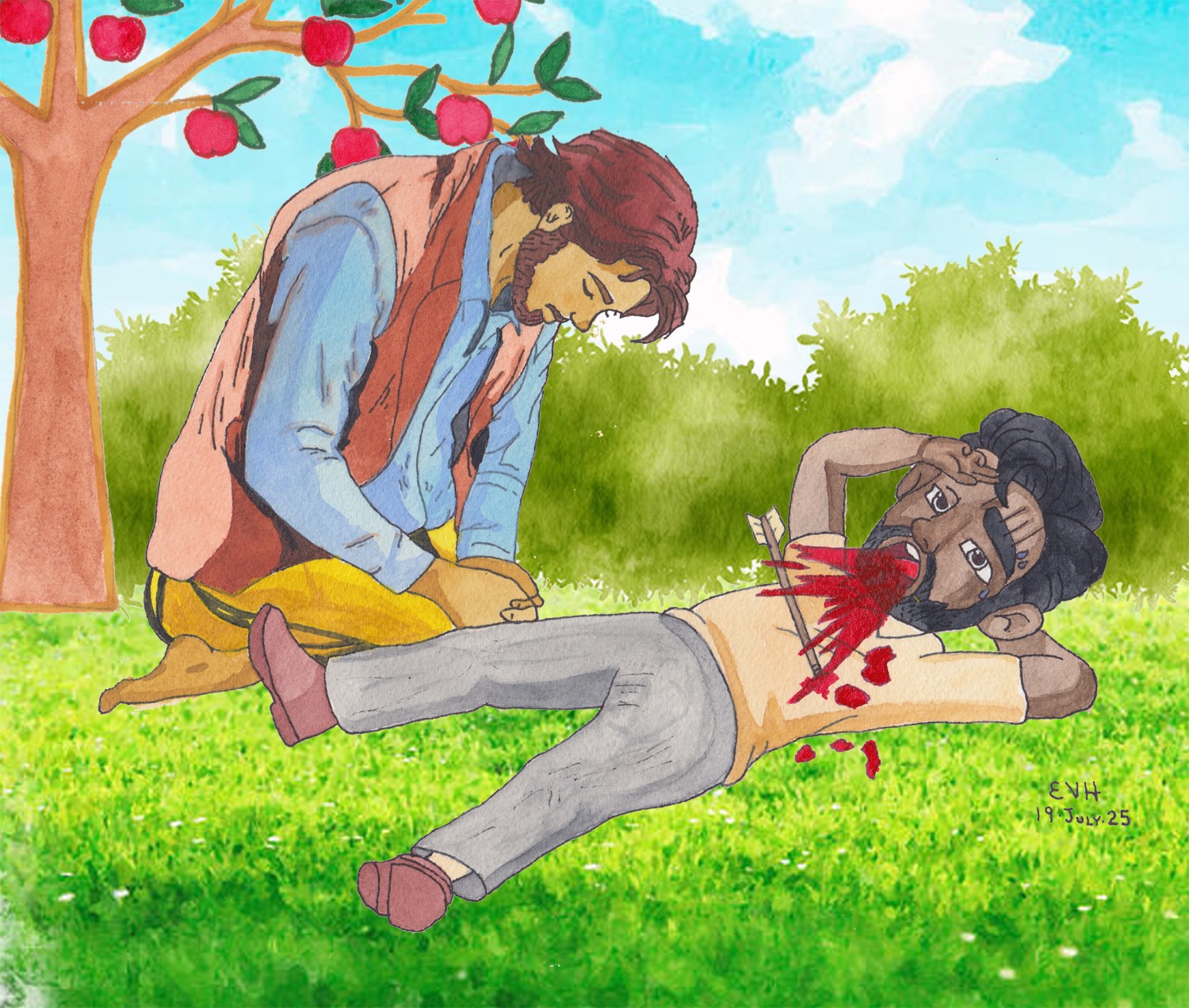
Figure: The Bodhisatta struggles
Then the Great Being replied, “What say you, O king? In all this Himavat there is not a deer that runs when he sees me.”
“Since my first years of thought began, as far as memory reaches back,
No quiet deer or beast of prey has fled in fear to cross my track.
“Since I first donned my dress of bark and left behind my childish days,
No quiet deer or beast of prey has fled to see me cross their ways.
“Nay, the grim goblins are my friends, who roam with me this forest’s shade,
Why should this deer then, as you say, at seeing me have fled afraid?”
When the king heard him, he thought to himself, “I have wounded this innocent being and told a lie. I must now confess the truth.” So he said:
“Sāma, no deer beheld you there, why should I tell a needless lie?
I was o’ercome by wrath and greed and shot that arrow, it was I.”
Then he thought again, “Suvaṇṇasāma cannot be living alone in this forest. His family no doubt lives here. I will ask him about them.” So he uttered a stanza:
“When did you come this morning, friend, who bade you take your water jar
And fill it from the river’s bank and bear the burden back so far?”
When he heard this, he felt a great pang and uttered a stanza as the blood poured from his mouth:
“My parents live in yonder wood, blind and dependent on my care,
For their sakes to the river’s bank, I came to fill my water jar.”
Then he went on, bemoaning their condition:
“Their life is but a flickering spark, their food at most a week’s supply,
Without this water which I bring, blind, weak, and helpless they will die.
“I reek not of the pain of death, that is the common fate of all,
Ne’er more to see my father’s face, ’tis this which does my heart appall.
“Long, long, a sad and weary time my mother there will nurse her woe,
At midnight and at early morn her tears will like a river flow.
“Long, long, a sad and weary time my father there will nurse his woe,
At midnight and at early morn his tears will like a river flow.
“They will go wand’ring through the wood and of their missing son complain,
Expecting still to hear my step or feel my soothing touch in vain.
“This thought is as a second shaft which pierces deeper than before,
That I, alas! lie dying here, fated to see their face no more.”
When he heard this lamentation, the king thought to himself, “This man has been fostering his parents in his excessive piety and devotion to duty, and even, now amidst all his pain. he only thinks of them. I have done evil to such a holy being. How can I comfort him? When I find myself in hell, what good will my kingdom do me? I will watch over his father and mother as he watched over them. In this way his death will be appeased.” Then he uttered his resolution in the following stanzas:
“O Sāma of auspicious face, let not despair your soul oppress,
Lo I myself will wait upon your parents in their lone distress.
“I am well practiced with the bow, my promise is a surety good,
I’ll be a substitute for you and nurse your parents in the wood.
“I’ll search for leavings of the deer, and roots and fruits to meet their need,
I’ll wait myself upon them both, their household slave in very deed.
“Which is the forest where they are? Tell me, O Sāma, for I vow
I will protect and foster them as you yourself has done till now.”
The Great Being replied, “It is well, O king, then do foster them.” So he pointed out the road to him:
“Where my head lies there runs a path two hundred bow lengths through the trees,
‘Twill lead you to my parents’ hut, go, nurse them there if so you please.”
Having thus shown the path and borne the great pain patiently in his love for his parents, he folded his hands respectfully and made his last request that he would take care of them:
“Honor to you, O Kāsi king, as thus you go upon your way,
Helpless my parents are and blind, O guard and nurse them both, I pray.
“Honor to you, O Kāsi king, I fold my hands respectfully,
Bear to my parents in my name the message I have given to thee.”
The king accepted the trust, and the Great Being, having delivered his final message, became unconscious.

Explaining this, the Master said:
“When Sāma of auspicious face thus to the king these words had said,
Faint with the poison of the shaft he lay unconscious as if dead.”
Up to this point when he uttered his words he had spoken as one out of breath. But here his speech was interrupted, as his form, heart, thoughts, and vital powers were progressively affected by the violence of the poison. His mouth and his eyes closed. His hands and feet became stiff. His whole body was wet with blood. The king exclaimed, “Till just this moment he was talking to me. What has suddenly stopped his inhaling and exhaling? These functions have now ceased. His body has become stiff. Surely Sāma is now dead.”
Unable to control his sorrow, he smacked his head with his hands and wailed in a loud voice.
Here the Master, to make the matter clearer, spoke these stanzas:
“Bitterly did the king lament, ‘I knew not until this befell.
That I should e’er grow old or die. I know it now, alas! too well.
“All men are mortal, now I see. For even Sāma had to die,
Who gave good counsel to the last, yea in his dying agony.
“Hell is my sure and certain doom, that murdered saint lies speechless there,
In every village all I meet will with one voice my guilt declare.
“But in this lone unpeopled wood who will there be to know my name?
Here in this desert solitude who will remind me of my shame?”
Now at this time a daughter of the gods named Bahusodarī, who lived in the Gandhamādana mountain and who had been a mother to the Great Being in his seventh existence before this one, was continually thinking of him with a mother’s affection. But on that day in the enjoyment of her divine bliss, she did not remember him as usual. Her friends only said that she had gone to the assembly of the gods and so remained silent. Suddenly she thought of him at the very moment when he became unconscious. She said to herself, “What has become of my son?” Then she saw that King Piliyakkha had wounded him with a poisoned arrow on the bank of the Migasammatā, and that he was lying on a sandbank. She saw that the king was loudly lamenting. “If I do not go to him, my son Suvaṇṇasāma will perish there. The king’s heart will break, and Sāma’s parents will die of hunger and thirst. But if I go there, the king will carry the jar of water and go to his parents, and after hearing their words, he will take them to their son. I and they will make a solemn declaration that will overpower the poison in Sāma’s body. Then my son will regain his life, and his parents will regain their sight. And the king, after hearing Sāma’s instruction, will go and distribute great gifts of charity and become destined for heaven. So I will go there at once.” So she went, and standing unseen in the sky by the bank of the river Migasammatā, she talked with the king.
Here the Master, to make the matter clearer, spoke these stanzas:
“The goddess, hidden out of sight upon the Gandhamādan mount,
Uttered these verses in his ears, by pity moved on his account.
“A wicked action you have done, heavy the guilt which rests on thee,
Parents and son all innocent, your single shaft has slain the three.
“Come, I will tell you how to find a refuge from your guilt and rest,
Nurse the blind pair in yonder wood, so shall your wicked self be blessed.”
When he heard her words, he believed what she said, that, if he went and supported the father and mother, he would attain to heaven. So he made a resolve: “What have I to do with a kingdom? I will go and devote myself to nursing them.” After an outburst of weeping, he conquered his sorrow, and thinking that Sāma was indeed dead, he paid homage to his body with all kinds of flowers and sprinkled it with water. He walked around it three times. Then he turned his right side towards it and paid homage at the four several points. Then he took the jar which had been consecrated by him, turned his face to the south and went on his way with a heavy heart.
Here the Master added this verse of explanation:
“After a burst of bitter tears, lamenting for the hapless youth,
The king took up the water jar and turned his face towards the south.”
Strong as was his nature, the king took up the water jar and resolutely forced his way to the hermitage. At last he reached the door of wise Dukūla’s hut. The wise man, seated inside, heard approaching footsteps, and, as he pondered uncertainly, he uttered these two lines:
“Whose are these footsteps that I hear? Someone approaches by this way.
‘Tis not the sound of Sāma’s steps. Who are you, tell me, sir, I pray.”
When the king heard him, he thought to himself, “If I tell him that I have killed his son and do not reveal my royal character, they will be angry and speak roughly to me. Then my anger will be roused against them, and I shall do some outrage. This would be wicked. But there is no one who does not feel afraid when he hears that it is a king. Therefore, I will make myself known to them.” So he placed the jar in the enclosure where the water jar belonged, and standing in the doorway of the hut, he exclaimed:
“I am the lord of the Kāsis, King Piliyakkha named, and here,
Leaving my throne in search of flesh, I roam to hunt the forest deer.
“Skilled in the archer’s craft am I, stout is my heart not given to change,
No Nāga can escape my shaft if once he comes within my range.”
The wise man gave him a friendly greeting, and replied:
“Welcome, O king, a happy chance directed you this way,
Mighty you are and glorious, what errand brings you, pray?
“The tindook and the piyal leaves, and kāsumārī sweet,
Though few and little, take the best we have, O king, and eat.
“And this cool water from a cave high hidden on a hill,
O mighty monarch, take of it, drink if it be your will.”
When the king heard his welcome, he thought to himself, “It would not be right to address him at once with the bare statement that I have just killed his son. I will begin to talk with him as if I knew nothing about it. Then I will tell him.” So he said to him:
“How can a blind man roam the woods? These fruits, who brought them to your door?
He must have had good eyes indeed, who gathered such a varied store.”
The old man repeated two stanzas to show the king that he and his wife did not gather the fruit, but that their son had brought it to them:
“Sāma our son is young in years, not very tall but fair to the eye,
The long black hair that crowns his head curls like a dog’s tail naturally.
“He brought the fruit, and then went off, hastening to fill our water jar,
He will be back here presently, the way to the river is not far.”
The king replied:
“Sāma, that dutiful son of yours, whom you describe so fair, so good,
I have slain him, those black curls of his are lying yonder, drenched in blood.”
Pārikā’s hut of leaves was close by, and as she sat there, she heard the king’s voice. She went out anxious to learn what had happened. And having gone near Dukūla by the aid of a rope, she exclaimed:
“Tell me, Dukūla, who is this who says that Sāma has been slain?
‘Our Sāma slain,’ such evil news seems to have cleft my heart in twain.
“Like a young tender pēpul shoot torn by the blast from off the tree,
Our Sāma slain, to hear such news my heart is pierced with agony.”
The old man gave her words of counsel:
“It is the king of Kāsi land, his cruel bow has slain, he shot
Our Sāma by the river’s bank, but let us pause and curse him not.”
Pārikā replied:
“Our darling son, our life’s sole stay, longed for and waited for so long,
How shall my heart contain its wrath against the man who did this wrong?”
The old man exclaimed:
“A darling son, our life’s sole stay, longed for and waited for so long!
But all the wise forbid our wrath against the doer of the wrong.”
Then they both uttered their laments, beating their breasts and praising the Bodhisatta’s virtues. The king tried to comfort them:
“Weep not, I pray you, overmuch, for your loved Sāma’s hapless fate,
Lo I will wait upon you both, mourn not as wholly desolate.
“I am well practiced with the bow, my promise is a surety good,
Lo I will wait upon you both and nurse you in this lonely wood.
“I’ll search for leavings of the deer, and roots and fruits for all your need,
Lo I will wait upon you both, your household slave in very deed.”
They protested with him:
“This is not right, O king of men, this would be utterly replete,
You are our lord and rightful king, here we pay homage at your feet.”
When the king heard this, he was glad. “A wonderful thing,” he thought, “they do not utter one harsh word against me who have committed such a wicked act. They only receive me kindly.” And he uttered this stanza:
“You foresters, proclaim the right, this welcome is true piety,
You are a father from henceforth, and you a mother unto me.”
They respectfully raised their hands and made their petition, “We have no need of any act of service from you, but guide us, holding out the end of a staff and show us our Sāma.” And they uttered this couplet of stanzas:
“Glory to you, O Kāsi king who are your realm’s prosperity,
Take us and lead us to the spot where Sāma, our loved son, does lie.
“There fallen prostrate at his feet, touching his face, eyes, every limb,
We will await the approach of death, patient so long as near to him.”
While they were speaking, the sun set. Then the king thought, “If I take them there now, their hearts will break. And if three people die because of me, I shall certainly lie down in hell. Therefore, I will not let them go there.” So he said these stanzas:
“A region full of beasts of prey, as though the world’s most extreme bound,
‘Tis there where Sāma lies, as if the moon had fallen on the ground.
“A region full of beasts of prey, as though the world’s most extreme bound,
‘Tis there where Sāma lies, as if the sun had fallen on the ground.
“At the world’s farthest end he lies, covered with dust and stained with blood,
Stay rather in your cottage here, don’t tempt the dangers of the wood.”
They answered in this stanza to show their fearlessness:
“Let the wild creatures do their worst, by thousands, millions, let them swarm,
We have no fear of beasts of prey, they cannot do us any harm.”
So the king, unable to stop them, took them by the hand and led them there.
When he had brought them near, he said to them, “This is your son.” Then his father clasped his head to his bosom and his mother his feet, and they sat down and lamented.
The Master, to make the matter clear, spoke these stanzas:
Covered with dust and pierced to th’ heart, beholding thus their Sāma lie
Prostrate as if a sun or moon had fallen earthward from the sky,
The parents lifted up their arms, lamenting with a bitter cry.
“O Sāma, are you fast asleep? Are angry? Or are we forgot?
Or say, has something troubled your mind, that you lie still and answer not?
“Who will now dress our matted locks and wipe the dirt and dust away,
When Sāma is no longer here, the poor blind couple’s only stay?
“Who now will sweep the floor for us, or bring us water, hot or cold?
Who fetch us forest roots and fruits, as we sit helpless, blind, and old?”
After a long lamentation the mother beat her bosom with her hand, and considering her sorrow carefully, she said to herself, “This is all mere grief for my son. He has swooned through the violence of the poison. I will perform a solemn declaration of truth to take the poison from him.” So she performed an act of truth and repeated the following stanzas:
“If it be true that in old days Sāma lived always virtuously,
Then may this poison in his veins lose its fell force and harmless be.
“If in old days he spoke the truth and nursed his parents night and day,
Then may this poison in his veins be overpowered and fall away.
“Whatever merit we have gained in former days, his sire and I,
May it o’erpower the poison’s strength and may our darling son not die.”
When his mother had made this solemn declaration, Sāma turned as he lay there. Then his father also made his solemn declaration in the same words. And while he was still speaking, Sāma turned around and lay on the other side.
Then the goddess made her solemn declaration.
The Master in explanation uttered these stanzas:
The goddess hidden out of sight upon the Gandhamādan mount
Performed a solemn act of truth, by pity moved on Sāma’s count.
“Here in this Gandhamādan mount long have I passed my life alone,
In forest depths where every tree does bear a perfume of its own.
“And none of earth’s inhabitants is dearer to my inmost heart,
As this is true so from his veins may all the poison’s power depart.”
While thus in turn by pity moved they all their solemn witness bore,
Lo in their sight up Sāma sprang, young, fair, and vigorous as before.”
In this way the Great Being recovered from his wound. His parents’ sight was restored. The dawn appeared, and all these marvels were produced in the hermitage at the same moment by the goddess’s supernatural power. The father and mother were delighted beyond measure to find that they had regained their sight and that Sāma was restored to health. Then Sāma uttered these stanzas:
“I am your Sāma, safe and well, see me before you and rejoice,
Dry up your tears and weep no more but greet me with a happy voice.
“Welcome to you, too, mighty king, may fortune wait on your commands,
You are our monarch, let us know what you most desire at our hands.
“Tindukas, piyals, madhukas, our choicest fruits we bring our guest,
Fruits sweet as honey to the taste, eat whatsoe’er may please you best.
“Here is cold water, gracious lord, brought from the caves in yonder hill,
The mountain stream best quenches thirst, if you are thirsty, drink your fill.”
The king also saw this miracle. He exclaimed:
“I am bewildered and amazed, which way to turn I cannot tell,
An hour ago I saw you dead, who now stands here alive and well!”
Sāma thought to himself, “This king looked upon me as dead. I will explain to him my being alive.” So he said:
“A man possessed of all his powers, with not one thought or feeling fled,
Because a swoon has stopped their play, that living man they think is dead.”
Then wanting to make sure the king understood the real meaning of the whole matter, he added two stanzas to teach him the Dharma:
“Those mortals who follow Dharma and nurse their parents in distress,
The gods observe their piety and come to heal their sicknesses.
“Those mortals who follow Dharma and nurse their parents in distress,
The gods in this world praise their deed and in the next with heaven them bless.”
The king, on hearing this, thought to himself; “This is a wonderful miracle. Even the gods heal someone who cherishes his parents when he falls into sickness. This Sāma is exceedingly glorious.” Then he said:
“I am bewildered more and more, which way to turn I cannot see,
Sāma, to you I fly for help, Sāma, please you my refuge be.”
Then the Great Being said, “O king, if you want to reach the world of the gods and enjoy divine happiness there, you must practice these duties.” And he uttered these stanzas about them:
“Towards your parents first of all fulfill your duty, warrior king,
Duty fulfilled in this life here to heaven hereafter you shall bring,
“Towards your children and your wife, fulfill your duty, warrior king,
Duty fulfilled in this life here to heaven hereafter you shall bring.
“Duty to friends and ministers, your soldiers with their different arms,
To townships and to villages, your realm with all its subject swarms,
“To ascetics, Brahman holy men, duty to birds and beasts, O king,
Duty fulfilled in this life here to heaven hereafter you shall bring.
“Duty fulfilled brings happiness, yea Indra, Brahma, all their host,
By following duty won their bliss, duty pursue at any cost.”
Having declared to him the duties of a king, the Great Being gave him some still further instruction and taught him the five Precepts. The king accepted the teaching with bended head. He reverentially took his leave and returned to Benares. And after giving many gifts and performing many other virtuous actions, he passed away with his court to swell the host of heaven. The Bodhisatta, as well, along with his parents, having attained the Supernatural Faculties (desire, intention, energy, and investigation) and the various degrees of ecstatic meditation (jhāna), went to the Brahma world.
After the lesson, the Master said, “O monks, it is an ancient custom with the wise to support their parents.” He then declared the Four Noble Truths, after which the monk attained to the Fruit of the First Path (stream-entry). Then he identified the birth: “At that time the king was Ānanda, the goddess was Uppalavaṇṇā, Sakka was Anuruddha, the father was Kassapa, the mother was Bhaddakāpilānī, and I was Suvaṇṇasāma.”
(Ānanda was the Buddha’s attendant and a senior monk, Uppalavaṇṇā was one of his most accomplished nuns, Kassapa was an accomplished senior monk, and Bhaddakāpilānī was an elder nun.)
